
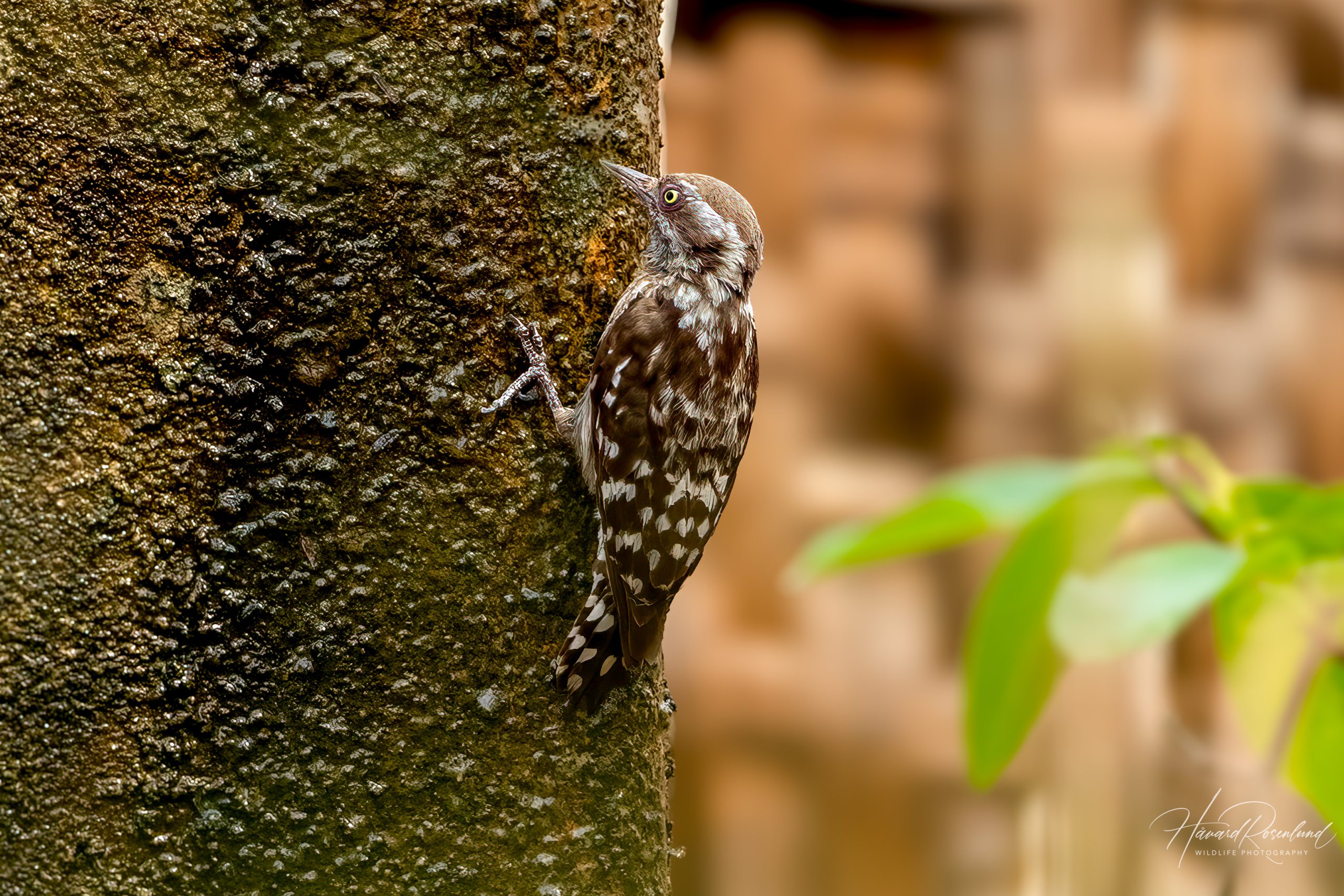
Brown-capped Pygmy Woodpecker
Yungipicus nanus
At a glance
Habitat
- Deciduous and open forest, woodland edge, secondary growth, orchards and plantations
Diet
- Ants, beetles, larvae and other small invertebrates; also fruit, flowers and nectar
Activity
- Diurnal
Size
- Length: About 13 cm Weight: 13–17 g
Range
- Nepal, India and Sri Lanka
Description
The brown-capped pygmy woodpecker (Yungipicus nanus), also known as the Indian pygmy woodpecker, is one of the smallest woodpeckers of the Indian subcontinent. It measures about 13 cm and weighs roughly 13–17 g.
The crown is brown, the dark upperparts are finely barred and spotted white, and the pale underparts carry narrow streaks. Males have a small red patch at the rear of the crown, while females lack red. Its tiny size, short bill and brown cap help separate it from larger black-and-white woodpeckers sharing the same forests.
Habitat
The species occurs from Nepal across much of India to Sri Lanka. It favours dry and moist deciduous woodland, open forest, forest edge, secondary growth, orchards, plantations and other landscapes that retain mature trees.
Its small body and short bill allow it to forage on thinner branches and smaller trunks than many larger woodpeckers. Old and decaying wood remains important for both feeding and nesting, even in partly modified landscapes.
Diet
Ants, beetles, larvae and other small invertebrates make up much of the diet. Figs, other soft fruit, flowers and nectar are also eaten.
Foraging
Brown-capped pygmy woodpeckers search bark, shallow crevices, twigs and branches, picking or probing out prey rather than relying on deep excavation. Their small body and short bill allow them to forage efficiently on fine branches that may be less accessible to larger woodpeckers.
Birds work around the sides and undersides of branches, peck lightly at bark and move on rapidly when prey is scarce. They may also forage with mixed-species flocks as several insectivorous birds move through the same trees.
Behaviour
Brown-capped pygmy woodpeckers are active by day and are usually seen alone or in pairs, though they also join mixed-species feeding flocks.
Thin, sharp calls are used for contact, and the drumming is lighter and less powerful than that of larger woodpeckers. The species is mainly resident, so pairs may use the same wooded area through much of the year. When disturbed, a bird often slips around the far side of a branch or trunk before making a short flight to another tree.
Breeding
Breeding mainly takes place from February to May. Pairs become territorial and use calls, light drumming and close movements around branches during courtship. Both adults excavate a nest chamber in a dead or decaying trunk or branch and later share care of the young.
A Wildlife Institute of India species account published in 2002 describes nest cavities in small dead branches about 2–12 m above ground and clutches of two or three white eggs. Reliable species-specific information on incubation length and the time to fledging remains limited.
Status
The brown-capped pygmy woodpecker is classified as least concern on the IUCN Red List. It has a large range and occurs in a variety of wooded habitats, including some modified landscapes.
State of India's Birds 2025 estimates a long-term national decline of about 44.2%. The recent trend is effectively stable: the estimate is a small increase of about 0.3% per year, but the uncertainty includes both decline and increase. The species is classed as Moderate Priority nationally.
Removal of mature and decaying trees from orchards, plantations and woodland edges can reduce both feeding opportunities and suitable places for nest excavation, even where the landscape remains well wooded.
Image gallery
Loading map and observations…
Have you seen this species?
Independent species archive
Did you find this species page useful?
Wildlife Vagabond is independently built and maintained. Voluntary support helps cover hosting, maps, data storage and continued improvements to the species archive.
Support Wildlife VagabondSpecies content will remain freely available.
References
Information about the species’ global distribution and status is based primarily on global Red List data. See the references below for details.
- Avibase. (n.d.). / AviList 2025 – Indian Pygmy Woodpecker (Yungipicus nanus). https://avibase.bsc-eoc.org/species.jsp?avibaseid=165CB4B38AC5798F
- BirdLife International. (n.d.). Indian Pygmy Woodpecker species factsheet. https://datazone.birdlife.org/species/factsheet/indian-pygmy-woodpecker-picoides-nanus
- Fuchs, J., & Pons, J.-M. (2015). A new classification of the Pied Woodpeckers assemblage (Dendropicini, Picidae) based on a comprehensive multi-locus phylogeny. Molecular Phylogenetics and Evolution, 88, 28-37. https://doi.org/10.1016/j.ympev.2015.03.016
- International Union for Conservation of Nature. (n.d.). Yungipicus nanus. The IUCN Red List of Threatened Species. https://www.iucnredlist.org/species/22681060/92891080
- State of India's Birds. (2025). 2025 – Brown-capped Pygmy Woodpecker. https://stateofindiasbirds.in/species/jk-bncwoo3/
- Wildlife Institute of India. (2002). Wildlife-Habitat Relationships in Conservation Areas – Brown-capped Pygmy Woodpecker species account. https://digitalrepository.wii.gov.in/server/api/core/bitstreams/2a10057d-dd8e-41cf-a612-a0880033fea0/content