
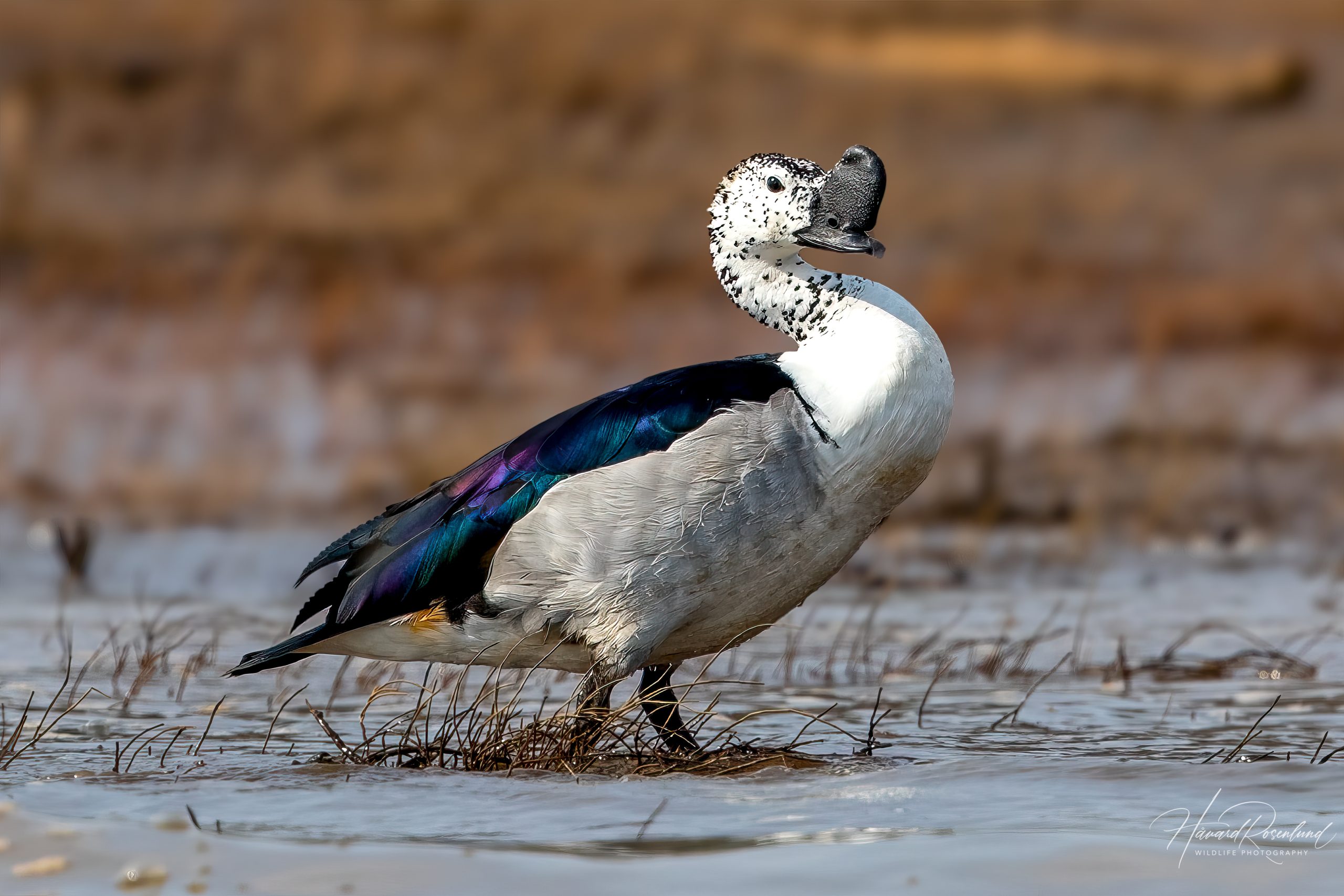
Knob-billed Duck
Sarkidiornis melanotos
At a glance
Habitat
- Freshwater wetlands, floodplains, marshes, lakes, reservoirs and seasonally flooded grassland, often with nearby trees
Diet
- Seeds, aquatic plants and grain, plus aquatic insects and occasional frogs and small fish
Activity
- Mostly diurnal
Size
- Length: about 64–79 cm; wingspan 116–145 cm Weight: around 1.9 kg on average, with males larger
Range
- Sub-Saharan Africa, Madagascar and South and Southeast Asia
Description
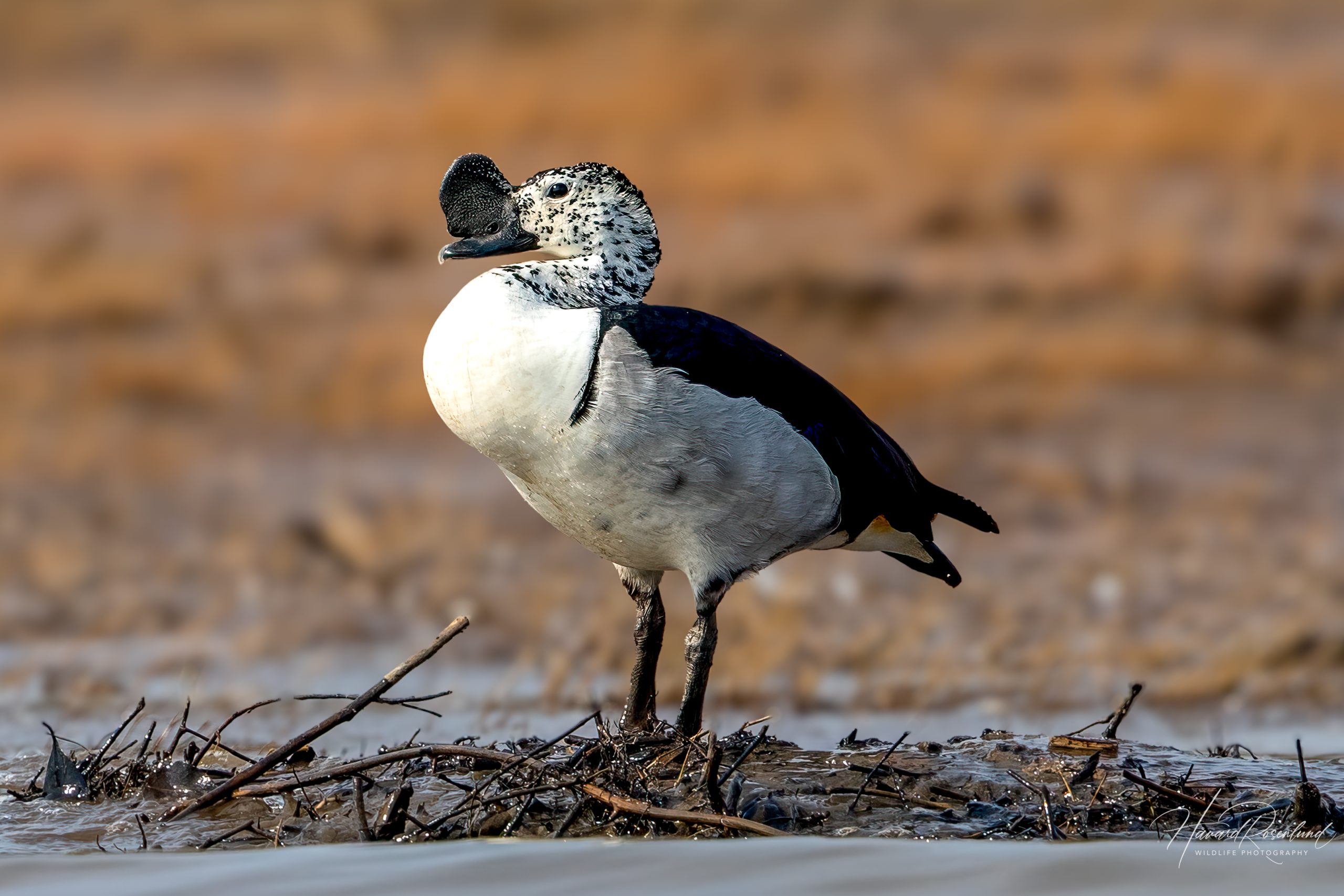
The knob-billed duck (Sarkidiornis melanotos) is one of the largest ducks, measuring roughly 64–79 cm with a wingspan of about 116–145 cm. Adults have a mostly white head and underparts marked with dark spotting, glossy blue-green to purple-black upperparts and a strong black-and-white contrast in flight. Males are larger than females and develop the species’ most distinctive feature: a large, laterally compressed black knob rising from the top of the bill.
The knob is largest in breeding males and can shrink outside the breeding season. Females lack the large structure and are more lightly built, while juveniles are duller and browner. In Africa and Asia the species is unmistakable when an adult male is present.
Taxonomy
Knob-billed duck was formerly treated together with the similar South American population as a single species. Major modern checklists now recognise two species: knob-billed duck (Sarkidiornis melanotos) in Africa and Asia, and comb duck (Sarkidiornis sylvicola) in South America.
The split was adopted by Clements and the Norwegian bird-name committee in 2018 and is retained by current global checklists. Older literature may therefore use S. melanotos for birds from both continents, which can make historical range descriptions appear much broader than the species concept used here.
Habitat
Knob-billed ducks use a wide variety of tropical and subtropical freshwater wetlands, including lakes, marshes, broad river reaches, reservoirs, swamps, floodplains and seasonally inundated grassland. They often favour wetlands with a mixture of shallow water, floating or emergent vegetation and mature trees nearby.
The trees are particularly important because natural cavities provide many nesting sites. Wetland use can be strongly seasonal: birds may move considerable distances as temporary pools, floodplains and grasslands fill after rain and then dry again.
Diet
The diet is dominated by seeds, grain and other plant material, including aquatic vegetation. Aquatic insects and other small invertebrates are also taken, with frogs and small fish recorded occasionally.
Birds feed by dabbling at the surface, tipping forward to reach submerged food and grazing or picking seeds on muddy margins and nearby fields. This flexibility allows them to exploit both natural floodplains and some agricultural landscapes.
Behaviour
Knob-billed ducks are mostly active by day and occur alone, in pairs or in loose groups, with larger gatherings forming at particularly productive wetlands. Between feeding bouts they rest on open water, banks or other quiet parts of the wetland and may mix with other waterfowl.
They are strong fliers and respond quickly to changing water conditions, moving between wetlands as rainfall and flooding create new feeding opportunities and leaving areas as temporary waters dry. This mobility allows the species to track highly seasonal wetland resources over large landscapes.
Breeding
Breeding is closely tied to rainfall and flooding. Across African records, knob-billed ducks bred more often in wetter-than-average months, and the same broad pattern applies through much of their tropical range. Males become conspicuous and competitive at this time and may associate with several females where habitat and nest sites are good rather than forming one exclusive pair. The enlarged bill knob is most developed during the breeding season and probably functions in visual competition and display.
Nests are most often placed in tree cavities or hollow trunks, although dense vegetation and other sheltered sites can also be used. A female usually lays about eight to eleven eggs and incubates for roughly 28–30 days. More than one female may lay in the same cavity, and communal nests containing up to about 50 eggs have been reported.
The ducklings hatch covered in down and can walk, swim and leave the nest soon afterwards. They remain dependent on the female for guidance and protection, and the flight feathers are fully developed at about 65–70 days.
Status
The knob-billed duck is classified as least concern on the IUCN Red List and remains widely distributed across Africa and Asia.
State of India’s Birds 2025 places it in the Low Priority category in India. The long-term estimate is a small increase of about 3.7%, while the current annual estimate is a small decline of about 0.78%; uncertainty around both spans increase and decline, so neither shows a clear national direction. Local populations remain dependent on floodplains, shallow wetlands and mature trees with nesting cavities.
Image gallery
Loading map and observations…
Have you seen this species?
Independent species archive
Did you find this species page useful?
Wildlife Vagabond is independently built and maintained. Voluntary support helps cover hosting, maps, data storage and continued improvements to the species archive.
Support Wildlife VagabondSpecies content will remain freely available.
References
Information about the species’ global distribution and status is based primarily on global Red List data. See the references below for details.
- AviList. (n.d.). v2025 – Global avian checklist. https://www.avilist.org/
- BirdLife International. (n.d.). Knob-billed Duck (Sarkidiornis melanotos) species factsheet. https://datazone.birdlife.org/species/factsheet/knob-billed-duck-sarkidiornis-melanotos
- BirdLife Norge. (2018). split of Comb Duck (Sarkidiornis sylvicola) from Knob-billed Duck. https://www.birdlife.no/fuglekunnskap/nyheter/?id=2202
- Birds of India. (n.d.). Sarkidiornis melanotos species biology. https://www.birdsofindia.org/Sarkidiornis-melanotos
- Cumming, G. S., Harebottle, D. M., Mundava, J., Otieno, N., & Tyler, S. J. (2016). Timing and location of reproduction in African waterfowl: an overview of >100 years of nest records. Ecology and Evolution, 6(3), 631-646. https://doi.org/10.1002/ece3.1853
- International Union for Conservation of Nature. (n.d.). Sarkidiornis melanotos. The IUCN Red List of Threatened Species. https://www.iucnredlist.org/species/45953631/95159254
- State of India's Birds. (2025). State of India’s Birds (2025 update) – Knob-billed Duck. https://stateofindiasbirds.in/species/comduc2/
- Store norske leksikon. (n.d.). kamand (Sarkidiornis melanotos). https://snl.no/kamand
- U.S. Fish & Wildlife Service. (2025). Ecological Risk Screening Summary – Knob-billed Duck (Sarkidiornis melanotos). https://www.fws.gov/sites/default/files/documents/Ecological-Risk-Screening-Summary-Knob-billed-Duck.pdf