
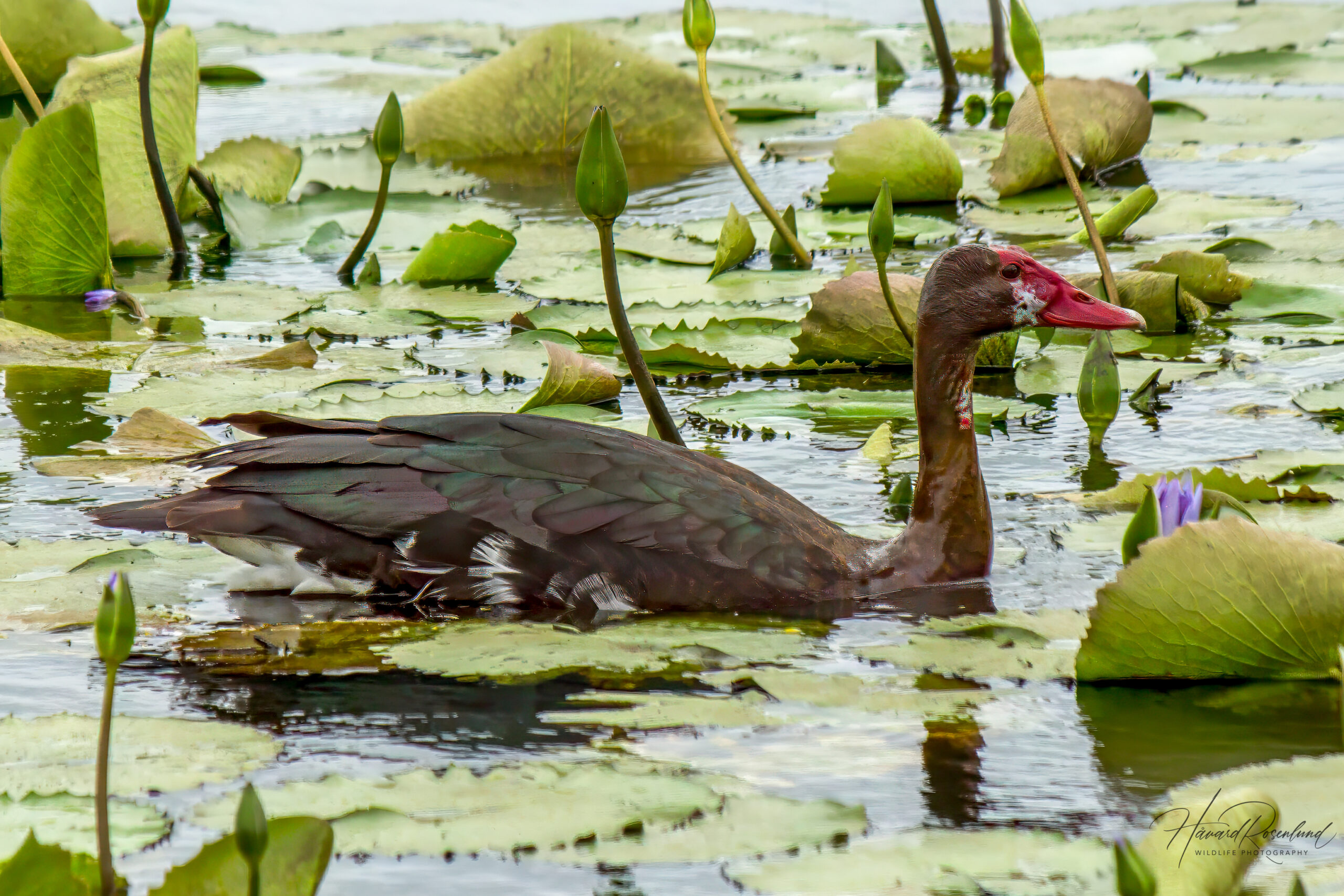
Spur-winged Goose
Plectropterus gambensis
At a glance
Habitat
- Freshwater wetlands, floodplains, grassland and crop fields near water
Diet
- Mostly plant matter, including aquatic plants, grasses and grain; also insects
Activity
- Diurnal
Size
- Length: About 75–115 cm Weight: 2.2–7.45 kg
Range
- Widespread across sub-Saharan Africa, scarce or absent in the driest regions
Description
The spur-winged goose (Plectropterus gambensis) is the largest waterfowl in Africa and one of the heaviest living members of the duck family. Adults are roughly 75–115 cm long and weigh about 2.2–7.45 kg, with males substantially larger than females. The plumage is predominantly dark, contrasting with a white face and extensive white on the wings and underparts, while the bill and bare facial skin are reddish.
The species takes its name from the hard, pointed spur at the bend of each wing. Males have particularly large spurs and also develop a more prominent knob at the base of the bill. Although it belongs to Anatidae, the species represents a distinctive lineage placed in the subfamily Plectropterinae. It is not a true goose and is considered closer evolutionarily to shelducks and sheldgeese than to typical geese.
Habitat
Spur-winged geese use a broad range of freshwater environments, including lakes, rivers, marshes, swamps, floodplains, seasonal pans and artificial reservoirs. They regularly leave the water to feed in nearby grassland and agricultural fields.
The species is scarce or absent in the driest parts of Africa and generally avoids strongly saline water. Productive wetlands surrounded by grassland or cropland can support particularly large numbers, especially outside the breeding season.
Diet
Plant material dominates the diet. Aquatic vegetation, grass leaves and seeds, roots and cultivated grains such as maize, wheat and rice are all eaten. Insects and other small animals provide additional food, with termites and beetles among the better documented invertebrate prey.
Feeding takes place both in wetlands and on land. Spur-winged geese graze, pick seeds and crop grain and forage in shallow water, while young birds have also been observed diving for small fish.
They often feed during the cooler parts of the day and rest near water during hotter periods, moving between wetlands, grassland and fields as local food and water conditions change.
Toxicity
Some spur-winged geese can become toxic to animals or people that eat their flesh because the birds consume blister beetles (Meloidae). These beetles contain cantharidin and related toxic compounds, which can be retained in the goose's tissues.
This toxicity is acquired through the diet rather than being an inherent property of the species. It occurs only where the birds have access to toxin-containing beetles and consume enough of them, so many spur-winged geese are not toxic.
Behaviour
Spur-winged geese are mainly diurnal. The sharp wing spurs are used in aggressive encounters and defence, particularly by large males.
Despite their heavy build, the birds are remarkably fast and powerful fliers. A maximum speed of 142 km/h has been recorded, the highest documented flight speed for any waterfowl. They readily commute between feeding areas, wetlands and resting sites.
Social behaviour
Outside the breeding season spur-winged geese are strongly gregarious. They usually occur in flocks and can gather in much larger concentrations at productive wetlands, feeding areas and post-breeding moulting sites.
These social groups become less cohesive during breeding, when pairs occupy territories and males become more aggressive toward rivals. Large seasonal gatherings therefore contrast strongly with the more territorial breeding period.
Breeding
The breeding bond is relatively short-lived. The male helps defend the breeding territory but usually contributes little to incubation and generally leaves after the young hatch. The female selects and builds the nest, incubates the clutch alone and cares for the goslings.
Nest sites are unusually varied. Many nests are concealed in grass or reeds on raised ground near water, but the species also uses aardvark burrows, tree cavities and abandoned nests of large birds such as hamerkops and raptors, sometimes well above the ground. Clutches usually contain about 7–14 eggs, and incubation lasts roughly 30–31 days.
The goslings leave the nest soon after hatching and remain with the female while feeding for themselves and developing. Their flight feathers are developed at around 12 weeks of age, with sustained flight following soon afterwards.
Relationship with humans
Spur-winged geese readily exploit cultivated crops and artificial reservoirs. Dams and expanded agriculture have created additional feeding and resting opportunities in parts of southern Africa and have helped the species increase locally.
The same adaptability can bring conflict with people when flocks feed on maize, wheat, rice and other crops. The species is also hunted for food in parts of its range, making its unusual diet-derived toxicity particularly relevant where blister beetles form part of the local diet.
Status
The spur-winged goose is classified as least concern on the IUCN Red List. It remains widespread across sub-Saharan Africa and is locally abundant in suitable wetland landscapes.
Hunting, wetland degradation and conflict on cropland can affect populations locally, while artificial water bodies and agricultural food have benefited the species in other areas. The species is not currently threatened across its range.
Image gallery
Loading map and observations…
Have you seen this species?
Independent species archive
Did you find this species page useful?
Wildlife Vagabond is independently built and maintained. Voluntary support helps cover hosting, maps, data storage and continued improvements to the species archive.
Support Wildlife VagabondSpecies content will remain freely available.
References
Information about the species’ global distribution and status is based primarily on global Red List data. See the references below for details.
- Avibase. (n.d.). AviList 2025 / Avibase – Spur-winged Goose (Plectropterus gambensis). https://avibase.bsc-eoc.org/species.jsp?avibaseid=EB01B24C6C4CDD54
- Biodiversity Explorer. (n.d.). Spur-winged Goose. Iziko Museums of South Africa. https://www.biodiversityexplorer.info/birds/anatidae/plectropterus_gambensis.htm
- BirdLife International. (n.d.). Spur-winged Goose species factsheet. https://datazone.birdlife.org/species/factsheet/spur-winged-goose-plectropterus-gambensis
- Guinness World Records. (n.d.). Fastest waterfowl in flight. https://www.guinnessworldrecords.com/world-records/558029-fastest-waterfowl-in-flight
- International Union for Conservation of Nature. (n.d.). Spur-winged Goose. The IUCN Red List of Threatened Species. https://www.iucnredlist.org/species/22680057/92840685
- Yeung, K. A., Chai, P. R., Russell, B. L., & Erickson, T. B. (2022). Avian Toxins and Poisoning Mechanisms. Journal of Medical Toxicology, 18(4), 321-333. https://doi.org/10.1007/s13181-022-00891-6