
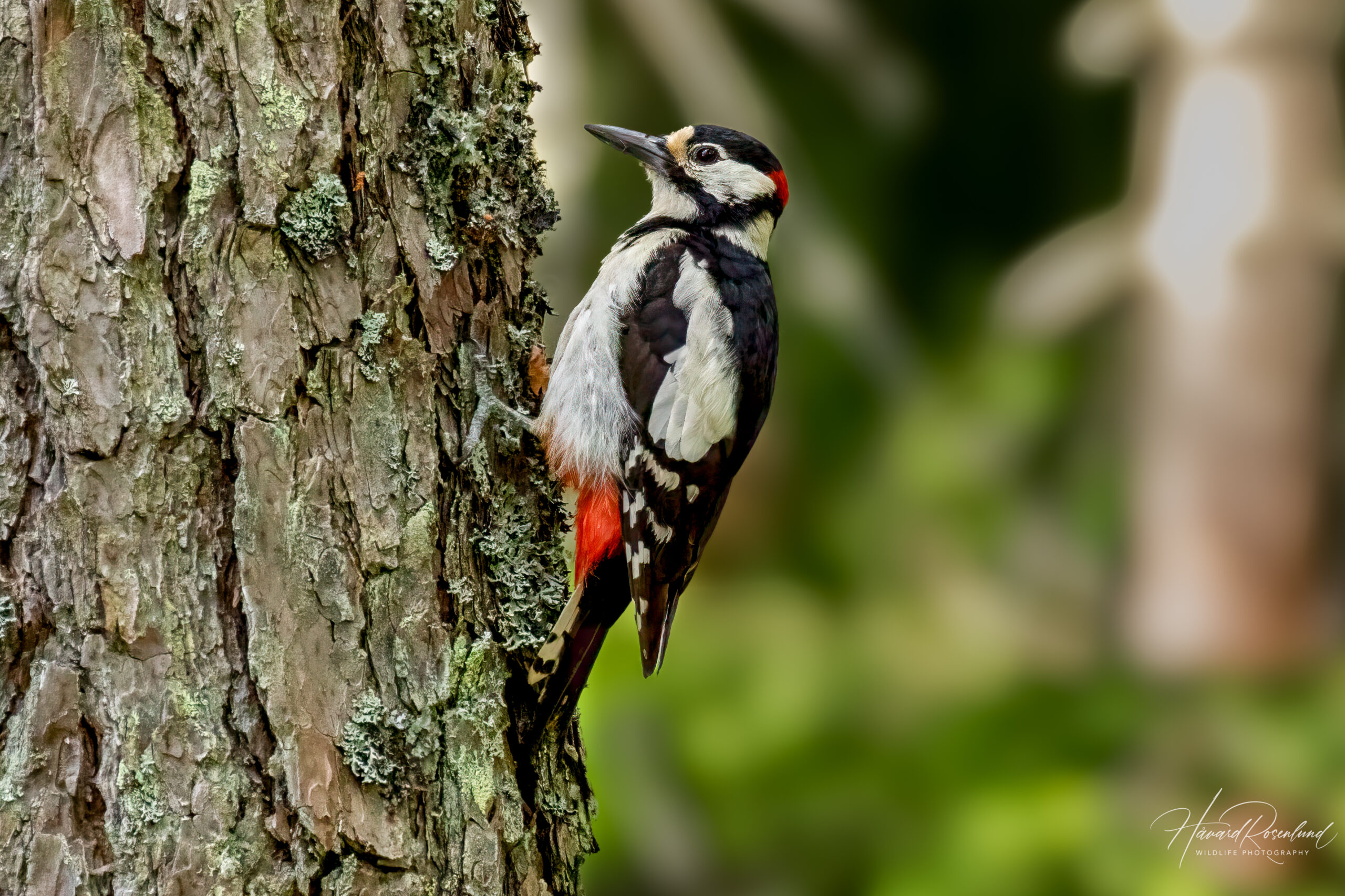
Great Spotted Woodpecker
Dendrocopos major
At a glance
Habitat
- Deciduous, mixed and coniferous woodland, parks and large gardens
Diet
- Insects and larvae; seeds and nuts become especially important in winter
Activity
- Diurnal
Size
- Length: 20–24 cm Weight: 79 g
Range
- Europe and much of northern and eastern Asia
Description
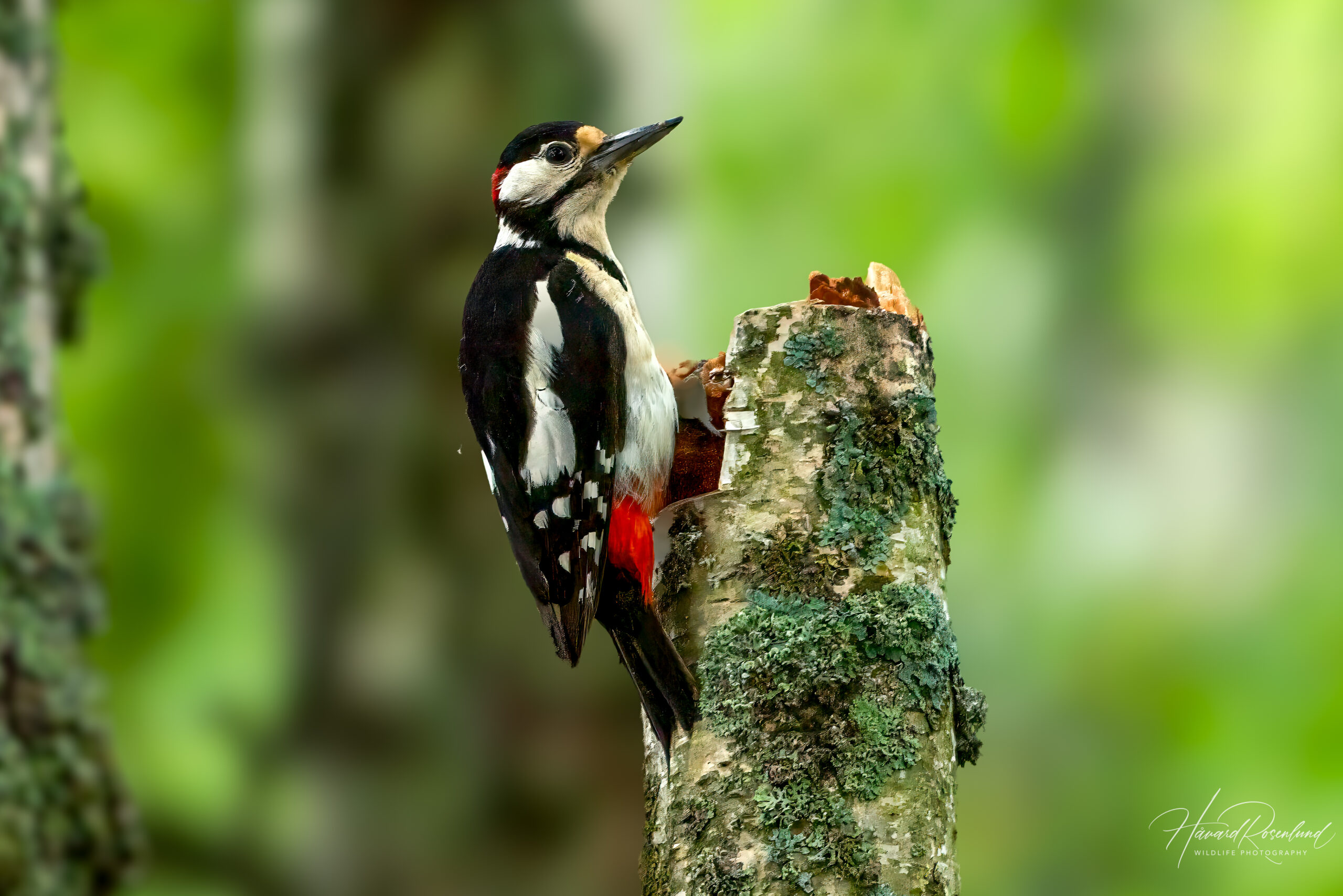
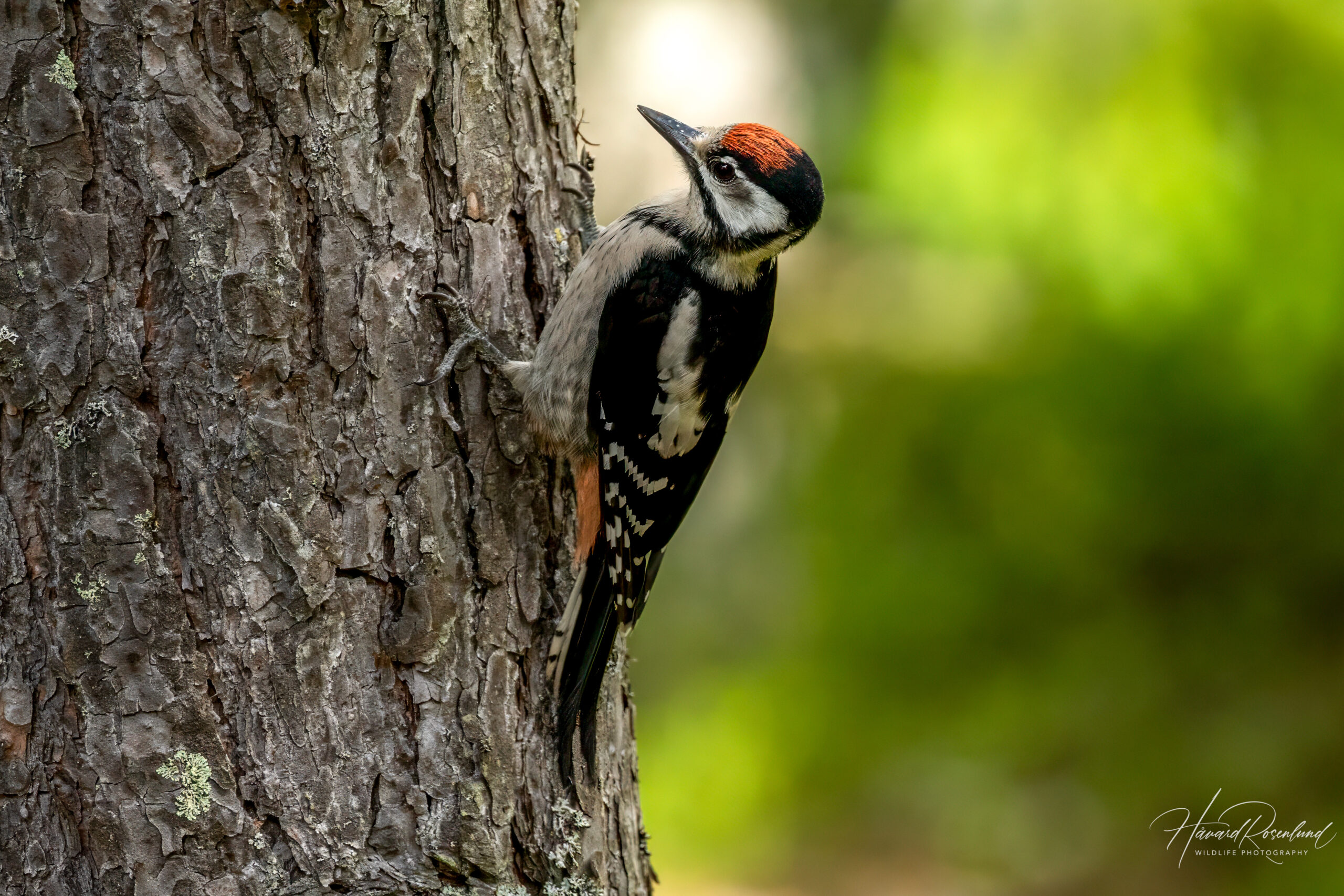
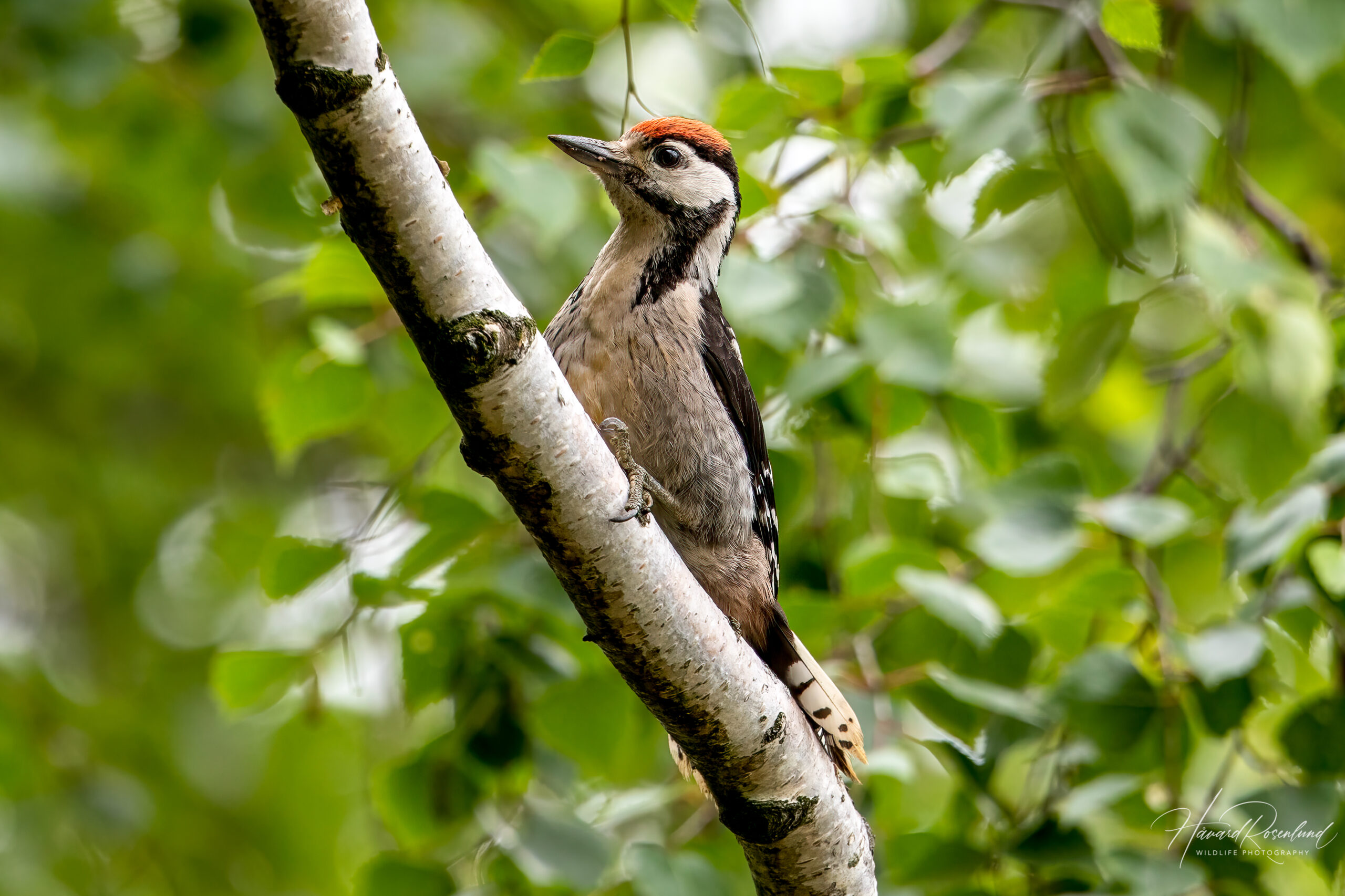
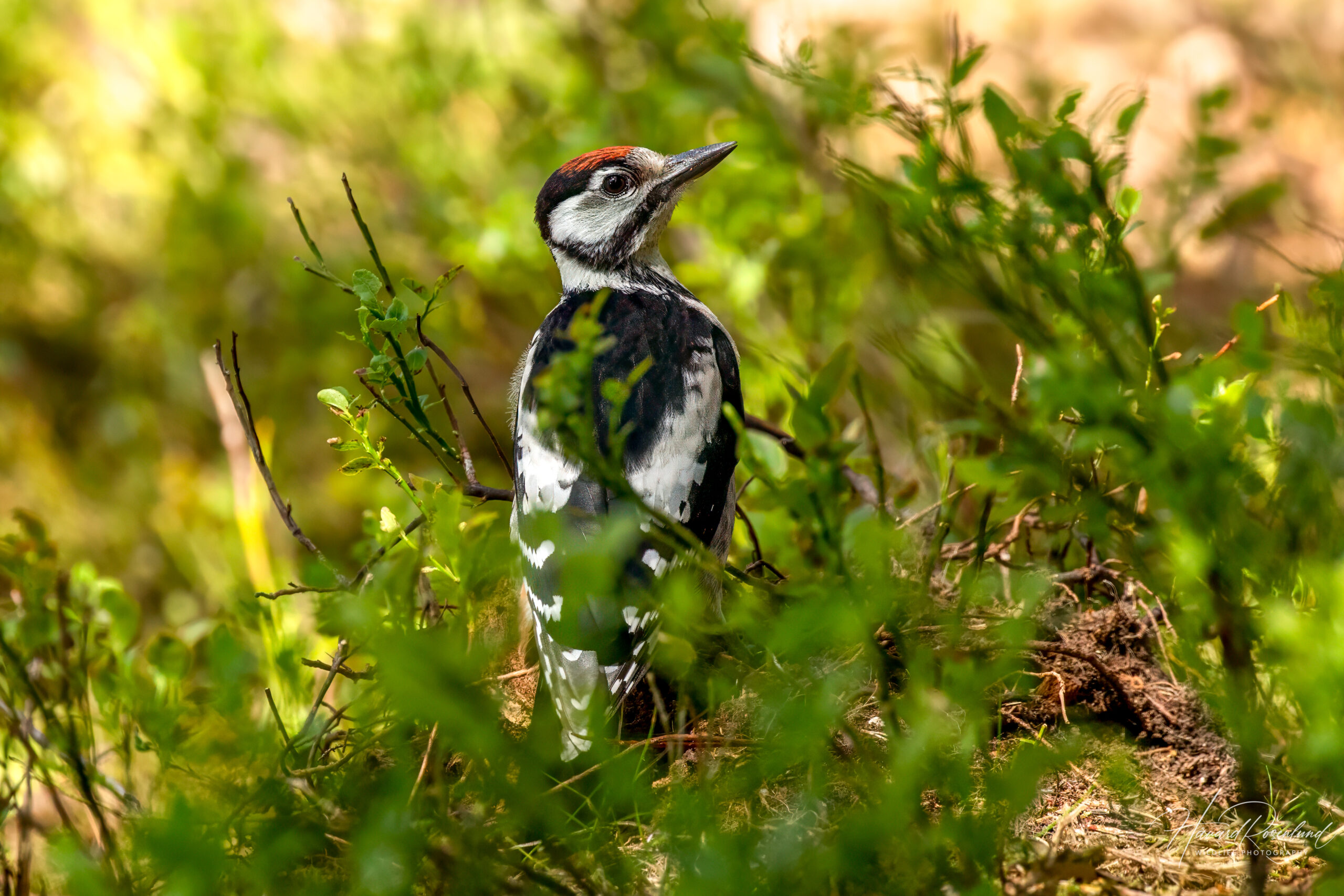
The great spotted woodpecker (Dendrocopos major) is a widespread medium-sized woodpecker found across Europe and much of northern and eastern Asia. Adults are about 20–24 cm long and average around 79 g. The plumage is strongly patterned black and white with bright red undertail coverts. Adult males have a red patch on the nape, females do not, while juveniles show red on the crown.
Like other true woodpeckers, it is highly adapted to life on tree trunks. Strong feet with two toes directed forwards and two backwards grip the bark, stiff tail feathers brace the body, and the chisel-like bill is used for excavation and feeding. The long protrusible tongue helps reach insects and larvae in narrow crevices and galleries.
It can be confused with several other pied woodpeckers where their ranges overlap. Syrian woodpecker (Dendrocopos syriacus) has a less complete black facial pattern, with the black moustachial stripe not joining the nape, while white-backed woodpecker (Dendrocopos leucotos) shows much more white across the back and wings.
Pecking
Repeated high-speed pecking is one of the most distinctive features of woodpecker biology. A study published in 2022 used measurements of impact deceleration and biomechanical models to test the long-standing idea that the skull acts as a shock absorber. Instead, the great spotted woodpecker and the other species examined used the head largely as a stiff hammer; absorbing much of each impact would reduce the energy transferred into the wood.
Simulations in the same study indicated that the size and shape of the braincase keep pressures in the brain below levels associated with concussion in primates, without relying on a soft cushioning system. This allows powerful blows to be delivered efficiently during feeding and excavation.
Habitat
Great spotted woodpeckers occupy a broad range of wooded habitats, including deciduous, mixed and coniferous forest, plantations, parks and large gardens. Their adaptability allows them to persist in heavily managed landscapes, provided that enough suitable trees and feeding resources remain.
Mature trees are important for both foraging and nesting, while dead and decaying wood provides rich insect feeding sites and softer material for cavity excavation. A 2026 study of 173 nest sites in north-eastern Poland found aspen to be the most strongly preferred nest tree, and more than 80% of cavity trees were affected by wood-decaying fungi. Birch and alder were also used frequently. Nest-site choice is therefore strongly linked to softened wood.
Diet
The diet changes strongly with season and opportunity. In spring and summer the birds take many insects and larvae, while seeds and nuts become increasingly important in autumn and winter and conifer seeds can dominate where cone crops are good. The species also visits bird feeders and may take eggs or nestlings of other birds.
This predation can be substantial locally. In a Lancashire nest-box study, great spotted woodpeckers took nestlings from 14 of 57 blue tit broods in 2005, sometimes by pecking through the sides of the boxes.
Foraging
Great spotted woodpeckers search bark and wood for hidden insects and larvae, using the bill to open the surface and the long protrusible tongue to reach prey in narrow crevices and galleries. The amount of drilling and probing changes with season as birds shift between animal prey and plant foods.
In winter they often process cones and nuts at a feeding “anvil”: the food is wedged into a bark crevice or another fixed site and hammered open. Favoured anvils can be reused repeatedly, leaving conspicuous piles of worked cones beneath the tree. Studies of feeding on Norway spruce and Scots pine also show that the birds select cones partly according to size and structure.
Drumming
Drumming is one of the species’ most characteristic signals and becomes especially conspicuous before and during the breeding season. It is used to advertise a territory and attract a mate rather than to locate food. A bird produces a rapid burst of blows on a resonant trunk, branch or sometimes a wooden or metal structure. Feeding and excavation sound different because the blows are slower, stronger and less regular.
Breeding
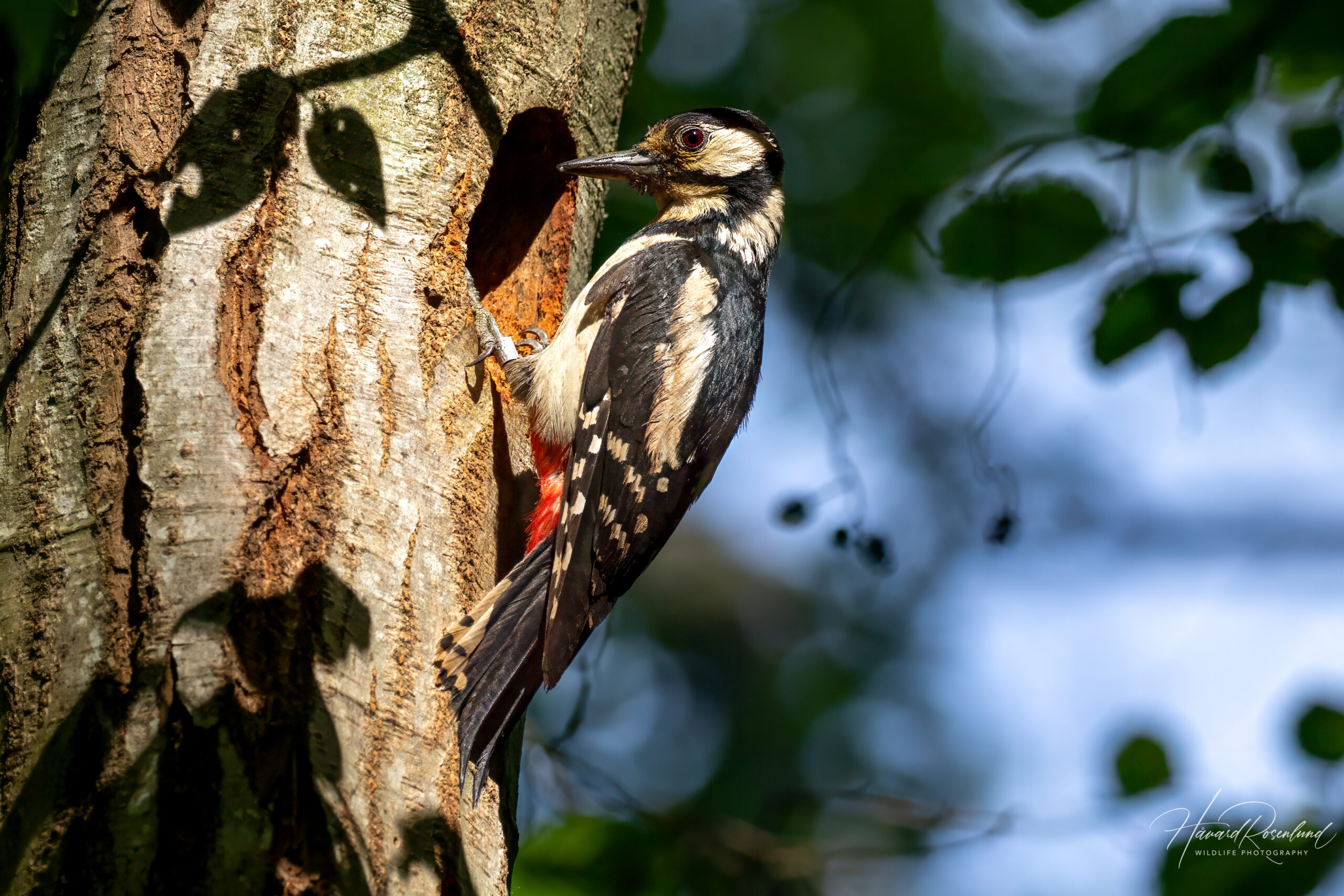
Great spotted woodpeckers usually excavate their own nesting cavity, with both sexes contributing. They can work in living wood, but dead trees, dead sections and wood softened by decay are frequently selected because excavation is easier. A 2010 study found that trees chosen for trial holes often had the same pattern of harder outer wood and softer inner wood as nest trees. The birds use these small test holes to judge whether a site is suitable before continuing with a full cavity.
The entrance leads to an unlined chamber where the female usually lays four to six white eggs. She does most of the incubation, with the male also incubating at times, and the typical incubation period is about 14–16 days. Both parents feed the naked, helpless chicks, which normally remain in the cavity for about 20–23 days.
Once abandoned, woodpecker cavities become part of the forest’s supply of natural holes and can later be used by other cavity-nesting birds, mammals and invertebrates. Great spotted woodpeckers therefore create nesting and shelter sites that remain useful to other species after the original breeding attempt is over.
Status
The great spotted woodpecker is classified as least concern on the IUCN Red List. It has a very large range and is highly adaptable, using managed woodland, parks and gardens as well as more natural forest.
The 2025 update from the Pan-European Common Bird Monitoring Scheme, based on data through 2024, shows a 97% increase in the European breeding index from 1980 to 2024 and a further 19% increase in 2015–2024. The species is therefore doing well at continental scale, although dead, decaying and mature trees remain important locally for feeding and cavity excavation.
Image gallery
Loading map and observations…
Have you seen this species?
Independent species archive
Did you find this species page useful?
Wildlife Vagabond is independently built and maintained. Voluntary support helps cover hosting, maps, data storage and continued improvements to the species archive.
Support Wildlife VagabondSpecies content will remain freely available.
References
Information about the species’ global distribution and status is based primarily on global Red List data. See the references below for details.
- BirdLife International. (n.d.). Great Spotted Woodpecker species factsheet. https://datazone.birdlife.org/species/factsheet/great-spotted-woodpecker-dendrocopos-major
- British Trust for Ornithology. (n.d.). Great Spotted Woodpecker BirdFacts. https://www.bto.org/learn/about-birds/birdfacts/great-spotted-woodpecker
- Dylewski, Ł., Yosef, R., & Myczko, Ł. (2017). Difference on cone size preferences between two coniferous species by Great Spotted Woodpecker (Dendrocopos major). PeerJ, 5, e3288. https://doi.org/10.7717/peerj.3288
- International Union for Conservation of Nature. (n.d.). Great Spotted Woodpecker. The IUCN Red List of Threatened Species. https://www.iucnredlist.org/species/22681124/87323054
- Mainwaring & Hartley. (2008). Covering nest boxes with wire mesh reduces great spotted woodpecker predation of blue tit nestlings. Conservation Evidence, 5, 45–46. https://eprints.lancs.ac.uk/id/eprint/33937/
- Matsuoka, S. (2010). Great Spotted WoodpeckersDendrocopos majorDetect Variation in Wood Hardness before Excavating Nest Holes. Ornithological Science, 9(1), 67-74. https://doi.org/10.2326/osj.9.67
- Pan-European Common Bird Monitoring Scheme. (n.d.). Species trends, 2025 update. https://pecbms.info/trends-and-indicators/species-trends/
- Smith, K. (1997). Nest site selection of the great spotted woodpecker Dendrocopus major in two oak woods in southern England and its implications for woodland management. Biological Conservation, 80(3), 283-288. https://doi.org/10.1016/S0006-3207(96)00038-9
- Van Wassenbergh, S., Ortlieb, E. J., Mielke, M., Böhmer, C., Shadwick, R. E., & Abourachid, A. (2022). Woodpeckers minimize cranial absorption of shocks. Current Biology, 32(14), 3189-3194.e4. https://doi.org/10.1016/j.cub.2022.05.052
- Zawadzka, D., & Zawadzki, G. (2026). The Influence of Forest Protection Level on Nest Site Selection by the Great Spotted Woodpecker: Evidence from the Augustów Forest, NE Poland. Forests, 17(2), 215. https://doi.org/10.3390/f17020215