
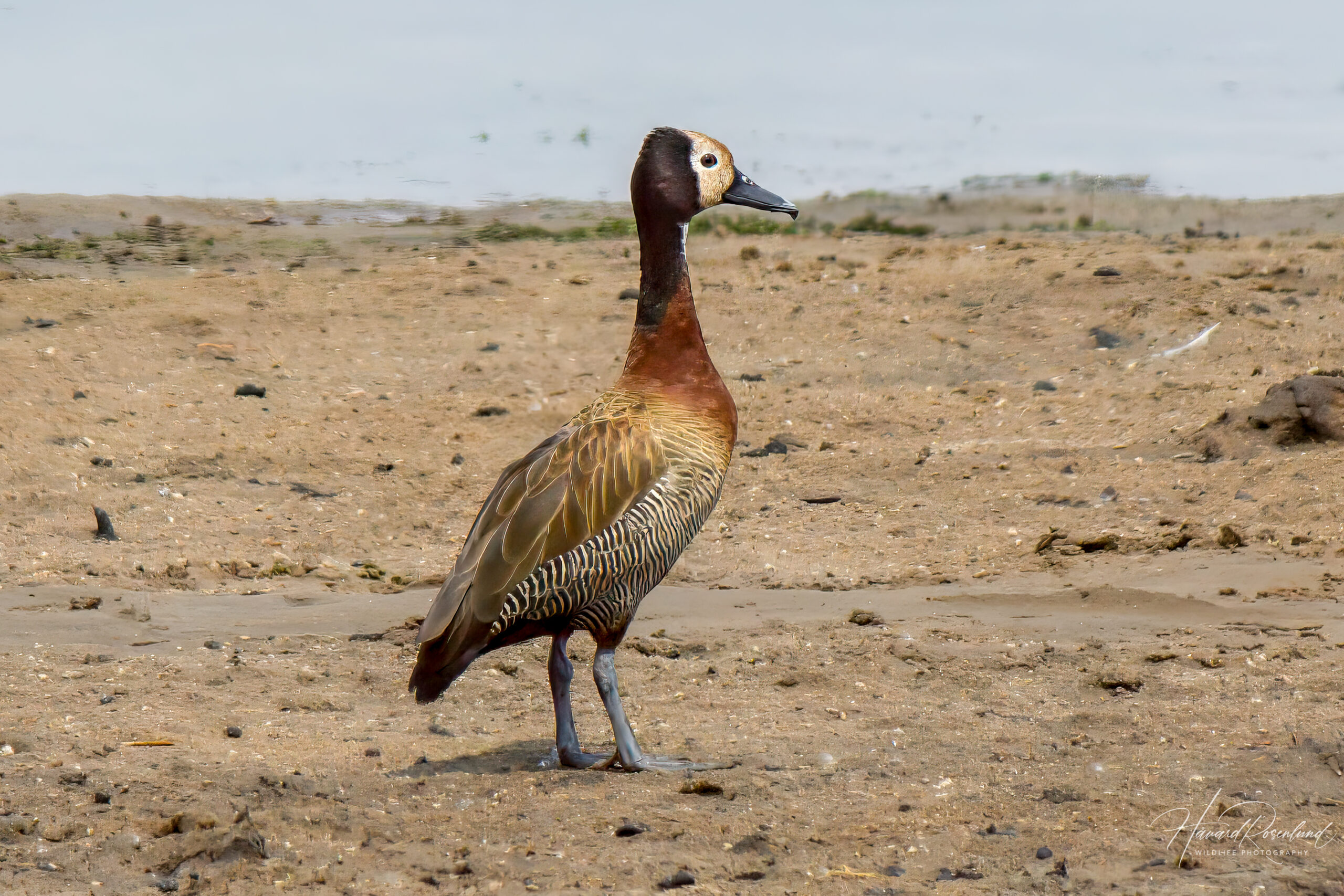
White-faced Whistling-Duck
Dendrocygna viduata
At a glance
Habitat
- Freshwater lakes, marshes, floodplains, rivers, rice fields and reservoirs
Diet
- Mostly seeds, grasses and aquatic plants; some aquatic invertebrates seasonally
Activity
- Most feeding from dusk through the night; often rests by day
Size
- Length: 46–53 cm Weight: 685–820 g
Range
- Sub-Saharan Africa, Madagascar and much of South America
Description
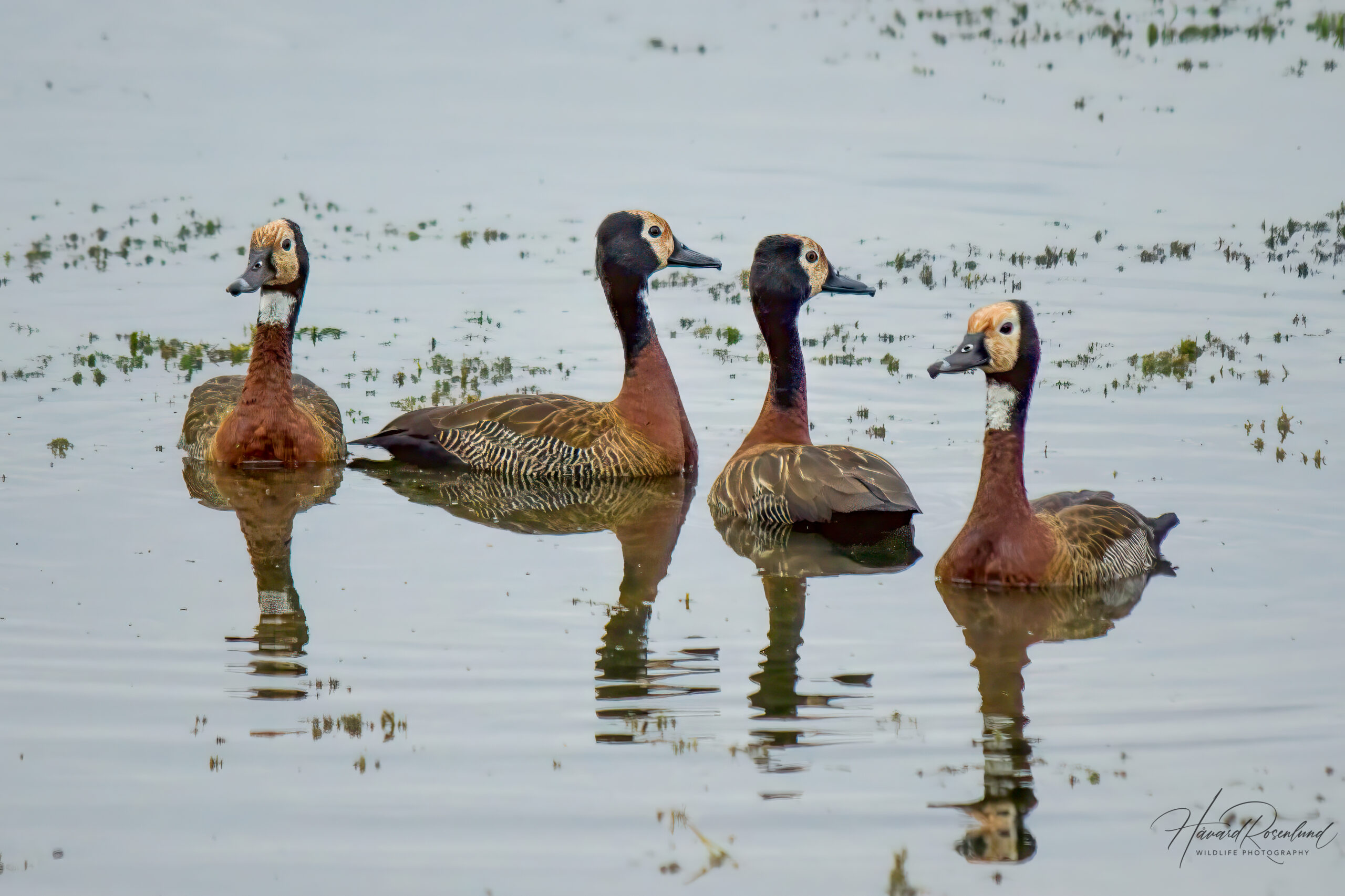
The white-faced whistling-duck (Dendrocygna viduata) is a long-legged, highly social waterfowl species occurring on both sides of the Atlantic: across most of sub-Saharan Africa and Madagascar and through much of South America. Adults are roughly 46–53 cm long and weigh about 685–820 g. The white face and throat contrast sharply with a black hindcrown and rear neck, while the breast is chestnut and the belly black; finely barred ochre flanks and a brown back complete the distinctive pattern.
Males and females look very similar. The long legs and upright posture are typical of whistling ducks, as is the clear whistled contact call used frequently in flight and when flocks move together. Unlike many dabbling ducks, the species walks readily on land and can perch in trees.
Habitat
White-faced whistling-ducks use a broad range of freshwater habitats, including shallow lakes, marshes, swamps, floodplains, rivers, deltas, reservoirs, sewage ponds and rice fields. Breeding birds often favour temporarily flooded wetlands with dense marginal vegetation.
Large permanent wetlands become especially important during the annual wing moult, when birds temporarily lose the ability to fly. At that stage they depend heavily on secure water bodies with abundant food and refuge from disturbance.
Diet
The diet is predominantly plant-based. Grass and sedge seeds, rice, maize, sorghum, aquatic vegetation and tubers are important, while molluscs, crustaceans and insects are taken more frequently in some seasons.
White-faced whistling-ducks feed at the water surface, upend and probe soft mud, and can also graze on land. Large flocks may spread across shallow water or flooded grassland while feeding. Feeding is often concentrated from dusk through the night and into the early morning, allowing the birds to use wetlands during the cooler and quieter parts of the daily cycle.
Behaviour
This is one of the most gregarious ducks in its range. Outside breeding, flocks may number hundreds or thousands and commonly mix with other waterbirds. The birds are highly vocal during take-off, landing and flock movements, and their whistled calls help keep moving groups together.
Much of the hottest part of the day is spent resting, often in dense aggregations. Seasonal movements are usually local or regional and are driven strongly by rainfall, flooding and the sudden appearance of productive wetlands rather than by one fixed long-distance migration route.
Breeding
Breeding is closely tied to rainfall and flooding. In southern Africa it usually begins with the rainy season and peaks from December to February. Pairs are monogamous and may nest singly or in loose groups.
The nest is usually a shallow, well-concealed structure among long grass or sedges close to water and is built largely from surrounding vegetation. Clutches contain 4–13 eggs. Both sexes incubate for roughly 26–30 days, with males often taking a substantial share of incubation.
Ducklings hatch well developed and leave the nest soon afterwards, but they remain dependent on both parents for protection and guidance. Young become capable of flight after roughly 9–12 weeks. Breeding success can vary greatly between years because rainfall controls wetland extent and food availability.
Status
The white-faced whistling-duck is classified as least concern on the IUCN Red List. The global population is estimated at roughly 1.41–1.70 million birds, and the global population trend is considered increasing.
In South Africa, Lesotho and Eswatini the species is also classified as least concern in 2025, but the regional population trend is declining and modelling indicates a range contraction of about 14% over three generations. Wetland degradation, pollution, altered water regimes and disease outbreaks such as avian botulism and avian influenza can affect populations. Large permanent wetlands are especially important because birds gather there during the flightless wing moult.
Image gallery
Loading map and observations…
Have you seen this species?
Independent species archive
Did you find this species page useful?
Wildlife Vagabond is independently built and maintained. Voluntary support helps cover hosting, maps, data storage and continued improvements to the species archive.
Support Wildlife VagabondSpecies content will remain freely available.
References
Information about the species’ global distribution and status is based primarily on global Red List data. See the references below for details.
- BirdLife International. (n.d.). White-faced Whistling-Duck species factsheet. https://datazone.birdlife.org/species/factsheet/white-faced-whistling-duck-dendrocygna-viduata
- BirdLife South Africa. (2025). White-faced Whistling Duck regional assessment. https://www.birdlife.org.za/red-list/white-faced-whistling-duck/
- Carboneras, C., & Kirwan, G. M. (2020). White-faced Whistling-Duck (Dendrocygna viduata). In Birds of the World. Cornell Lab of Ornithology. https://doi.org/10.2173/bow.wfwduc1.01
- International Union for Conservation of Nature. (n.d.). White-faced Whistling-Duck. The IUCN Red List of Threatened Species. https://www.iucnredlist.org/species/22679763/92829021
- Roux et al. (n.d.). Feeding ecology and bioenergetics of the White-faced Whistling Duck in Venezuela. https://tidsskrift.dk/Wildfowl/article/view/154225