
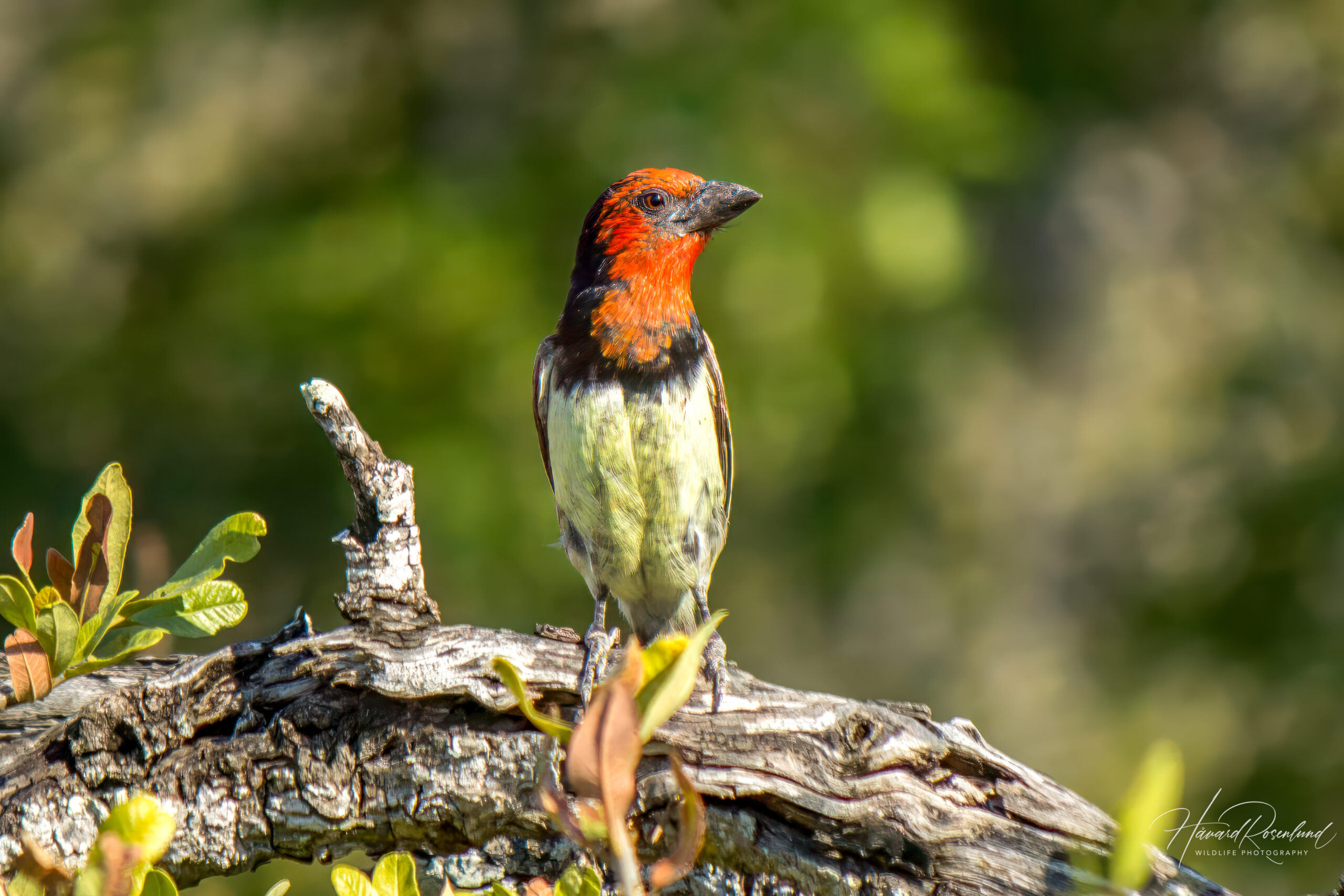
Black-collared Barbet
Lybius torquatus
At a glance
Habitat
- Woodland, savanna, forest edge, riverine vegetation, parks and gardens
Diet
- Mainly fruit, especially figs; also insects, nectar and other small animal prey
Activity
- Diurnal
Size
- Length: 20–22 cm Weight: 45–80 g
Range
- Eastern and southern sub-Saharan Africa, mainly south of the equator
Description
The black-collared barbet (Lybius torquatus) is a stocky, brightly coloured African barbet found across much of eastern and southern sub-Saharan Africa. Adults are about 20–22 cm long and weigh roughly 45–80 g. The typical form has a vivid red face, throat and upper breast framed by a broad black hindcrown and breast band, with pale yellowish underparts and a dark, finely patterned back. The heavy black bill is well suited both to fruit feeding and excavating cavities.
Several geographic subspecies occur and head pattern varies across the range. The subspecies L. t. zombae of southern Tanzania, Malawi and parts of Mozambique is particularly distinctive, with a black throat speckled white rather than the typical red throat. Rare yellow-headed individuals also occur in populations that are normally red-headed. The sexes are alike in plumage and generally cannot be separated by appearance alone.
Habitat
Black-collared barbets occupy a broad range of wooded habitats, including savanna woodland, forest edge, riverine vegetation, coastal bush and mature suburban gardens. Fruiting trees are particularly important, and the species has adapted well to landscapes where people have planted figs and other fruit-bearing trees.
Mature and decaying trees are also valuable because the birds excavate their own roosting and nesting cavities. A landscape can therefore provide abundant food yet still be poor breeding habitat if old trees and soft dead branches are removed.
Diet
Fruit dominates the diet, with wild figs (Ficus) especially important where available. Other fruits, insects and nectar are also eaten, and occasional small vertebrate prey has been recorded.
Black-collared barbets forage mainly in trees and shrubs, clambering among branches and sometimes hanging awkwardly to reach fruit and other food. Fruiting trees can become particularly important feeding sites when crops ripen. By swallowing fruit and later passing viable seeds elsewhere, the birds also act as seed dispersers within wooded habitats.
Social behaviour
The species occurs as pairs or in small social groups that often contain retained family members. Groups use a characteristic greeting display, while the breeding pair defends the territory and performs the species' best-known vocal display: a precisely coordinated duet.
The duet is antiphonal, with the two birds alternating complementary notes so closely that the result can sound like one patterned call. It is often rendered as “too-puddly too-puddly” or “too-doodle too-doodle”. The two members of the breeding pair have distinct roles in the duet, which forms part of both pair interaction and territorial advertisement.
Example of the duet:
Breeding
Black-collared barbets excavate their own nest holes, usually in the underside or side of a dead or decaying branch. Both members of the breeding pair take part in excavation, and suitable cavities may be reused for many years. In South Africa egg laying is recorded mainly from September to February, with regional variation elsewhere in the range.
Clutches contain two to five white eggs. Both members of the pair incubate for roughly 18 days. The chicks remain in the cavity for about 33–36 days and are fed fruit and animal prey by the parents. In cooperative social groups, additional adult helpers may also contribute food and other care at the nest.
The species is an important host of the lesser honeyguide (Indicator minor). The honeyguide chick hatches with pronounced hooks at the bill tips that it uses to wound and kill the host young. It then normally becomes the only chick fed by the barbet adults in the parasitised nest.
Status
The black-collared barbet is classified as least concern on the IUCN Red List. It is widespread and remains common across much of eastern and southern Africa.
The species tolerates many human-modified wooded landscapes and has expanded locally where gardens and settlements provide mature trees and abundant fruit. Loss of large or decaying trees can reduce local nesting opportunities, but no major range-wide threat is currently known.
Image gallery
Loading map and observations…
Have you seen this species?
Independent species archive
Did you find this species page useful?
Wildlife Vagabond is independently built and maintained. Voluntary support helps cover hosting, maps, data storage and continued improvements to the species archive.
Support Wildlife VagabondSpecies content will remain freely available.
References
Information about the species’ global distribution and status is based primarily on global Red List data. See the references below for details.
- Biodiversity Explorer. (n.d.). Black-collared Barbet (Lybius torquatus). Iziko Museums of South Africa. https://www.biodiversityexplorer.info/birds/lybiidae/lybius_torquatus.htm
- BirdLife International. (n.d.). Black-collared Barbet species factsheet. https://datazone.birdlife.org/species/factsheet/black-collared-barbet-lybius-torquatus
- International Union for Conservation of Nature. (n.d.). Black-collared Barbet. The IUCN Red List of Threatened Species. https://www.iucnredlist.org/species/22681845/92922862
- Payne & Skinner. (1970). Temporal patterns of duetting in African barbets. http://hdl.handle.net/11295/65499
- Péron, G., Altwegg, R., Jamie, G. A., & Spottiswoode, C. N. (2016). Coupled range dynamics of brood parasites and their hosts responding to climate and vegetation changes. Journal of Animal Ecology, 85(5), 1191-1199. https://doi.org/10.1111/1365-2656.12546
- Short & Horne. (1983). Review of duetting, sociality and speciation in some African barbets. https://academic.oup.com/condor/article/85/3/323/5205033
- Spottiswoode & Koorevaar. (2012). Coevolution between brood-parasitic honeyguides and their hosts. http://hdl.handle.net/11427/10653