
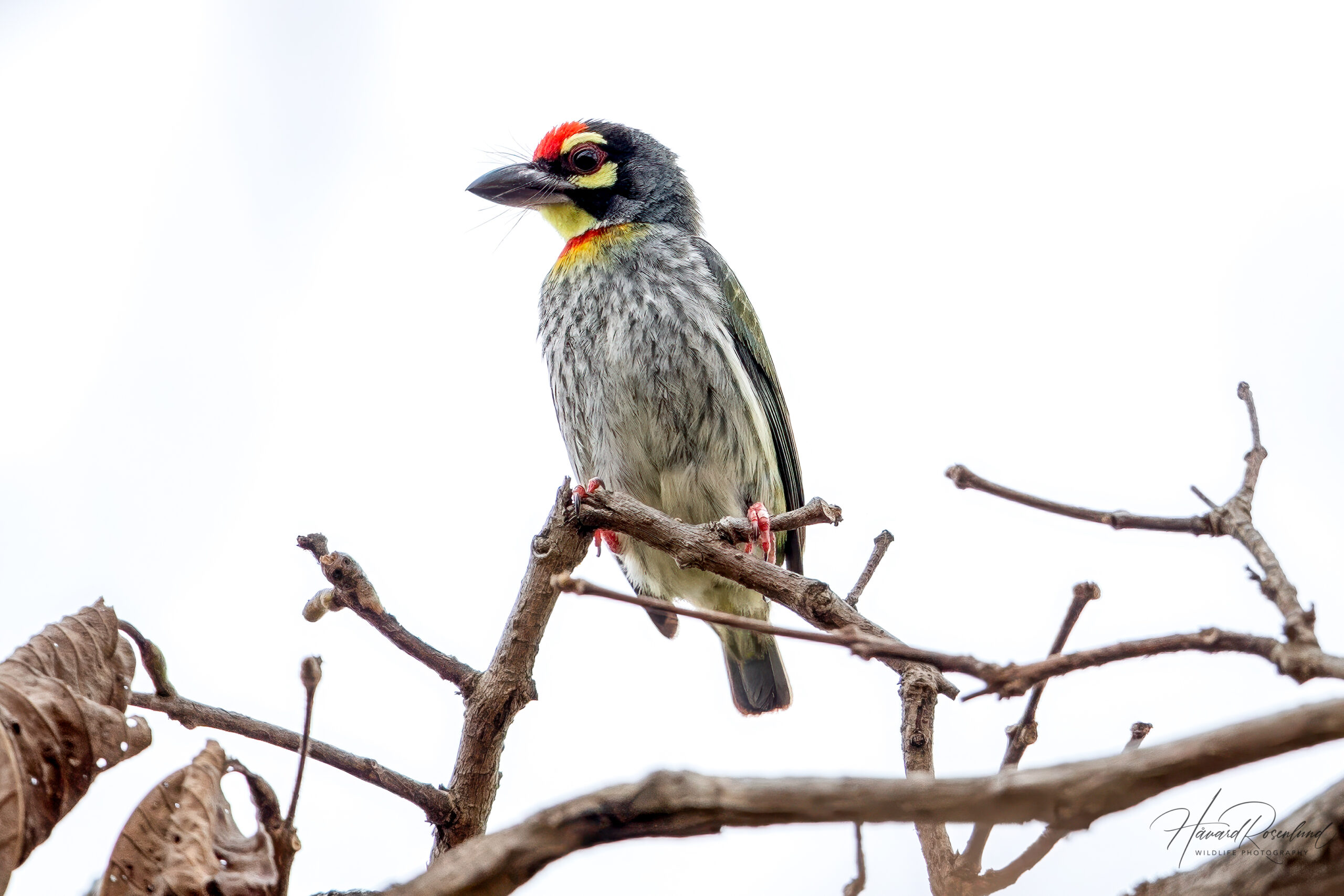
Coppersmith Barbet
Psilopogon haemacephalus
At a glance
Habitat
- Open woodland, forest edges, orchards, plantations, parks and well-wooded urban areas
Diet
- Mostly fruit, especially figs and other berries; insects supplement the diet and are fed to chicks
Activity
- Diurnal
Size
- Length: 15–18 cm Weight: about 40 g
Range
- Indian subcontinent through mainland Southeast Asia and parts of the Malay Archipelago
Description
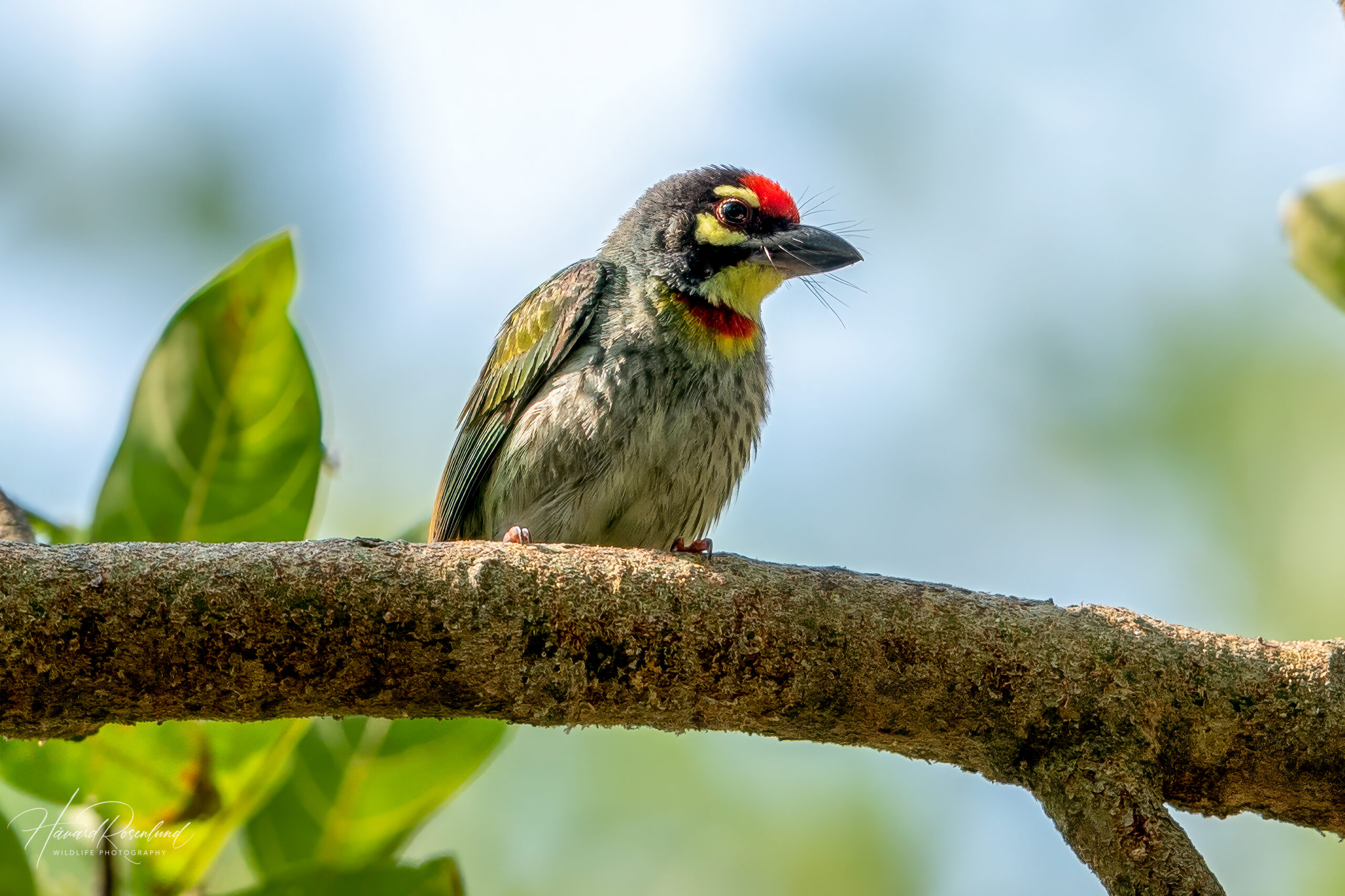
The coppersmith barbet (Psilopogon haemacephalus) is a small, compact Asian barbet found from the Indian subcontinent through much of Southeast Asia. Adults are about 15–18 cm long and weigh around 40 g. The body is predominantly green, with pale streaked underparts, a black eye-mask, yellow face and throat patches, and striking red on the forehead and upper breast. The sexes are very similar, while juveniles are duller and lack much of the bright red head pattern.
Plumage varies geographically. Most populations show the yellow face and throat patches described above, while some island populations in Indonesia and the Philippines have much more red and black on the face. It can be confused with other green barbets where ranges overlap, but in much of India the larger brown-headed barbet (Psilopogon zeylanicus) is the most obvious comparison. The coppersmith is much smaller and more brightly patterned around the face and breast.
Habitat
Coppersmith barbets live in open woodland, forest edges, orchards, plantations, parks, gardens and well-wooded towns and cities. They tolerate heavily modified landscapes as long as mature trees provide fruit, cover and suitable wood for nesting cavities.
The species is therefore common in many tree-rich human landscapes, but its dependence on older trees means that heavily cleared urban and agricultural areas can still become unsuitable even when food is present.
Diet
The diet is strongly fruit-based. Figs, berries and other soft fruits are particularly important, while insects and other small invertebrates supplement the diet and are also fed to growing young. Birds feed mostly in trees and may gather with other fruit-eating species at heavily laden fruiting trees. Insects can also be caught in short aerial sallies from a perch.
By swallowing fruit and moving between trees, coppersmith barbets can also contribute to seed dispersal. Their combination of fruit-eating and cavity nesting ties them closely to areas with mature, structurally varied trees.
Vocalisations
The species is named for its remarkably regular metallic call, usually rendered as a repeated “tuk” or “kuk” that recalls a coppersmith striking metal. A bird may continue the same note in long, steady sequences, sometimes for extended periods, and the sound often reveals an otherwise well-hidden bird in the canopy before it is seen.
Breeding
Coppersmith barbets are cavity nesters and normally excavate their own nest chamber in dead or softened wood, often in a decaying branch or trunk. Both members of the pair can take part in excavation, and old cavities may also be reused. Breeding timing varies across the broad range and is influenced by local climate. The chicks are altricial and remain in the cavity for about five weeks before fledging.
A study published in 2013 from Dhaka, Bangladesh, followed 20 nests and found clutches of 2–4 eggs, averaging three. Incubation lasted about 14 days, and both sexes incubated, brooded and fed the nestlings. Parents brought both fruit and insects to the cavity. Nest losses included predation, human disturbance and ectoparasites, illustrating that cavity nesting reduces some risks but does not remove them.
Status
The coppersmith barbet is classified as least concern on the IUCN Red List. It has a broad distribution and remains common in many natural and human-modified landscapes.
State of India's Birds lists the species as a low conservation priority. Its 2025 update shows that both the long-term national trend and the current annual trend are stable. The species can use plantations, orchards and urban tree cover, but local populations still depend on the retention of mature fruiting and cavity-bearing trees.
Image gallery
Loading map and observations…
Have you seen this species?
Independent species archive
Did you find this species page useful?
Wildlife Vagabond is independently built and maintained. Voluntary support helps cover hosting, maps, data storage and continued improvements to the species archive.
Support Wildlife VagabondSpecies content will remain freely available.
References
Information about the species’ global distribution and status is based primarily on global Red List data. See the references below for details.
- BirdLife International. (n.d.). Coppersmith Barbet species factsheet. https://datazone.birdlife.org/species/factsheet/coppersmith-barbet-psilopogon-haemacephalus
- eBird. (n.d.). Coppersmith Barbet. Cornell Lab of Ornithology. https://ebird.org/species/copbar1
- International Union for Conservation of Nature. (n.d.). Coppersmith Barbet. The IUCN Red List of Threatened Species. https://www.iucnredlist.org/species/22681681/92916283
- Sarker, N. J., Jaman, M. F., Mustafa, S., & Rahman, M. S. (2013). Breeding biology of coppersmith barbet, Megalaima haemacephala (Müller, 1776). University Journal of Zoology, Rajshahi University, 31, 31-34. https://doi.org/10.3329/ujzru.v31i0.15397
- State of India's Birds. (2025). 2025 – Coppersmith Barbet. https://stateofindiasbirds.in/species/copbar1/
- Tobias, J. A., Sheard, C., Pigot, A. L., Devenish, A. J. M., Yang, J., Sayol, F., Neate‐Clegg, M. H. C., Alioravainen, N., Weeks, T. L., Barber, R. A., Walkden, P. A., MacGregor, H. E. A., Jones, S. E. I., Vincent, C., Phillips, A. G., Marples, N. M., Montaño‐Centellas, F. A., Leandro‐Silva, V., Claramunt, S., … Schleuning, M. (2022). AVONET: morphological, ecological and geographical data for all birds. Ecology Letters, 25(3), 581-597. https://doi.org/10.1111/ele.13898