
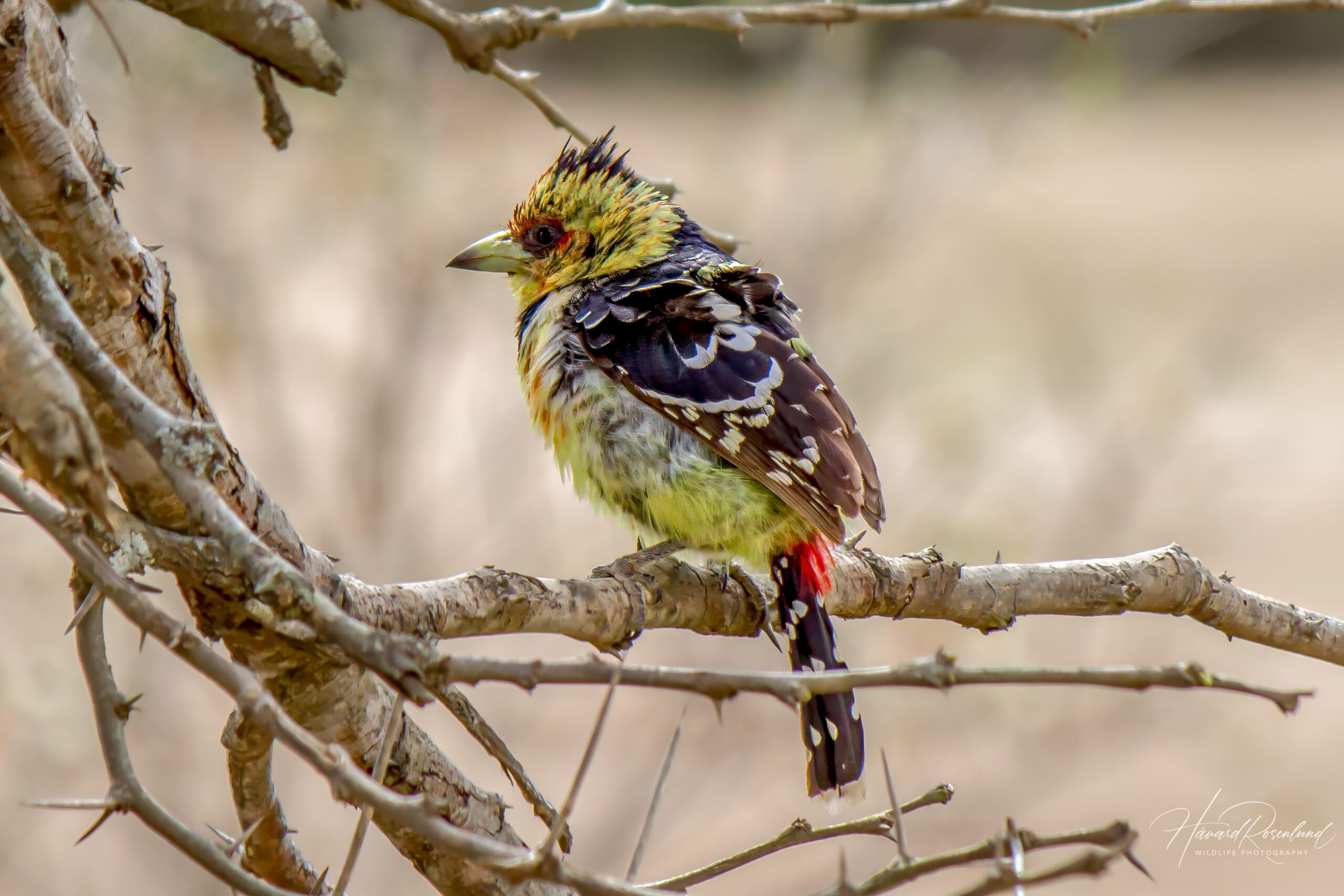
Crested Barbet
Trachyphonus vaillantii
At a glance
Habitat
- Savanna, open woodland, thickets, riverine vegetation and well-treed gardens
Diet
- Fruit, insects and other invertebrates; also seeds and occasional nectar
Activity
- Diurnal
Size
- Length: about 22 cm Weight: around 69 g
Range
- Southern and south-central Africa, from Angola and Zambia south to South Africa
Description
The crested barbet (Trachyphonus vaillantii) is a chunky, vividly patterned African barbet with a heavy pale bill and a shaggy black crest. The head and underparts combine yellow, red and black, while the upperparts are dark with bold white spotting. Adults are about 22 cm long and weigh around 69 g. The sexes are similar.
The combination of the heavy bill, spotted upperparts and bright yellow-red underparts makes adults unmistakable through most of the range. Juveniles are duller and less strongly patterned.
Habitat
Crested barbets inhabit open woodland, wooded and bushy savanna, thickets and riverine vegetation. They favour landscapes with enough trees to provide feeding sites, roosting holes and nesting cavities but are not dependent on closed forest.
The species is adaptable and also occurs in well-treed gardens and suburban areas. Mature trees, dead branches and existing cavities can be especially important because the same territory may be used year-round for feeding, roosting and breeding.
Diet
The diet is broad. Fruit and insects are important, together with other invertebrates such as snails; seeds and nectar are also taken, and eggs or nestlings of small birds have been recorded occasionally. Growing chicks are fed insects rather than the fruit-heavy diet that adults may use when fruit is abundant.
Crested barbets forage both in trees and on the ground. They may pick fruit directly from branches, search bark and foliage for invertebrates or hop through low vegetation and open patches while looking for food.
Behaviour
Crested barbets usually live alone or in territorial pairs and can defend the same area throughout the year. Both sexes produce loud trilling and grating calls, and pairs may call at the same time without the tightly synchronised antiphonal duet heard in some other African barbets.
The calls are not restricted to breeding and also function in territorial communication. Resident birds respond actively to the calls of a perceived intruder, searching the territory and inspecting roost holes. Competition for cavities also occurs with other species, reflecting how valuable suitable holes are for a bird that uses them for both roosting and breeding.
Breeding
Crested barbets breed in cavities. Both sexes can excavate a chamber in dead wood, and pairs also use natural holes and nest boxes. Breeding timing varies geographically and can extend through much of the year, with a strong spring and early-summer peak in southern Africa.
A nine-season study in suburban Pretoria found an average clutch of 3.3 eggs and an average of 2.4 breeding attempts per pair per season. The modal incubation period was 14 days and chicks remained in the nest for 28–31 days. Both parents incubate and feed the young.
Brood parasitism can cause breeding failure. Lesser honeyguides (Indicator minor) parasitised nests in the Pretoria study, and both lesser and greater honeyguides (Indicator indicator) have been recorded using crested barbets as hosts. Barbets also defend nest holes vigorously against other cavity-nesting birds.
Relationship with humans
Crested barbets adapt readily to wooded suburbs and gardens. Nest boxes can provide additional roosting and nesting cavities, while lawns, fruiting garden plants and scattered trees offer feeding opportunities.
This adaptability makes the species familiar around homes in parts of southern Africa, but suburban populations still depend on suitable trees and vegetation. Where mature and dead trees with cavities disappear, both roosting and nesting sites can become scarce even if the surrounding area remains green.
Status
The crested barbet is widespread and common across much of southern and south-central Africa and is classified as least concern on the IUCN Red List.
No major range-wide threat is currently recognised. Local removal of mature or dead trees can nevertheless reduce the availability of roosting and breeding cavities.
Image gallery
Loading map and observations…
Have you seen this species?
Independent species archive
Did you find this species page useful?
Wildlife Vagabond is independently built and maintained. Voluntary support helps cover hosting, maps, data storage and continued improvements to the species archive.
Support Wildlife VagabondSpecies content will remain freely available.
References
Information about the species’ global distribution and status is based primarily on global Red List data. See the references below for details.
- Biodiversity Explorer. (n.d.). Crested Barbet, based on Roberts Birds of Southern Africa. Iziko Museums of South Africa. https://www.biodiversityexplorer.info/birds/lybiidae/trachyphonus_vaillantii.htm
- BirdLife International. (n.d.). Crested Barbet species factsheet. https://datazone.birdlife.org/species/factsheet/crested-barbet-trachyphonus-vaillantii
- International Union for Conservation of Nature. (n.d.). Crested Barbet. The IUCN Red List of Threatened Species. https://www.iucnredlist.org/species/22681881/92924169
- Prozesky, O. P. M. (1966). A study of the behaviour of the crested barbet, <i>Trachyphonus vaillantii</i>. Ostrich, 37(sup1), 171-182. https://doi.org/10.1080/00306525.1966.9639796
- Van Zyl, A. J. (1994). The influence of the environment on breeding success of a suburban population of crested barbet <i>Trachyphonus vaillantii</i>. Ostrich, 65(3-4), 291-296. https://doi.org/10.1080/00306525.1994.9632689
- Ward, D. (1986). Vocalizations and associated behaviour of crested and black-collared barbets. Ostrich, 57(3), 129-137. https://doi.org/10.1080/00306525.1986.9633641