
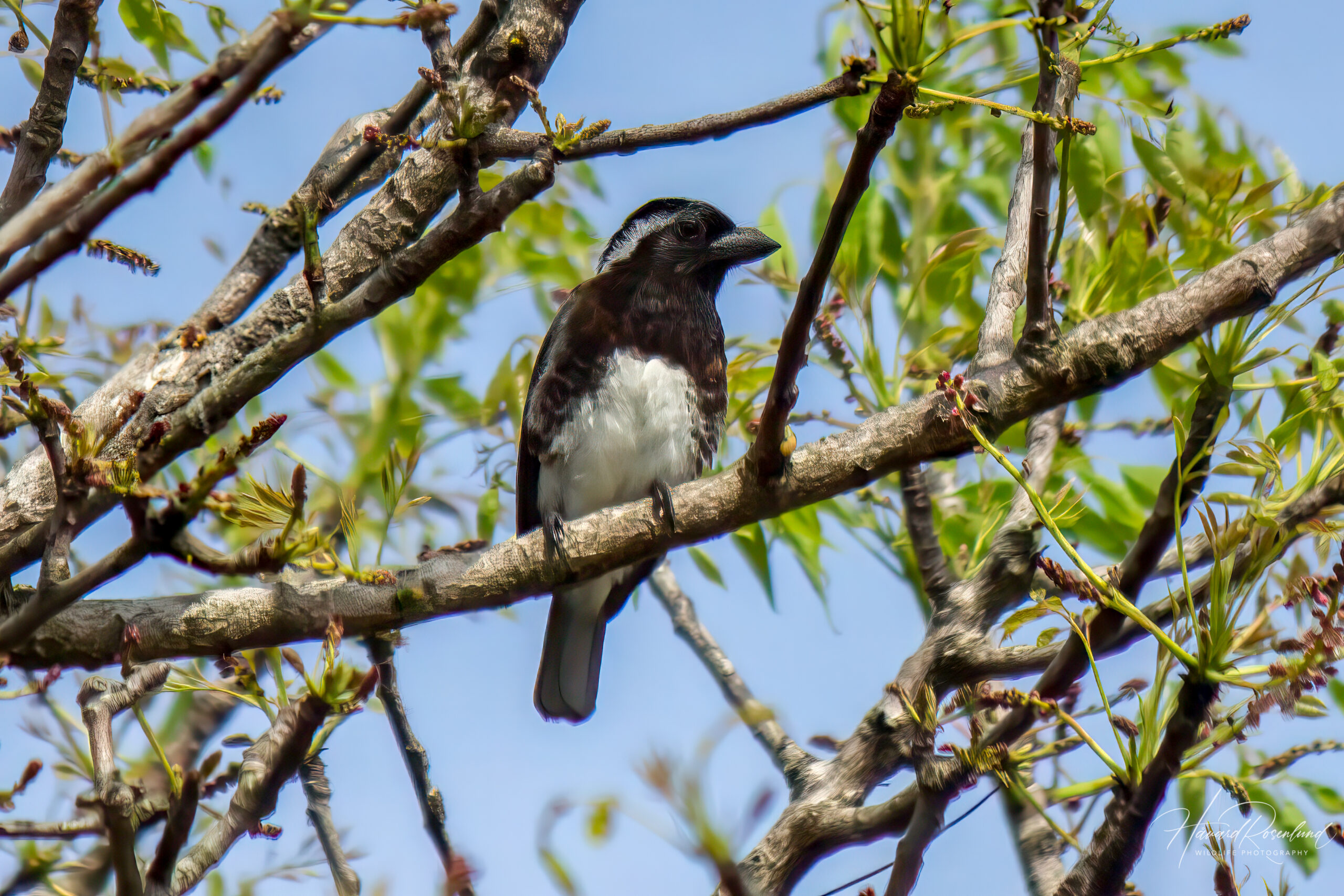
White-eared Barbet
Stactolaema leucotis
At a glance
Habitat
- Moist woodland, forest edge, riverine forest, coastal bush and wooded gardens
Diet
- Mostly fruit, especially figs; insects are important, particularly for chicks
Activity
- Diurnal
Size
- Length: ~18 cm Weight: 51–63 g
Range
- Disjunct populations from Kenya and Tanzania south through Mozambique, Zimbabwe and eastern South Africa
Description
The white-eared barbet (Stactolaema leucotis) is a stocky, dark African barbet with a patchy distribution along the eastern side of the continent. Adults are about 18 cm long and weigh roughly 51–63 g. The head, throat and breast are dark brown to blackish, contrasting with the conspicuous white ear-coverts and pale belly. The back and wings are dark brown, and the heavy bill is well suited to both fruit feeding and excavating nest cavities.
Three subspecies are recognised. The nominate S. l. leucotis occurs from Malawi and Mozambique south to South Africa, S. l. leucogrammica in south-central Tanzania, and S. l. kilimensis from central Kenya to northeastern Tanzania.
Habitat
White-eared barbets favour moist woodland, forest edge, riverine forest, coastal bush and other wooded habitats with mature fruiting trees. In South Africa they are especially associated with the humid eastern coastal belt and are locally conspicuous around St Lucia and other well-wooded parts of KwaZulu-Natal.
Dead and decaying branches are important alongside fruiting trees because the birds excavate their own roosting and nesting cavities. Areas with mature trees and dead wood therefore provide both food and suitable cavities.
Diet
Fruit dominates the diet, with figs (Ficus) especially important. Other berries and fruits are also taken, together with insects such as grasshoppers and cicadas.
Feeding often centres on mature fruiting trees, especially figs, where birds forage through the canopy with other members of the family group when fruit is abundant. The diet shifts strongly during breeding: adults that otherwise live largely on fruit take more insects when provisioning chicks. About 64% of recorded food deliveries to chicks consisted of insects, while nearly all fruit brought to the nest consisted of figs.
Social behaviour
The species normally lives in small, stable family groups rather than only as pairs. Group members forage, call and roost together, and the harsh calls carry far and often reveal a group before the birds themselves are visible in the canopy.
Young birds can remain with their family after fledging, so groups can contain several age classes. These long-lasting family groups are closely linked to the species' cooperative breeding system.
Breeding
White-eared barbets are cooperative breeders. The breeding pair may be assisted by one to six other group members, often family members that have remained with the group, which can help with excavation, incubation, chick provisioning and nest guarding.
The nest is usually excavated by the breeding pair, sometimes with help from other group members, and is typically placed in the underside of a dead or decaying branch. Ficus, Erythrina and Syzygium are among the tree genera used for nesting. In southern Africa egg laying occurs mainly from August to March, with a peak from October to December.
Clutches contain three to six eggs, usually four or five. The breeding pair and helpers can share incubation, which lasts about 14–18 days. Chicks remain in the nest cavity for about 39 days, with several group members contributing food and defence before the young join the wider family group.
Status
The white-eared barbet is classified as least concern on the IUCN Red List. Its distribution is broad but discontinuous across eastern and southeastern Africa.
The species can use wooded gardens and other modified habitats where mature trees remain, but local populations depend on both fruiting trees and dead or decaying wood suitable for cavity excavation. Loss of mature trees and dead wood can therefore reduce both feeding and nesting opportunities.
Image gallery
Loading map and observations…
Have you seen this species?
Independent species archive
Did you find this species page useful?
Wildlife Vagabond is independently built and maintained. Voluntary support helps cover hosting, maps, data storage and continued improvements to the species archive.
Support Wildlife VagabondSpecies content will remain freely available.
References
Information about the species’ global distribution and status is based primarily on global Red List data. See the references below for details.
- Avibase. (n.d.). White-eared Barbet (Stactolaema leucotis). https://avibase.bsc-eoc.org/species.jsp?avibaseid=6C81D39B2E8E2C9A
- Biodiversity Explorer. (n.d.). White-eared Barbet (Stactolaema leucotis). Iziko Museums of South Africa. https://www.biodiversityexplorer.info/birds/lybiidae/stactolaema_leucotis.htm
- BirdLife International. (n.d.). White-eared Barbet species factsheet. https://datazone.birdlife.org/species/factsheet/white-eared-barbet-stactolaema-leucotis
- International Union for Conservation of Nature. (n.d.). White-eared Barbet. The IUCN Red List of Threatened Species. https://www.iucnredlist.org/species/22726050/94910036
- Oiseaux.net. (n.d.). White-eared Barbet. https://www.oiseaux.net/birds/white-eared.barbet.html