
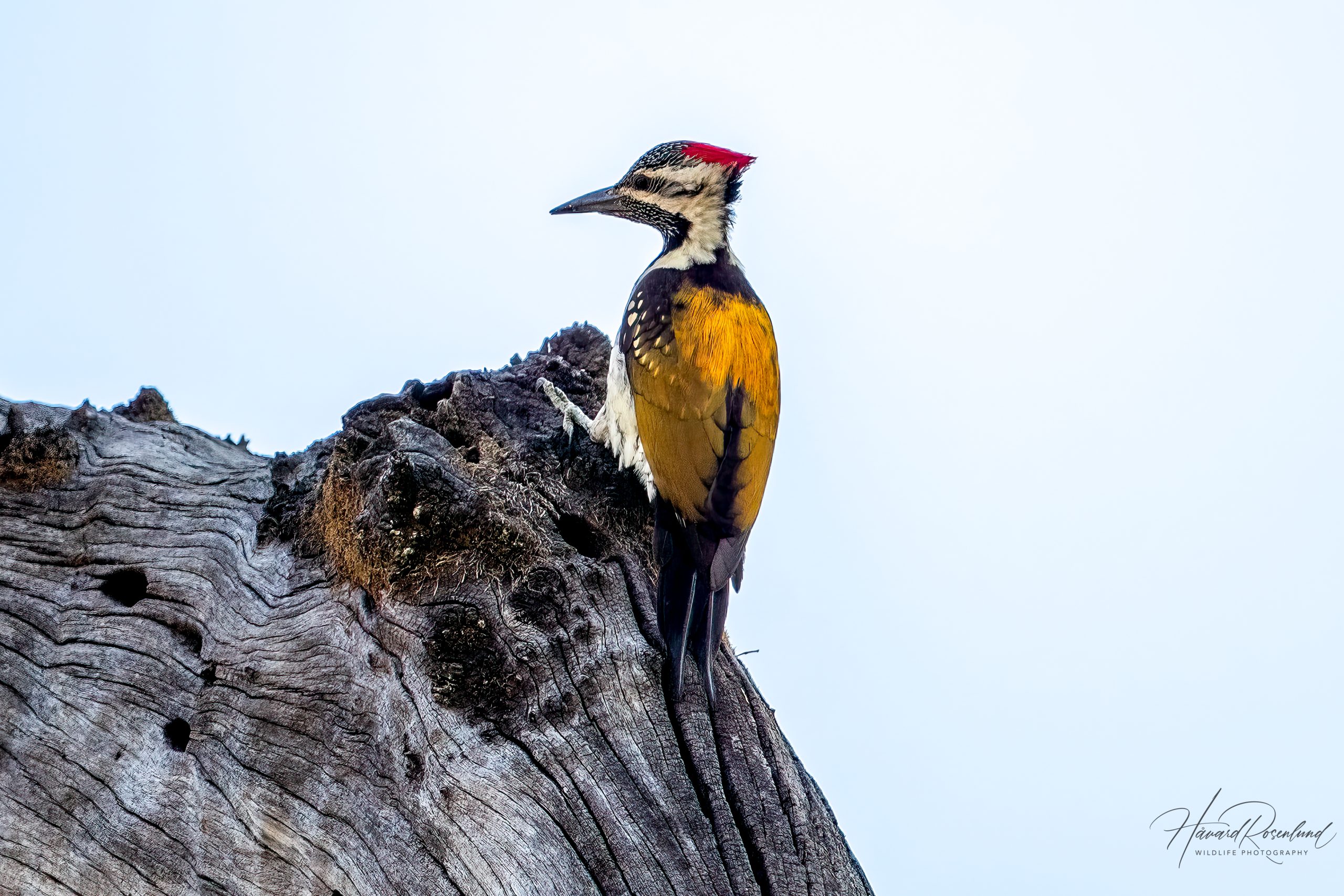
Black-rumped Flameback
Dinopium benghalense
At a glance
Habitat
- Open woodland, dry and moist forest, groves, plantations, farmland and well-treed urban areas
Diet
- Mainly ants, beetles, termites and other invertebrates; also fruit and nectar
Activity
- Diurnal
Size
- Length: 26–29 cm Weight: about 86–133 g
Range
- Indian subcontinent, from Pakistan and Nepal through India and Bangladesh to parts of Sri Lanka
Description
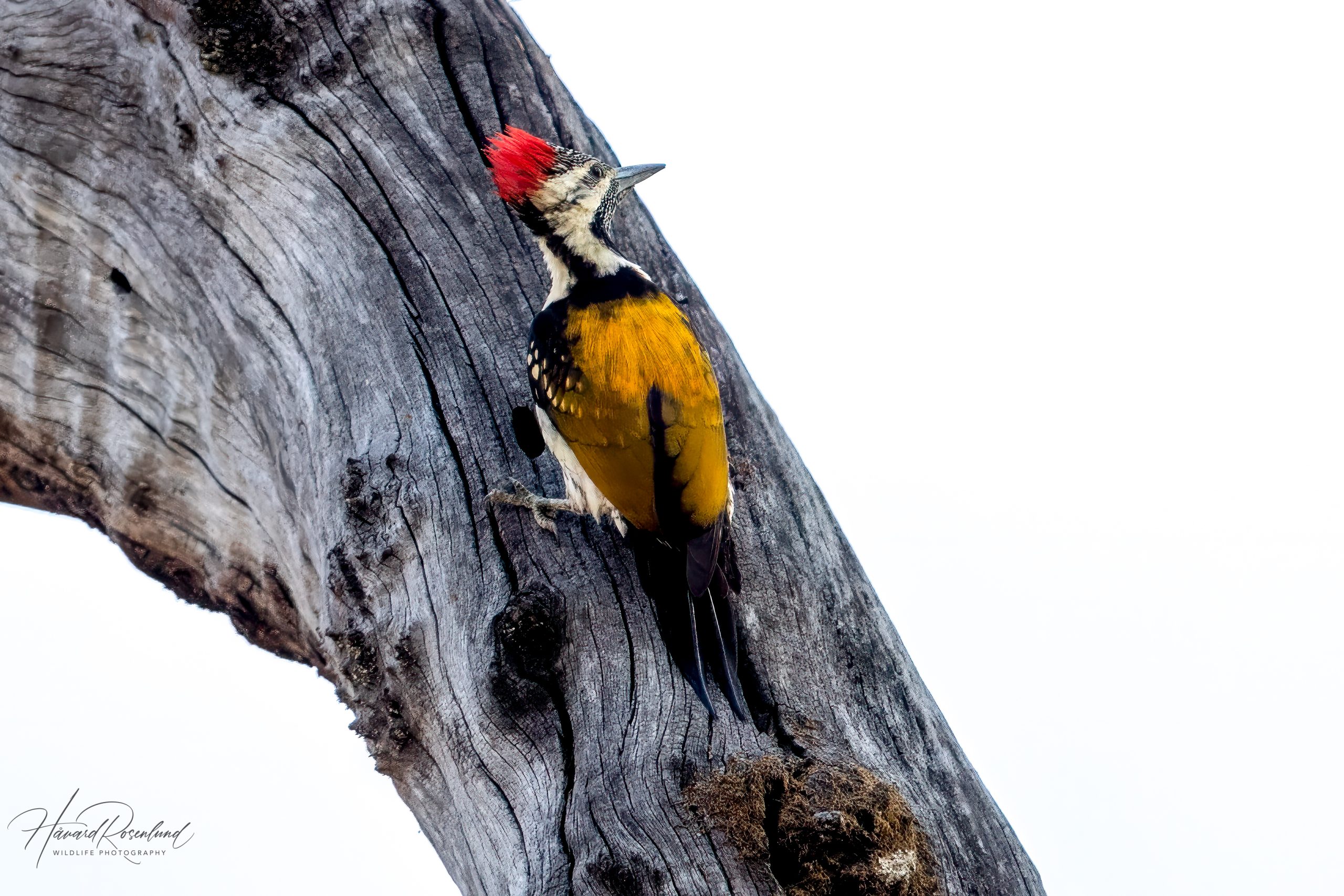
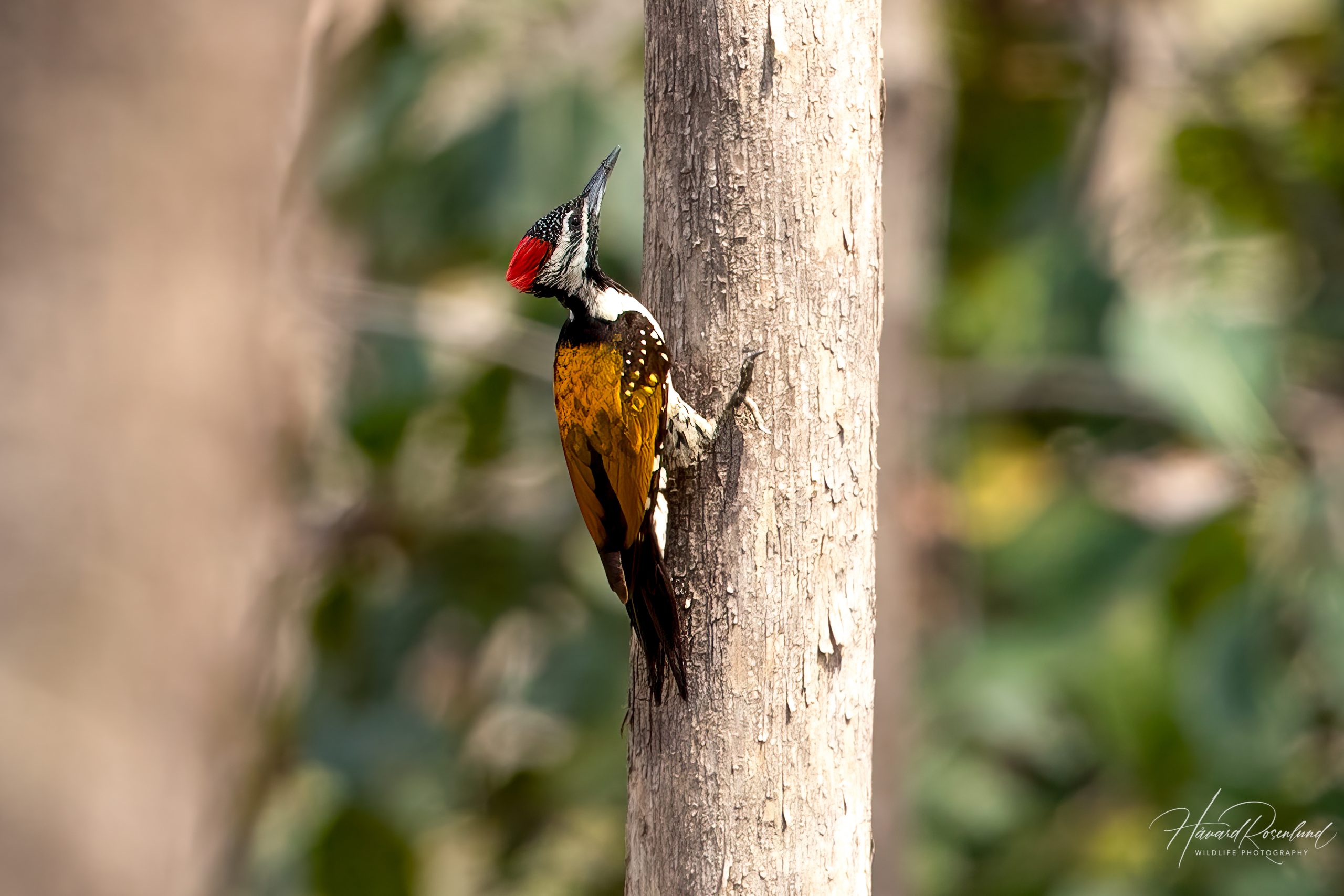
The black-rumped flameback (Dinopium benghalense) is a colourful medium-sized woodpecker of the Indian subcontinent. Adults are about 26–29 cm long and weigh roughly 86–133 g. The golden-yellow back and wings contrast with a distinctly black lower back and rump, while the throat is also black and the underparts are pale with dark markings.
Males have a fully red crown and crest, whereas females have a black forecrown spotted with white and red restricted mainly to the rear of the crest. The strong, chisel-shaped bill, stiff tail feathers and gripping feet are typical woodpecker adaptations for moving and feeding on tree trunks. The combination of golden upperparts, a black throat and a black rump is particularly useful for separating the species from other similar flamebacks.
Taxonomy
The red-backed flameback (Dinopium psarodes) was formerly treated as a form of the black-rumped flameback on Sri Lanka but is now recognised as a separate species. Studies of the contact zone showed strong differentiation despite some hybridisation.
Genomic work published in 2024 showed that the Sri Lankan situation is even more complex. Two genetically distinct populations of D. benghalense occur in northern Sri Lanka and interact with D. psarodes farther south, producing a three-way hybrid zone. The work shows that visible plumage differences reveal only part of the evolutionary history of these flamebacks.
Habitat
Black-rumped flamebacks use a remarkably broad range of wooded habitats, including dry and moist deciduous forest, open woodland, scrub with mature trees, orchards, plantations, farmland groves, gardens and city parks. They are resident and are among the Indian woodpeckers most often found close to people.
Even in human-modified landscapes, large trees and structural diversity remain important. A study published in 2014 from sal forests of north-western India found that woodpecker communities benefited from large trees and standing dead wood, while the abundance of black-rumped flamebacks was associated with features including tree density, tree diameter, standing dead trees and termite-mound density.
Diet
Ants, beetles, termites and their larvae make up much of the diet, together with other insects and arthropods found on bark, inside wood and on the ground. Fruit and nectar are also eaten, broadening the food supply available in gardens, orchards and other human-modified habitats.
Foraging
Black-rumped flamebacks usually forage alone or in pairs, moving in short hops up trunks and along branches while bracing themselves with their stiff tail feathers. They chisel into bark and decaying wood, probe cracks with the bill and use the long tongue to extract prey, and they also search termite mounds, fallen logs and exposed soil.
A study published in 2020 comparing ten woodpecker species in north-western India found that this species tended to forage relatively low in the vegetation and used tree sizes more similar to those chosen by some smaller woodpeckers than by the largest species. Such differences in where and how species feed help several woodpeckers share the same forest.
Behaviour
The flight is strongly undulating, with bursts of wingbeats separated by short glides. Outside breeding, birds are usually encountered alone or in pairs within a familiar area.
Breeding
Breeding timing varies across the range but commonly falls between late winter and the monsoon season. Pairs communicate with loud rapid calls and drum to advertise and defend breeding territories. Both adults help excavate a nest cavity, usually in a tree trunk or large branch. Dead or softened wood is easier to excavate, but the species also nests in living trees. Nest cavities have also occasionally been excavated in earthen or mud embankments.
Three glossy white eggs are typical. Both parents incubate, with hatching after about 11 days. The chicks hatch blind and largely helpless, are fed by both adults and usually leave the cavity after around 20 days. By excavating new cavities, woodpeckers also create holes that may later be used by other cavity-nesting animals.
Status
The black-rumped flameback is classified as least concern on the IUCN Red List. It has a large range across the Indian subcontinent and is able to persist in plantations, farmland and urban areas as well as more natural woodland.
Indian monitoring published in 2025 gives an uncertain picture of the long-term population trend, while the trend in recent years has been positive. Local populations can nevertheless decline where large trees, standing dead wood and wooded patches are removed completely.
Image gallery
Loading map and observations…
Have you seen this species?
Independent species archive
Did you find this species page useful?
Wildlife Vagabond is independently built and maintained. Voluntary support helps cover hosting, maps, data storage and continued improvements to the species archive.
Support Wildlife VagabondSpecies content will remain freely available.
References
Information about the species’ global distribution and status is based primarily on global Red List data. See the references below for details.
- BirdLife International. (n.d.). Black-rumped Flameback species factsheet. https://datazone.birdlife.org/species/factsheet/black-rumped-flameback-dinopium-benghalense
- India Biodiversity Portal. (n.d.). Dinopium benghalense. https://indiabiodiversity.org/species/show/257492
- International Ornithologists’ Union. (n.d.). IOC World Bird List – accepted split of Red-backed Flameback from Black-rumped Flameback. https://www.worldbirdnames.org/new/updates/archive-splits-lumps-2016/
- International Union for Conservation of Nature. (n.d.). Black-rumped Flameback. The IUCN Red List of Threatened Species. https://www.iucnredlist.org/species/61517196/95169889
- Kumar, R., Shahabuddin, G., & Kumar, A. (2014). Habitat Determinants of Woodpecker Abundance and Species Richness in Sub-Himalayan Dipterocarp Forests of North-West India. Acta Ornithologica, 49(2), 243-256. https://doi.org/10.3161/173484714X687136
- Kumar, R., Shahabuddin, G., & Kumar, A. (2020). Foraging Niche Differentiation Among Sympatric Woodpecker Species in Forests of North-Western India. Acta Ornithologica, 55(1). https://doi.org/10.3161/00016454AO2020.55.1.009
- Ranasinghe, R. W., Seneviratne, S. S., & Irwin, D. (2024). Cryptic Hybridization Dynamics in a Three-Way Hybrid Zone of Flamebacks on a Tropical Island. Ecology and evolution, 14(12), e70716. https://doi.org/10.1002/ece3.70716
- State of India's Birds. (2025). State of India’s Birds 2025 – Black-rumped Flameback. https://stateofindiasbirds.in/species/bkrfla1/
- Store norske leksikon. (n.d.). bengalspett. https://snl.no/bengalspett
- Winkler, H., & Christie, D. (2020). Black-rumped Flameback (Dinopium benghalense). In Birds of the World. Cornell Lab of Ornithology. https://doi.org/10.2173/bow.bkrfla1.01