
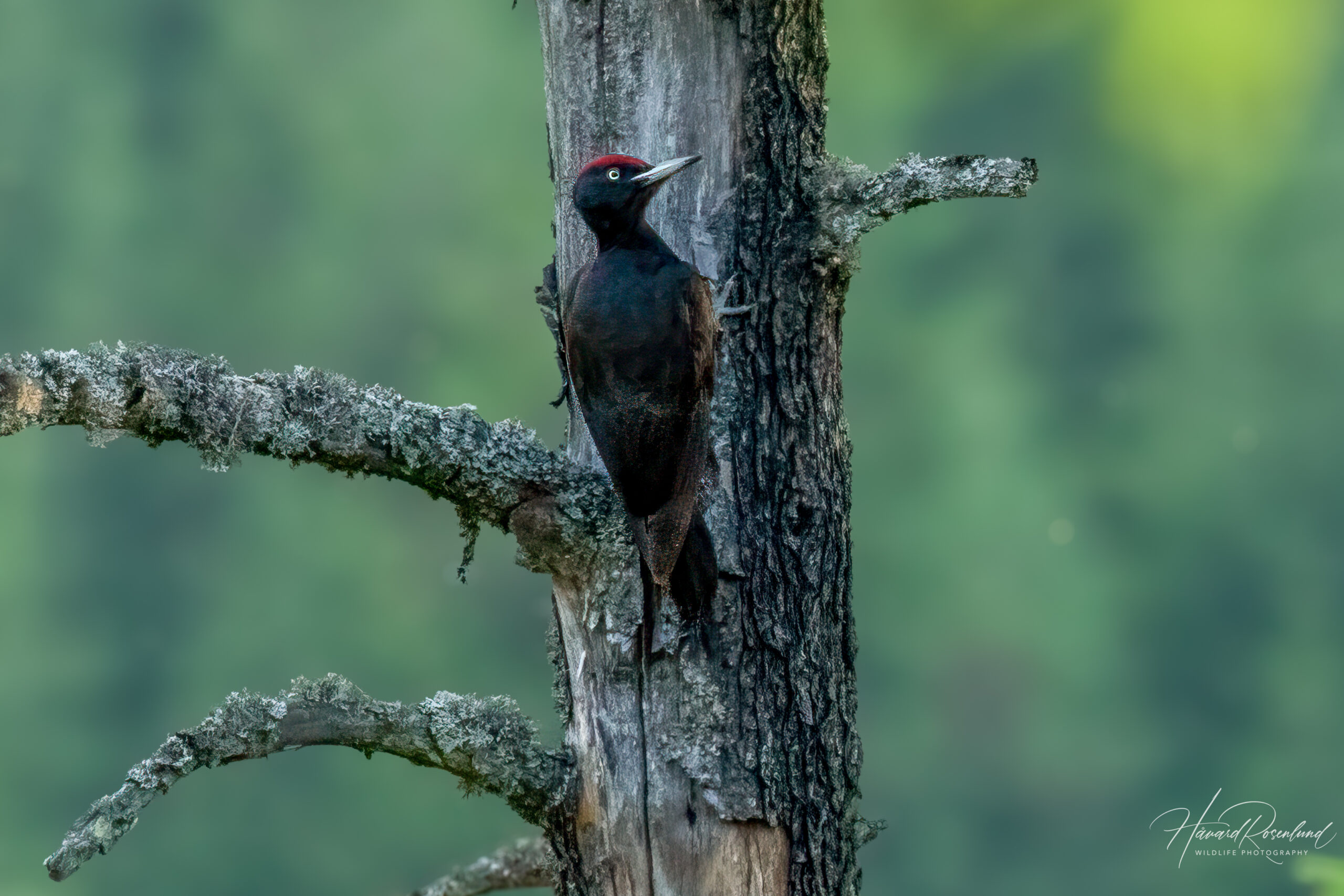
Black Woodpecker
Dryocopus martius
At a glance
Habitat
- Mature coniferous, deciduous and mixed forest with large trees, dead wood and open feeding patches
Diet
- Primarily ants and their larvae; also other wood-dwelling insects
Activity
- Diurnal
Size
- Length: 45–55 cm Weight: 250–370 g
Range
- A broad Eurasian range from western Europe across the boreal and temperate forests of Asia
Description
The black woodpecker (Dryocopus martius) is the largest woodpecker in Europe and one of the most imposing forest birds of northern Eurasia. Adults are about 45–55 cm long and usually weigh around 250–370 g. The plumage is almost entirely black, with a pale ivory-grey bill and a striking red crown. Males have red extending over most of the crown, while females show a smaller red patch confined to the rear of the crown.
Its size and all-black body make identification straightforward, even at a distance. In flight it differs from many smaller woodpeckers by following a relatively direct course with deep wingbeats and much less pronounced bounding. Its loud calls carry far through the forest and are often the first sign that a black woodpecker is present.
Habitat
Black woodpeckers use coniferous, deciduous and mixed forests across a broad part of Eurasia. Good territories usually combine large mature trees with dead or decaying wood and more open patches where feeding is efficient. The species is not restricted to untouched old-growth forest and can persist in managed landscapes when sufficiently large trees, cavity trees and a varied supply of dead wood are retained.
Large, relatively clear trunks provide suitable places for excavating cavities, while decaying stumps, fallen logs and standing dead trees provide good feeding sites. Recent European studies also show that cavity trees often stand in patches with a different structure from the surrounding forest, so both the trees themselves and the forest around them can be important.
Diet
Ants dominate the diet, including both adults and larvae, and other wood-dwelling insects are taken as well. Tree sap may also be used occasionally, but animal prey is far more important.
Foraging
Black woodpeckers chisel deeply into stumps, fallen trunks, standing dead wood and sometimes living trees to reach ant colonies and other insects hidden inside. Feeding can leave conspicuous elongated excavations and heavily opened sections of decaying wood.
Feeding sites change through the year as insect availability shifts, and birds search both high on trunks and around stumps and fallen wood near the ground. A forest with living, dying and dead wood in different stages therefore provides a broader and more reliable food supply than a uniform stand with few large dead trunks and logs.
Behaviour
Adults are largely resident and territorial throughout the year. Pairs occupy extensive forest territories, although the two birds spend much of their time apart outside the breeding season. Several powerful calls are used in territorial and pair communication, and the species drums loudly on resonant trunks or branches, particularly as breeding approaches.
Young birds disperse after becoming independent, whereas established adults often remain within the same general area from year to year.
Breeding
Both sexes help excavate the large nest cavity, usually high in a substantial tree with a clear trunk and enough solid wood for a deep chamber. Tree choice varies geographically: beech is important in many central and western European forests, while large pines and aspens are frequently used farther north. Studies in managed forests show that black woodpeckers usually select nest trees that are much larger in diameter than surrounding trees.
A typical clutch contains 3–5 eggs. Both parents incubate for about 12 days and feed the chicks, which normally remain in the cavity for around 26–28 days. Ants make up much of the food delivered to the young. Pairs may reuse an old cavity or excavate a new one. A recent study across several French forests found fewer small trees around cavity trees than in the surrounding forest, suggesting that suitable nesting conditions involve more than the trunk alone.
After the woodpeckers move on, old cavities provide nesting or shelter sites for many birds and mammals that cannot excavate such large chambers themselves. The species is therefore widely regarded as an ecosystem engineer, and retaining its cavity trees can benefit a much wider forest community.
Status
The black woodpecker has a very large Eurasian range and is classified as least concern on the IUCN Red List. It remains widespread across much of continental Europe and northern Asia.
Local habitat quality can decline when forestry removes large potential cavity trees, dead wood and good places to find insects too thoroughly. Because black woodpeckers create cavities later used by many other animals, retaining large living trees, cavity trees and dead or dying wood can support both the species itself and wider forest biodiversity.
Image gallery
Loading map and observations…
Have you seen this species?
Independent species archive
Did you find this species page useful?
Wildlife Vagabond is independently built and maintained. Voluntary support helps cover hosting, maps, data storage and continued improvements to the species archive.
Support Wildlife VagabondSpecies content will remain freely available.
References
Information about the species’ global distribution and status is based primarily on global Red List data. See the references below for details.
- BirdLife International. (n.d.). Black Woodpecker species factsheet. https://datazone.birdlife.org/species/factsheet/black-woodpecker-dryocopus-martius
- Breton, V., Guignot, M.-E., Vincenot, L., Husté, A., Leclerc, L., Fuhr, M., & Paillet, Y. (2025). How do forest structure and composition near trees with black woodpecker (Dryocopus martius L.) cavities differ from the surrounding forest? A multisite approach in French forests. Annals of Forest Science, 82(1), 39. https://doi.org/10.1186/s13595-025-01313-7
- International Union for Conservation of Nature. (n.d.). Black Woodpecker. The IUCN Red List of Threatened Species. https://www.iucnredlist.org/species/22681382/87301348
- Johnsson, K., Nilsson, S. G., & Tjernberg, M. (1993). Characteristics and utilization of old Black Woodpecker Dryocopus martius holes by hole‐nesting species. Ibis, 135(4), 410-416. https://doi.org/10.1111/j.1474-919X.1993.tb02113.x
- Puverel, C., Abourachid, A., Böhmer, C., Leban, J.-M., Svoboda, M., & Paillet, Y. (2019). This is my spot: What are the characteristics of the trees excavated by the Black Woodpecker? A case study in two managed French forests. Forest Ecology and Management, 453, 117621. https://doi.org/10.1016/j.foreco.2019.117621
- Zawadzki, G. (2023). Nesting-tree preferences of the black woodpecker—the biggest cavity excavator in a conifer-dominated forests in Poland. Canadian Journal of Forest Research, 54(3), 305-314. https://doi.org/10.1139/cjfr-2023-0143