
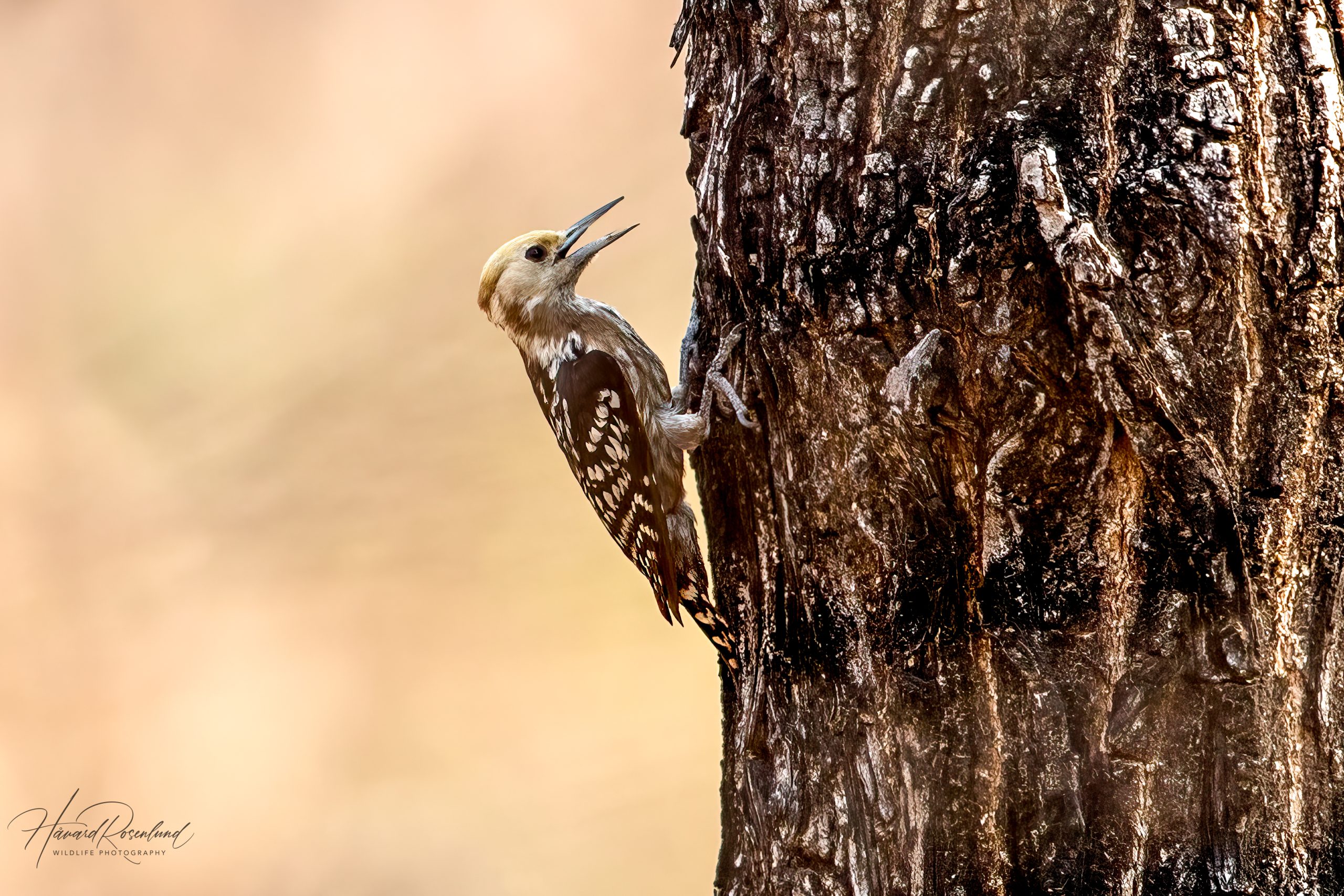
Yellow-crowned Woodpecker
Leiopicus mahrattensis
At a glance
Habitat
- Dry deciduous forest, open woodland, thorn scrub, groves and wooded farmland
Diet
- Mainly insects and larvae; some fruit and other plant material
Activity
- Diurnal and resident
Size
- Length: 17–18 cm Weight: 28–46 g
Range
- Eastern Pakistan and the Indian subcontinent east to Myanmar and parts of mainland Southeast Asia
Description
The yellow-crowned woodpecker (Leiopicus mahrattensis) is a small black-and-white woodpecker measuring about 17–18 cm and weighing roughly 28–46 g. It occurs from eastern Pakistan across much of the Indian subcontinent and east into Myanmar and parts of mainland Southeast Asia.
The upperparts are black with bold white spotting and barring, while the pale underparts are streaked and marked by a small red-orange patch in the centre of the belly. The sexes differ most clearly on the crown: females have a golden-yellow crown, while males show a red area in addition to yellow. The short, strong bill and stiff tail feathers are well suited to climbing and feeding on trunks and branches.
Habitat
Yellow-crowned woodpeckers use dry deciduous forest, open woodland, thorn scrub, riverine woodland, groves, plantations and lightly wooded farmland. They are less dependent on closed forest than many woodpeckers and can persist in fairly open landscapes as long as enough trees remain.
Mature trees are important for feeding, shelter and nesting, while dead and decaying wood provides additional places to search for insects and excavate nest cavities. Intensive removal of old trees and dead wood can therefore reduce habitat quality even where some tree cover remains.
Diet
The diet consists mainly of insects and their larvae, including ants and beetles. Birds search bark, branches and foliage, peck into wood and probe crevices for hidden prey, while exposed insects may simply be picked from the surface.
Fruit and other plant material are also eaten occasionally. The species often moves steadily from branch to branch and around trunks, combining light pecking, probing and picking prey from surfaces rather than relying only on deep excavation.
Behaviour
Yellow-crowned woodpeckers are active by day and usually seen alone or in pairs, although they sometimes join mixed-species feeding flocks. They are resident across most of the range and move through trees in the typical woodpecker manner, gripping bark with the feet while the stiff tail is pressed against the trunk as a brace.
Sharp repeated calls help maintain contact between birds. Short bursts of drumming also carry over long distances and are used in territorial communication. When disturbed, birds usually move higher or around the far side of a trunk before flying to another tree.
Breeding
Breeding has been recorded mainly from late winter through the first part of the monsoon period, broadly from February into July, although timing varies across the wide range. Calling and drumming can also accompany courtship, and a pair excavates a nest cavity in a dead or living trunk or branch.
Clutches usually contain three white eggs, and incubation lasts around 13 days. Both parents take part in nesting duties and feeding the young. Reliable species-specific information on the time to fledging remains limited.
Status
The yellow-crowned woodpecker is classified as least concern on the IUCN Red List. It has a broad global range, but the picture in India is considerably less reassuring.
State of India's Birds classifies the species as High Priority nationally. Its 2025 update estimates a long-term decline of about 71% and a continuing decline of about 2.6% per year. The cause of this sharp decline remains unclear. Mature trees, dead wood and structurally varied woodland nevertheless provide the feeding and nesting resources on which the species depends.
Image gallery
Loading map and observations…
Have you seen this species?
Independent species archive
Did you find this species page useful?
Wildlife Vagabond is independently built and maintained. Voluntary support helps cover hosting, maps, data storage and continued improvements to the species archive.
Support Wildlife VagabondSpecies content will remain freely available.
References
Information about the species’ global distribution and status is based primarily on global Red List data. See the references below for details.
- Avibase. (n.d.). Yellow-crowned Woodpecker. https://avibase.bsc-eoc.org/species.jsp?avibaseid=CBBA6CB0C3F71B1D
- BirdLife International. (n.d.). Yellow-crowned Woodpecker (Leiopicus mahrattensis) species factsheet. https://datazone.birdlife.org/species/factsheet/yellow-crowned-woodpecker-leiopicus-mahrattensis
- Cornell Lab of Ornithology. (n.d.). Birds of the World – Yellow-crowned Woodpecker. https://birdsoftheworld.org/bow/species/yecwoo1/cur/introduction
- eBird. (n.d.). Yellow-crowned Woodpecker. Cornell Lab of Ornithology. https://ebird.org/species/yecwoo1
- International Union for Conservation of Nature. (n.d.). Leiopicus mahrattensis. The IUCN Red List of Threatened Species. https://www.iucnredlist.org/species/22681092/92892393
- Macaulay Library, Cornell Lab of Ornithology. (n.d.). Macaulay Library – Yellow-crowned Woodpecker media archive. https://search.macaulaylibrary.org/catalog?taxonCode=yecwoo1
- Myhrvold, N. P., Baldridge, E., Chan, B., Sivam, D., Freeman, D. L., & Ernest, S. K. M. (2015). An amniote life‐history database to perform comparative analyses with birds, mammals, and reptiles. Ecology, 96(11), 3109-3109. https://doi.org/10.1890/15-0846R.1
- State of India's Birds. (n.d.). Yellow-crowned Woodpecker. https://stateofindiasbirds.in/species/yecwoo1/