
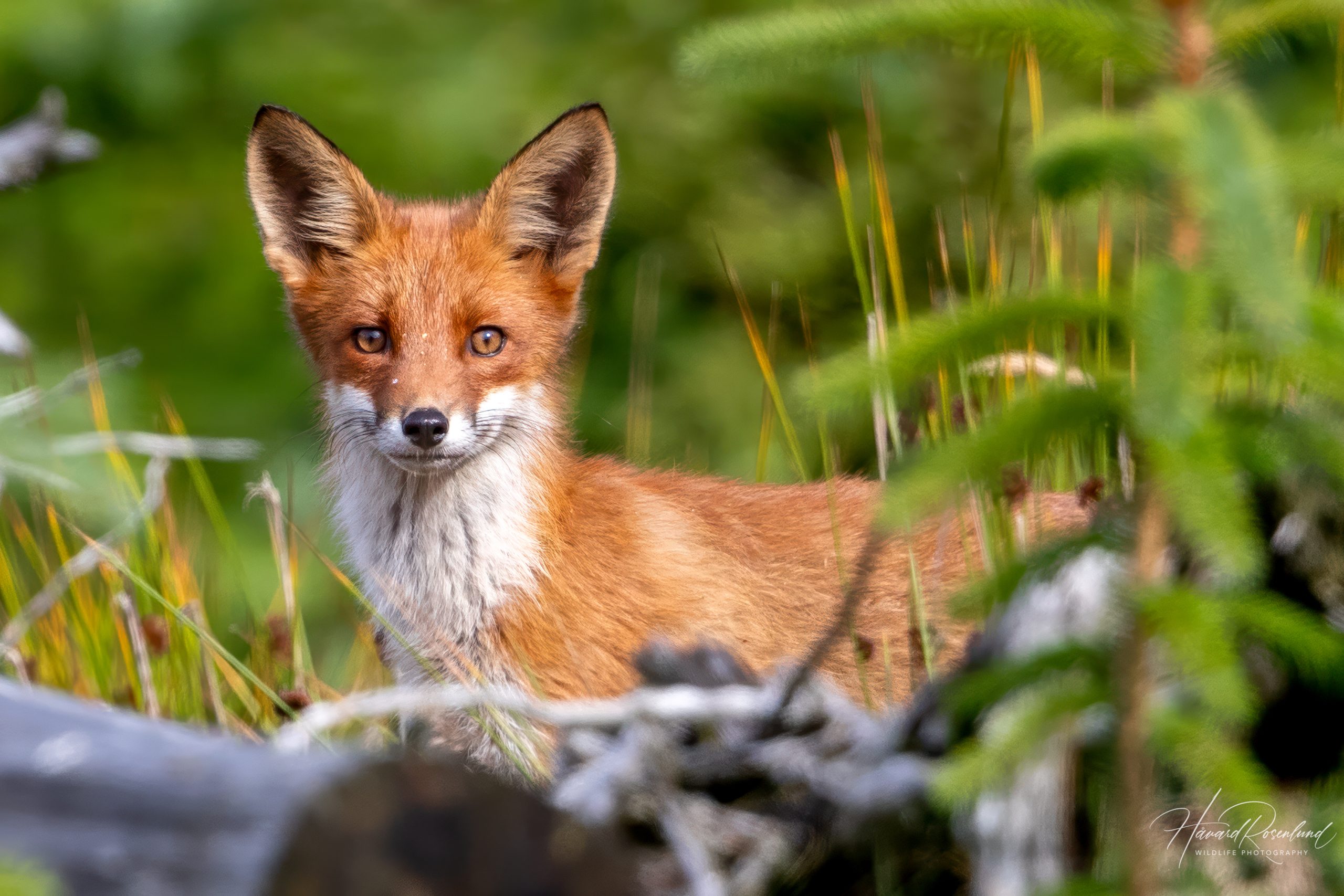
Red Fox
Vulpes vulpes
At a glance
Habitat
- Tundra, forest, scrub, grassland, farmland, mountains and cities
Diet
- Opportunistic omnivore; mainly small mammals, birds, invertebrates and fruit
Activity
- Often crepuscular and nocturnal near people
Size
- Length: 45–90 cm body; 30–55 cm tail Weight: 3–14 kg
Range
- Most of the Northern Hemisphere, including North Africa; introduced to Australia
Description
The red fox (Vulpes vulpes) is one of the most widespread and adaptable carnivores in the world. It occurs across most of the Northern Hemisphere, from Arctic tundra and boreal forest to temperate farmland, dry landscapes and city centres, and its range extends south into North Africa. Adults typically measure 45–90 cm from nose to rump, with a 30–55 cm tail, and weigh around 3–14 kg.
Size and colour vary considerably across the range. The familiar coat is reddish brown with pale underparts, black lower legs and dark-backed ears, but silver, black and cross-coloured forms also occur. The long, bushy tail often ends in a white tip.
Habitat
Few carnivores use such a wide range of habitats. Red foxes live in tundra, forest, scrub, grassland, mountains, coastal dunes, farmland and deserts, although they generally avoid the most extreme arid regions. Mixed landscapes with woodland edges and open feeding areas are especially suitable.
The species also adapts readily to towns and cities. Gardens, parks, railway corridors and other green spaces can provide cover, while food may come from natural prey, fruit, refuse and feeding by people. A 2022 camera-trap study in south-west London found that foxes could shift their activity towards times of day with less human disturbance, illustrating the behavioural flexibility that helps them thrive in urban environments.
Diet
Red foxes are opportunistic omnivores. Small mammals such as voles, mice, rabbits and hares are often important, but the diet may also include birds, eggs, amphibians, reptiles, insects, earthworms, carrion, fruit and other plant material. What they eat changes with season and local availability.
In northern ecosystems the ability to switch prey can affect other species as well. During years with many voles, foxes feed heavily on them. When vole numbers crash, foxes may turn more strongly to alternative prey such as hares and grouse. Long-term Scandinavian studies have shown that these shifts can carry the effects of small-rodent cycles through the wider food web.
Hunting
Red foxes usually hunt alone and combine slow searching with sudden attacks. Their acute hearing helps them detect small mammals moving beneath vegetation or snow; a fox often pauses to listen before launching the characteristic high, arcing pounce used to pin hidden prey.
The species can switch readily among hunting opportunities rather than relying on one fixed technique. Small prey may be stalked or rushed at close range, while surplus food is often cached and recovered later, allowing a fox to exploit temporary periods of abundance.
Behaviour
Red foxes can be active at any time of day. Where human disturbance is high they are usually most active at night and around dawn and dusk, while foxes in quiet areas are often seen in daylight. Individuals regularly move through familiar parts of their home range while foraging, resting and visiting scent-marking sites.
Territories and frequently used routes are marked with scent, especially urine, while calls, posture and facial expressions provide additional communication. These signals allow neighbouring and group-living foxes to exchange information without needing frequent direct encounters.
Social behaviour
Red fox social organisation is highly flexible. Many territories are occupied by a breeding pair, but where food is abundant and population density is high they may contain family groups with a dominant breeding male and female plus subordinate adults, often relatives that have remained on or joined the territory. The animals still forage mainly alone, so a social group does not usually move or hunt as a pack.
Subordinate females may help feed, guard, groom and play with the dominant female's cubs. A 2019 camera-trap study in Bristol also found consistent differences in social status: dominant animals occupied central positions in local social networks, while females appeared especially important in maintaining group cohesion through the year. This combination of solitary foraging and flexible group living is one of the more distinctive features of red fox social biology.
Home ranges
Red fox home ranges vary enormously in size. A 2017 GPS study of 52 foxes in Norway and Sweden found ranges from 0.95 to 44 km². Foxes in the northern boreal zone, where food was generally less abundant, used home ranges about four times larger than animals in the south. This shows how strongly food availability can influence the area an individual needs.
The study also found that elevation and the proportion of farmland were linked to home-range size. Ranges were smaller at lower elevations and where farmland made up a greater share of the landscape, conditions that can concentrate food resources within a smaller area. This flexibility in space use is one reason red foxes succeed across such contrasting environments.
Interspecific competition
At the northern edge of its range, the red fox is the dominant competitor of the smaller Arctic fox (Vulpes lagopus). The two overlap strongly in diet and den requirements. A 1989 field study in Norway and Sweden described seven aggressive encounters and documented red foxes killing both an adult Arctic fox and a cub, as well as chasing other Arctic foxes from dens. This is one reason red foxes are locally culled to protect Arctic fox populations.
The strength of the competition depends on context. A 2022 satellite-telemetry study on Bylot Island and Herschel Island in the High Canadian Arctic found extensive overlap between the species and relatively little direct conflict at very low red-fox densities. Competition has the greatest impact where red foxes are sufficiently numerous to dominate access to food, dens and the most resource-rich parts of the tundra.
Reproduction
Breeding time varies with latitude: usually December–January in the south, January–February in central parts of the range and February–April in the north. After a gestation of about 49–58 days, the female gives birth in a den, commonly to four to six cubs. Foxes may dig their own den or enlarge a burrow made by another animal. The male supplies food during the first weeks, and both parents care for the young.
The cubs begin emerging from the den at around one month old and are gradually weaned; by 8–10 weeks they are usually fully weaned. By autumn most are independent and many disperse in search of a territory of their own. Wild red foxes often live only a few years, but longevity can be far greater in captivity. One verified captive record reached 21.3 years.
Cultural significance
Foxes have been powerful symbols in human storytelling for centuries, often representing intelligence, deception and adaptability. In medieval European literature this role is epitomised by Reynard the Fox, the cunning central figure in a cycle of animal fables that spread widely across Europe.
Fox symbolism developed differently in East Asia. In Japanese Shinto tradition, foxes are closely associated with Inari and are represented as the deity's messengers, especially at Inari shrines. These traditions helped make the fox one of the most culturally recognisable wild mammals across very different societies.
Relationship with humans
The red fox's ability to live close to people produces a mixture of fascination and conflict. Foxes have long been hunted for fur, sport and predator control, and they may take poultry or game birds where these are poorly protected. In cities, access to refuse and deliberate feeding can bring foxes into very close contact with people.
The species was introduced to Australia in the nineteenth century. There it became a major invasive predator and continues to affect native wildlife, particularly small and medium-sized mammals, ground-nesting birds and reptiles. Management in Australia therefore focuses on reducing fox impacts rather than conserving the introduced population.
Status
The red fox is listed as least concern on the IUCN Red List. Its enormous range, large population and ability to use human-modified landscapes mean that it is not threatened globally.
Local abundance can nevertheless change sharply. A study published in 2000 described how a major sarcoptic mange outbreak in Fennoscandia reduced red fox abundance by more than 70% in affected populations. The decline also altered relationships with prey and competing predators, showing how strongly disease can affect even a common and adaptable predator.
Image gallery
Loading map and observations…
Have you seen this species?
Independent species archive
Did you find this species page useful?
Wildlife Vagabond is independently built and maintained. Voluntary support helps cover hosting, maps, data storage and continued improvements to the species archive.
Support Wildlife VagabondSpecies content will remain freely available.
References
Information about the species’ global distribution and status is based primarily on global Red List data. See the references below for details.
- AnAge: The Animal Ageing and Longevity Database. (n.d.). AnAge – Red fox (Vulpes vulpes) longevity, ageing, and life history. https://genomics.senescence.info/species/entry.php?species=Vulpes_vulpes
- Angelstam, P., Lindström, E., & Widén, P. (1984). Role of predation in short-term population fluctuations of some birds and mammals in Fennoscandia. Oecologia, 62(2), 199–208. https://doi.org/10.1007/BF00379014
- Animal Diversity Web. (n.d.). Vulpes vulpes. https://animaldiversity.org/accounts/Vulpes_vulpes/
- British Museum. (n.d.). Fox as messenger of Inari. https://www.britishmuseum.org/collection/object/A_1893-1101-22
- British Museum. (n.d.). Reynard the Fox. https://www.britishmuseum.org/collection/term/BIOG164326
- Dorning, J., & Harris, S. (2019). Individual and seasonal variation in contact rate, connectivity and centrality in red fox (Vulpes vulpes) social groups. Scientific Reports, 9(1), 20095. https://doi.org/10.1038/s41598-019-56713-3
- Forchhammer, M. C., & Asferg, T. (2000). Invading parasites cause a structural shift in red fox dynamics. Proceedings of the Royal Society of London. Series B: Biological Sciences, 267(1445), 779-786. https://doi.org/10.1098/rspb.2000.1071
- Frafjord, K., Becker, D., & Angerbjörn, A. (1989). Interactions between Arctic and Red Foxes in Scandinavia - Predation and Aggression. ARCTIC, 42(4). https://doi.org/10.14430/arctic1677
- International Union for Conservation of Nature. (n.d.). Vulpes vulpes. The IUCN Red List of Threatened Species. https://www.iucnredlist.org/species/23062/9414323
- IUCN SSC Canid Specialist Group. (n.d.). Red Fox species account. https://www.canids.org/species/view/preklp237241
- Lai, S., Warret Rodrigues, C., Gallant, D., Roth, J. D., & Berteaux, D. (2022). Red foxes at their northern edge: competition with the Arctic fox and winter movements. Journal of Mammalogy, 103(3), 586-597. https://doi.org/10.1093/jmammal/gyab164
- Lovell, C., Li, S., Turner, J., & Carbone, C. (2022). The effect of habitat and human disturbance on the spatiotemporal activity of two urban carnivores: The results of an intensive camera trap study. Ecology and Evolution, 12(3), e8746. https://doi.org/10.1002/ece3.8746
- Macdonald, D. W. (1979). ‘Helpers’in fox society. Nature, 282(5734), 69-71. https://doi.org/10.1038/282069a0
- Malkemper, E. P., Topinka, V., & Burda, H. (2015). A behavioral audiogram of the red fox (<i>Vulpes vulpes</i>). Hearing Research, 320, 30–37. https://doi.org/10.1016/j.heares.2014.12.001
- Mammal Diversity Database. (n.d.). Vulpes vulpes. American Society of Mammalogists. https://www.mammaldiversity.org/taxon/1005977/
- Walton, Z., Samelius, G., Odden, M., & Willebrand, T. (2017). Variation in home range size of red foxes Vulpes vulpes along a gradient of productivity and human landscape alteration. PLOS ONE, 12(4), e0175291. https://doi.org/10.1371/journal.pone.0175291