
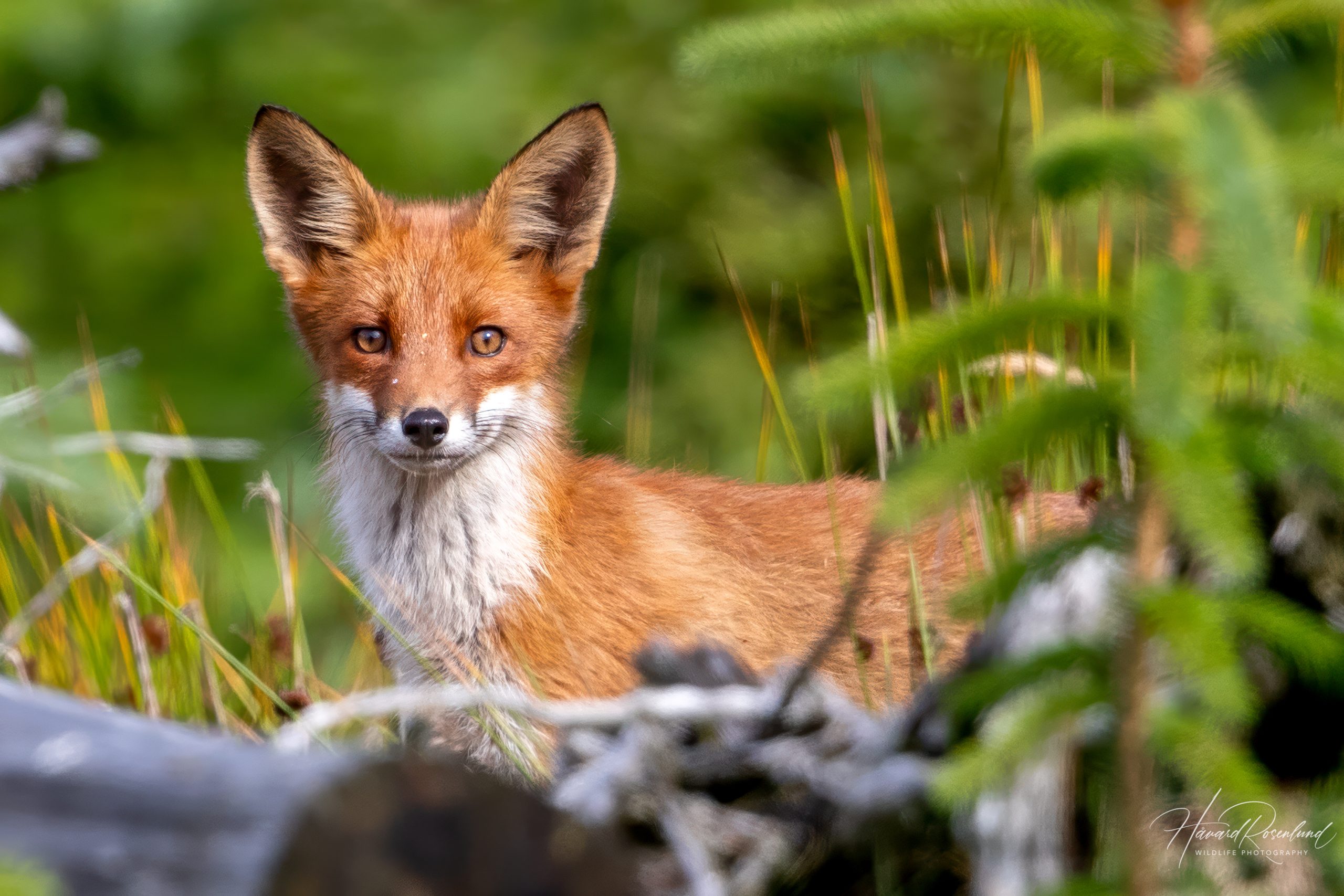
Rødrev
Vulpes vulpes
Kort fortalt
Habitat
- Tundra, skog, kratt, gressland, jordbrukslandskap, fjell og byer
Føde
- Opportunistisk alteter; særlig små pattedyr, fugler, virvelløse dyr og frukt
Aktivitet
- Ofte skumrings- og nattaktiv nær mennesker
Størrelse
- Lengde: 45–90 cm kropp; 30–55 cm hale Vekt: 3–14 kg
Utbredelse
- Det meste av den nordlige halvkule, inkludert Nord-Afrika; innført til Australia
Bildegalleri
Laster kart og observasjoner…
Har du sett denne arten?
Uavhengig artsarkiv
Har denne artssiden vært nyttig?
Wildlife Vagabond er utviklet og vedlikeholdt uavhengig. Frivillig støtte bidrar til drift, kart, datalagring og videre oppdatering av artsarkivet.
Støtt Wildlife VagabondArtsinnholdet forblir fritt tilgjengelig.
Kilder
Informasjon om artens globale utbredelse og status bygger hovedsakelig på globale rødlistedata. Se kildene nedenfor for detaljer.
- AnAge: The Animal Ageing and Longevity Database. (n.d.). AnAge – Red fox (Vulpes vulpes) longevity, ageing, and life history. https://genomics.senescence.info/species/entry.php?species=Vulpes_vulpes
- Angelstam, P., Lindström, E., & Widén, P. (1984). Role of predation in short-term population fluctuations of some birds and mammals in Fennoscandia. Oecologia, 62(2), 199–208. https://doi.org/10.1007/BF00379014
- Animal Diversity Web. (n.d.). Vulpes vulpes. https://animaldiversity.org/accounts/Vulpes_vulpes/
- British Museum. (n.d.). Fox as messenger of Inari. https://www.britishmuseum.org/collection/object/A_1893-1101-22
- British Museum. (n.d.). Reynard the Fox. https://www.britishmuseum.org/collection/term/BIOG164326
- Dorning, J., & Harris, S. (2019). Individual and seasonal variation in contact rate, connectivity and centrality in red fox (Vulpes vulpes) social groups. Scientific Reports, 9(1), 20095. https://doi.org/10.1038/s41598-019-56713-3
- Forchhammer, M. C., & Asferg, T. (2000). Invading parasites cause a structural shift in red fox dynamics. Proceedings of the Royal Society of London. Series B: Biological Sciences, 267(1445), 779-786. https://doi.org/10.1098/rspb.2000.1071
- Frafjord, K., Becker, D., & Angerbjörn, A. (1989). Interactions between Arctic and Red Foxes in Scandinavia - Predation and Aggression. ARCTIC, 42(4). https://doi.org/10.14430/arctic1677
- International Union for Conservation of Nature. (n.d.). Vulpes vulpes. The IUCN Red List of Threatened Species. https://www.iucnredlist.org/species/23062/9414323
- IUCN SSC Canid Specialist Group. (n.d.). Red Fox species account. https://www.canids.org/species/view/preklp237241
- Lai, S., Warret Rodrigues, C., Gallant, D., Roth, J. D., & Berteaux, D. (2022). Red foxes at their northern edge: competition with the Arctic fox and winter movements. Journal of Mammalogy, 103(3), 586-597. https://doi.org/10.1093/jmammal/gyab164
- Lovell, C., Li, S., Turner, J., & Carbone, C. (2022). The effect of habitat and human disturbance on the spatiotemporal activity of two urban carnivores: The results of an intensive camera trap study. Ecology and Evolution, 12(3), e8746. https://doi.org/10.1002/ece3.8746
- Macdonald, D. W. (1979). ‘Helpers’in fox society. Nature, 282(5734), 69-71. https://doi.org/10.1038/282069a0
- Malkemper, E. P., Topinka, V., & Burda, H. (2015). A behavioral audiogram of the red fox (<i>Vulpes vulpes</i>). Hearing Research, 320, 30–37. https://doi.org/10.1016/j.heares.2014.12.001
- Mammal Diversity Database. (n.d.). Vulpes vulpes. American Society of Mammalogists. https://www.mammaldiversity.org/taxon/1005977/
- Walton, Z., Samelius, G., Odden, M., & Willebrand, T. (2017). Variation in home range size of red foxes Vulpes vulpes along a gradient of productivity and human landscape alteration. PLOS ONE, 12(4), e0175291. https://doi.org/10.1371/journal.pone.0175291
Om innholdet: Artssiden er opprinnelig skrevet av Wildlife Vagabond og oppdateres og forbedres med KI-assistanse. Den gjennomgås redaksjonelt.Slik brukes KI