
Harbour Seal
Phoca vitulina
At a glance
Habitat
- Temperate to Arctic coasts, estuaries, bays, tidal flats, rocky shores and glacial ice
Diet
- Mostly fish; also squid, crustaceans and other marine invertebrates
Activity
- Active both day and night; foraging follows prey and local tides
Size
- Length: 1.5–1.9 m Weight: 80–130 kg
Range
- Coasts of the North Atlantic and North Pacific, from temperate regions into the Arctic
Description
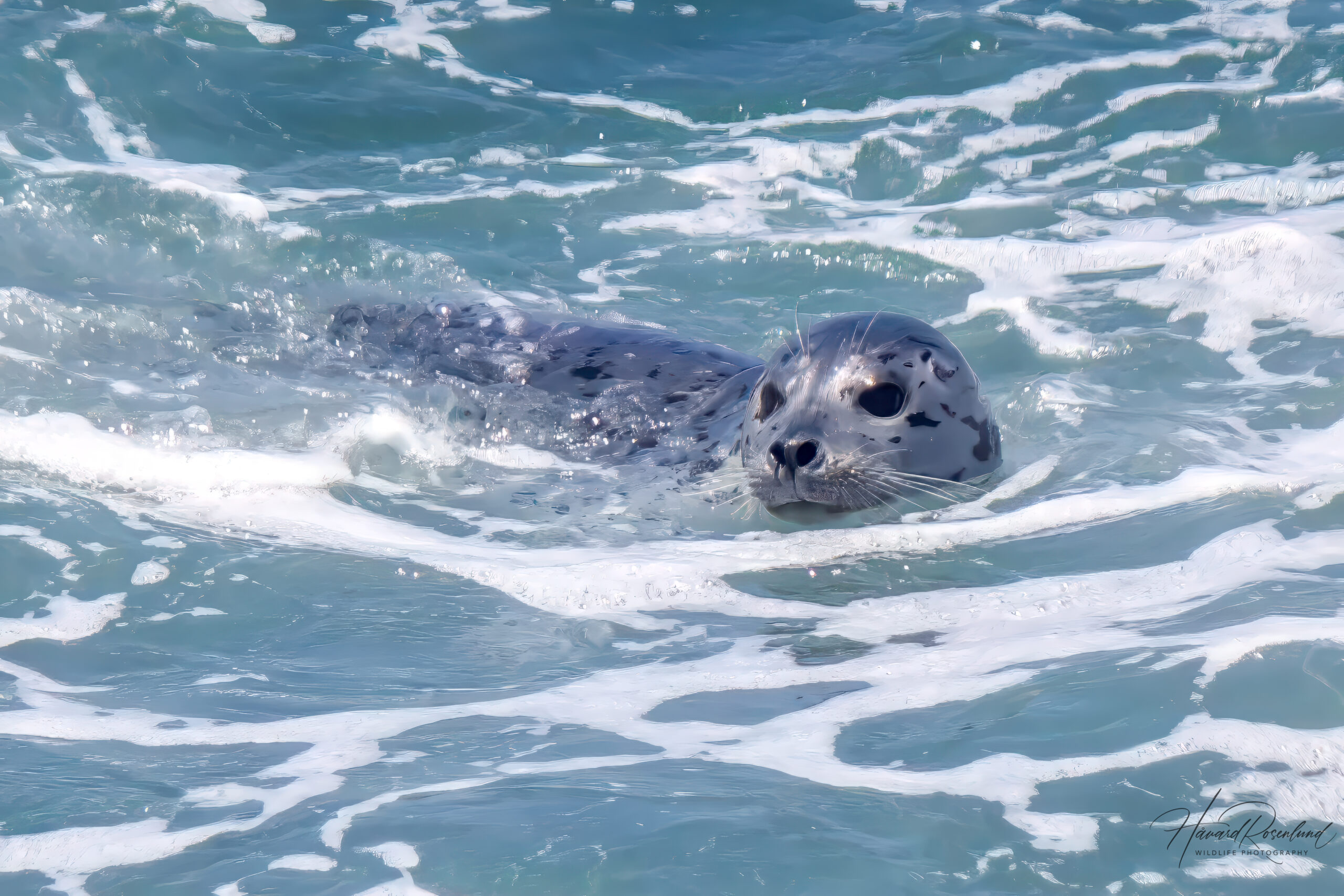
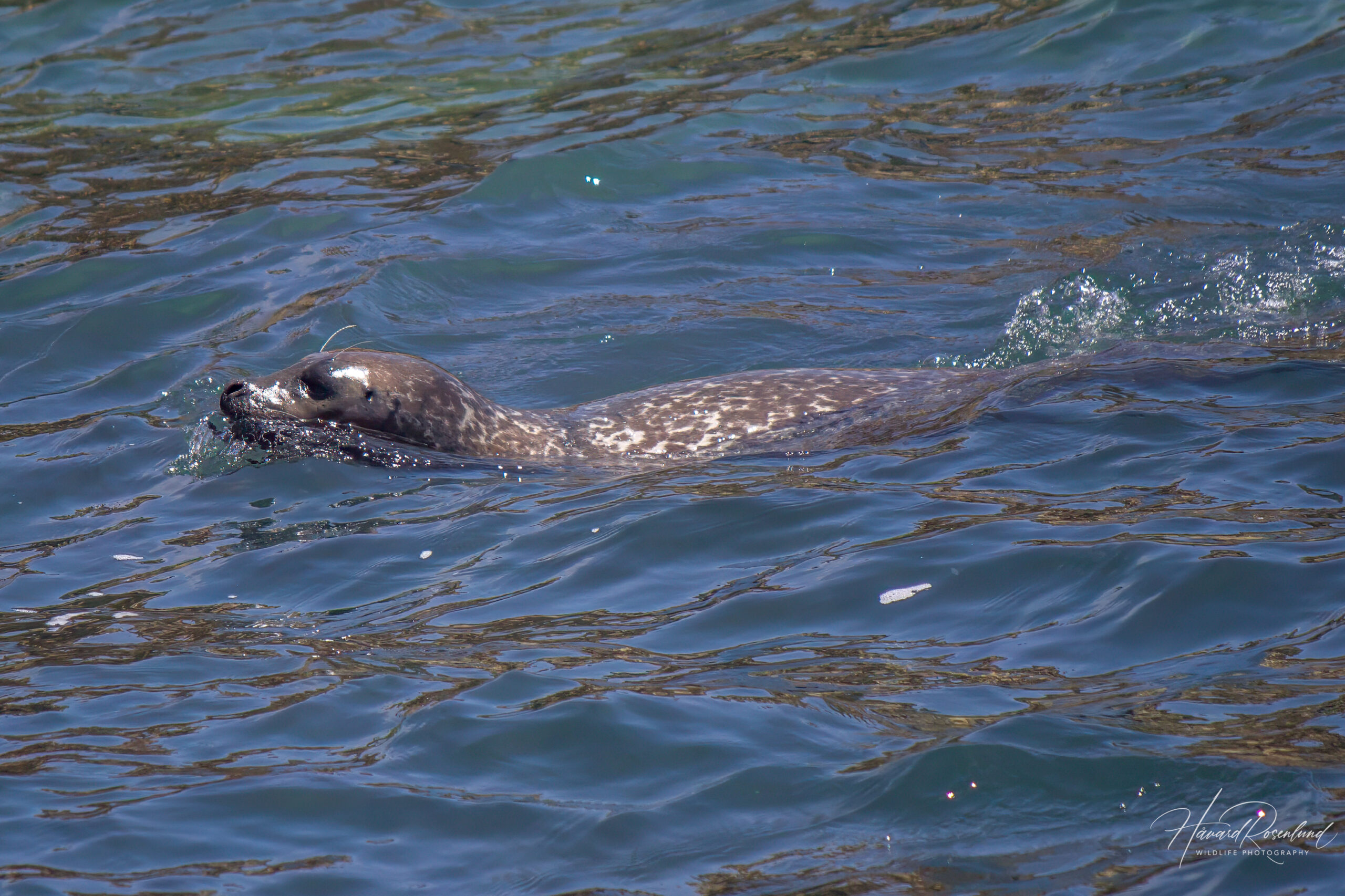
The harbour seal (Phoca vitulina), also known as the common seal, is a compact true seal distributed along temperate to Arctic coasts of the Northern Hemisphere. Adults are usually about 1.5–1.9 m long and commonly weigh around 80–130 kg, although size varies geographically and males are generally somewhat larger than females. The coat ranges from pale grey or yellowish-brown to dark brown or almost black and is covered in spots, rings and mottling that vary greatly among individuals.
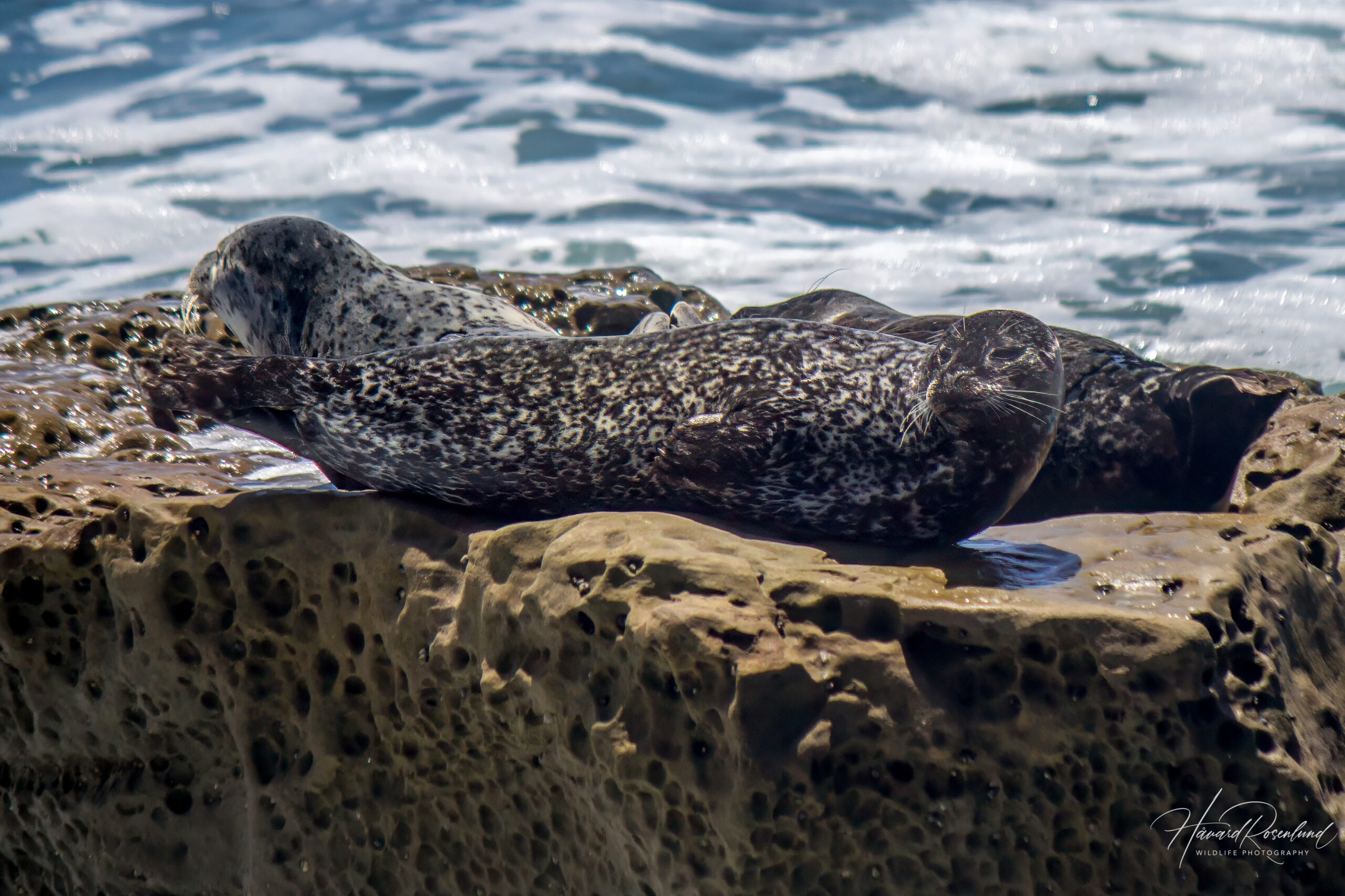
The rounded head, short muzzle and large eyes give the species a more compact profile than the longer-headed grey seal (Halichoerus grypus). Like other true seals, harbour seals cannot rotate the hind flippers beneath the body and therefore move on land by undulating the body rather than walking on all four limbs.
Taxonomy
Three subspecies are currently recognised. Phoca vitulina vitulina includes all Atlantic harbour seals, from the western North Atlantic through Europe and into the Baltic and Arctic Atlantic. P. v. richardii occurs in the North Pacific, including the California animals photographed on this page, while P. v. mellonae is a small freshwater form restricted to the Ungava region of northern Canada.
The western Atlantic form formerly known as P. v. concolor is no longer recognised as a separate subspecies. Genetic analyses found it to be paraphyletic and morphological differences were insufficient to support subspecies status, so all Atlantic populations are now included within P. v. vitulina.
Habitat
Harbour seals live along both sheltered and exposed coasts, including estuaries, bays, fjords and nearshore waters. They haul out on rocks, reefs, beaches, sandbanks, tidal flats and, in northern regions, glacier ice. Access to undisturbed haul-out sites is essential for resting, thermoregulation, moulting, giving birth and nursing pups.
The species is strongly coastal but not confined to one narrow habitat type. Individuals often return repeatedly to familiar haul-out areas while ranging through surrounding waters to feed. Glacier fjords, tidal estuaries and rocky archipelagos can all support important local populations.
Diet
The diet consists mainly of fish, supplemented by squid, octopus, crustaceans and other marine invertebrates. Prey composition varies greatly among regions and seasons because harbour seals exploit species that are locally abundant and of suitable size.
Hunting
Harbour seals normally hunt alone and use several complementary ways of finding and capturing prey. They can pursue fish actively in open water, search close to the seabed and around structures where prey concentrate, and use their highly specialised whiskers to detect minute water movements.
Experiments have shown that harbour seals can follow hydrodynamic trails left by moving animals even after the animal or object that created them has already passed, giving them access to prey information when visibility is poor at night, at depth or in turbid water. A feeding-mechanics study published in 2014 also showed that harbour seals can seize food with the teeth or draw it into the mouth by powerful suction, and can even jet water toward concealed prey to dislodge it before using suction.
Most foraging is much shallower, but harbour seals are capable of extreme dives. A telemetry study published in 2020 from South Greenland recorded four seals diving deeper than 575 m and a maximum depth of 631 m. Dives beyond 400 m made up less than 1% of all dives recorded.
Behaviour
Harbour seals gather socially on land, with haul-out groups ranging from a few animals to colonies of hundreds. Activity can occur by day or night and is strongly influenced by tides, prey availability, weather and disturbance.
The species shows strong site fidelity, especially around pupping and moulting areas, but individuals can still travel tens or hundreds of kilometres while following seasonal food or moving among haul-out sites. These movements are better described as ranging and dispersal than as regular migration.
Moulting adults spend particularly long periods hauled out because warm skin speeds replacement of the coat while avoiding the high heat loss that would occur in cold water.
Predation
Predation on harbour seals varies strongly between regions. Killer whales (Orcinus orca) are important predators in some coastal systems: long-term observations from Norway identified stable groups that repeatedly hunted both harbour seals and grey seals close to shore, taking both young and adults. Large sharks are also important predators in parts of the Pacific and North Atlantic.
The risk can influence where and when seals use the water and their haul-out sites. Harbour seals may spend more time on land when killer whales are active nearby, showing that predators can shape behaviour even when attacks themselves are relatively uncommon.
Reproduction
Females normally give birth to one pup each year, with timing varying geographically. Mating occurs in the water after the nursing period. Males advertise acoustically underwater during the breeding season and compete for access to females; the low-frequency calls function in male competition and courtship.
Embryonic development includes delayed implantation, so the embryo does not attach to the uterine wall immediately after conception. The total pregnancy lasts about 9–11 months. Pups are born unusually well developed for a true seal: they have already shed most of the white fetal coat and can swim very soon after birth.
Nursing is brief but intense. Across well-studied populations pups are commonly suckled for about four to six weeks on extremely energy-rich milk, although the exact duration varies geographically. The mother provides all direct care and alternates nursing with foraging trips before the pup becomes independent. Sexual maturity is usually reached between about three and seven years depending on sex and population. Harbour seals can live for more than three decades; East Atlantic animals have been aged to 36 years in females and 31 years in males.
Status
The harbour seal is classified as least concern on the IUCN Red List. It is one of the most widespread pinnipeds of the Northern Hemisphere and remains abundant across much of its range.
Regional populations can nevertheless fluctuate sharply. Disease outbreaks have caused mass mortality in parts of Europe, while bycatch, entanglement, pollution, disturbance at haul-out and pupping sites and changing coastal habitat remain important local pressures.
Image gallery
Loading map and observations…
Have you seen this species?
Independent species archive
Did you find this species page useful?
Wildlife Vagabond is independently built and maintained. Voluntary support helps cover hosting, maps, data storage and continued improvements to the species archive.
Support Wildlife VagabondSpecies content will remain freely available.
References
Information about the species’ global distribution and status is based primarily on global Red List data. See the references below for details.
- Dehnhardt, G., Mauck, B., Hanke, W., & Bleckmann, H. (2001). Hydrodynamic Trail-Following in Harbor Seals (Phoca vitulina). Science, 293(5527), 102-104. https://doi.org/10.1126/science.1060514
- Hanggi, E. B., & Schusterman, R. J. (1994). Underwater acoustic displays and individual variation in male harbour seals, Phoca vitulina. Animal Behaviour, 48(6), 1275–1283. https://doi.org/10.1006/anbe.1994.1363
- International Union for Conservation of Nature. (n.d.). Harbour Seal. The IUCN Red List of Threatened Species. https://www.iucnredlist.org/species/17013/45229114
- Jourdain, E., Vongraven, D., Bisther, A., & Karoliussen, R. (2017). First longitudinal study of seal-feeding killer whales (Orcinus orca) in Norwegian coastal waters. PLOS ONE, 12(6), e0180099. https://doi.org/10.1371/journal.pone.0180099
- Mammal Diversity Database. (n.d.). Phoca vitulina. American Society of Mammalogists. https://www.mammaldiversity.org/taxon/1005926/
- Marshall, C. D., Wieskotten, S., Hanke, W., Hanke, F. D., Marsh, A., Kot, B., & Dehnhardt, G. (2014). Feeding Kinematics, Suction, and Hydraulic Jetting Performance of Harbor Seals (Phoca vitulina). PLoS ONE, 9(1), e86710. https://doi.org/10.1371/journal.pone.0086710
- NOAA Fisheries. (n.d.). Harbor Seal. https://www.fisheries.noaa.gov/species/harbor-seal
- Society for Marine Mammalogy. (n.d.). List of marine mammal species and subspecies. https://marinemammalscience.org/science-and-publications/list-marine-mammal-species-subspecies/
- Wieskotten, S., Dehnhardt, G., Mauck, B., Miersch, L., & Hanke, W. (2010). The impact of glide phases on the trackability of hydrodynamic trails in harbour seals (Phoca vitulina). Journal of Experimental Biology, 213(21), 3734-3740. https://doi.org/10.1242/jeb.047134