
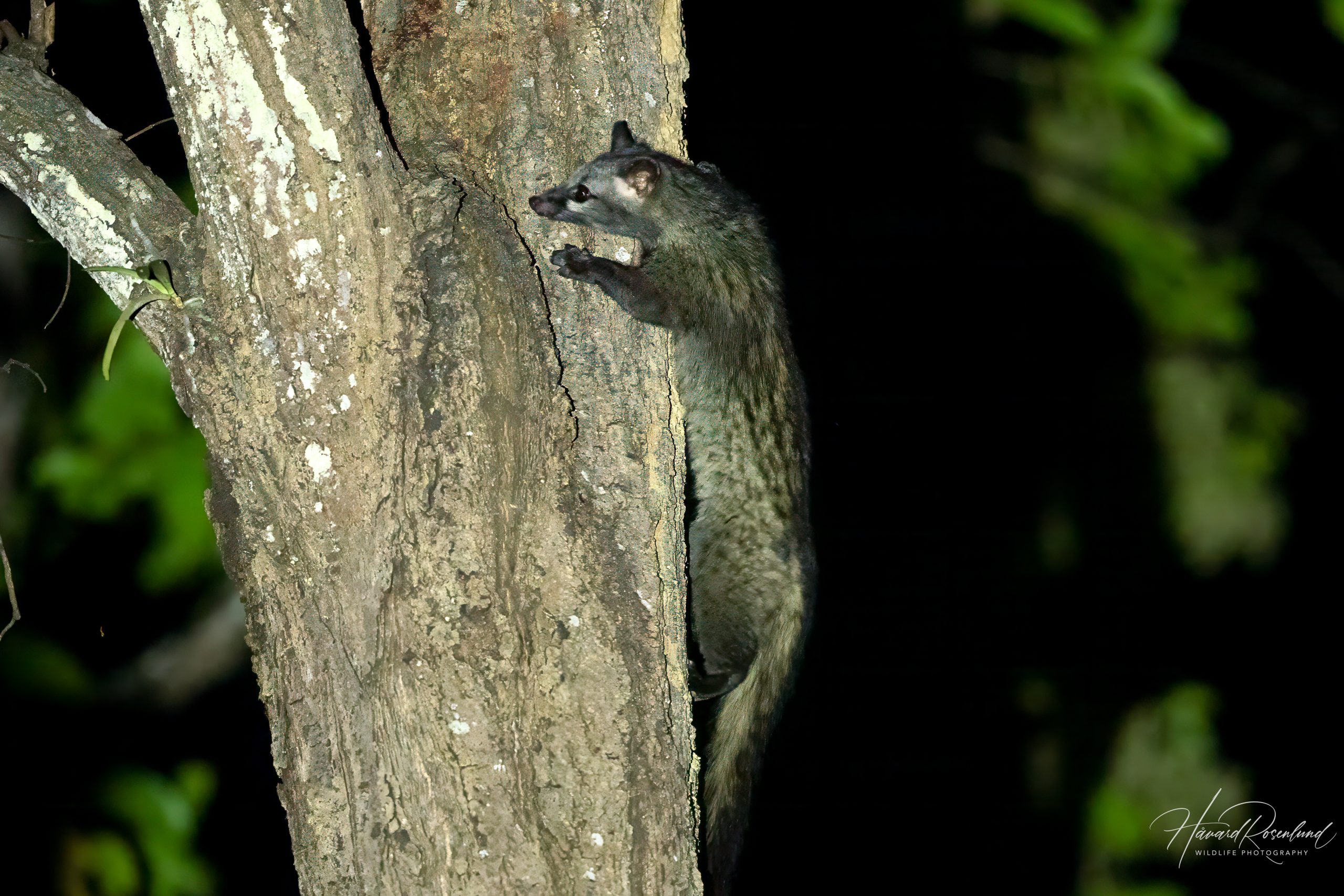
Northern Palm Civet
Paradoxurus hermaphroditus
At a glance
Habitat
- Forest, secondary woodland, plantations, orchards and wooded rural or urban landscapes with suitable daytime resting cover
Diet
- Strongly fruit-based omnivorous diet, supplemented by insects and small vertebrates
Activity
- Nocturnal
Size
- Length: 53–71 cm body length Weight: about 2–5 kg
Range
- Asian mainland from Pakistan and the Indian subcontinent east through southern China, Myanmar, Laos, Thailand and Vietnam
Description
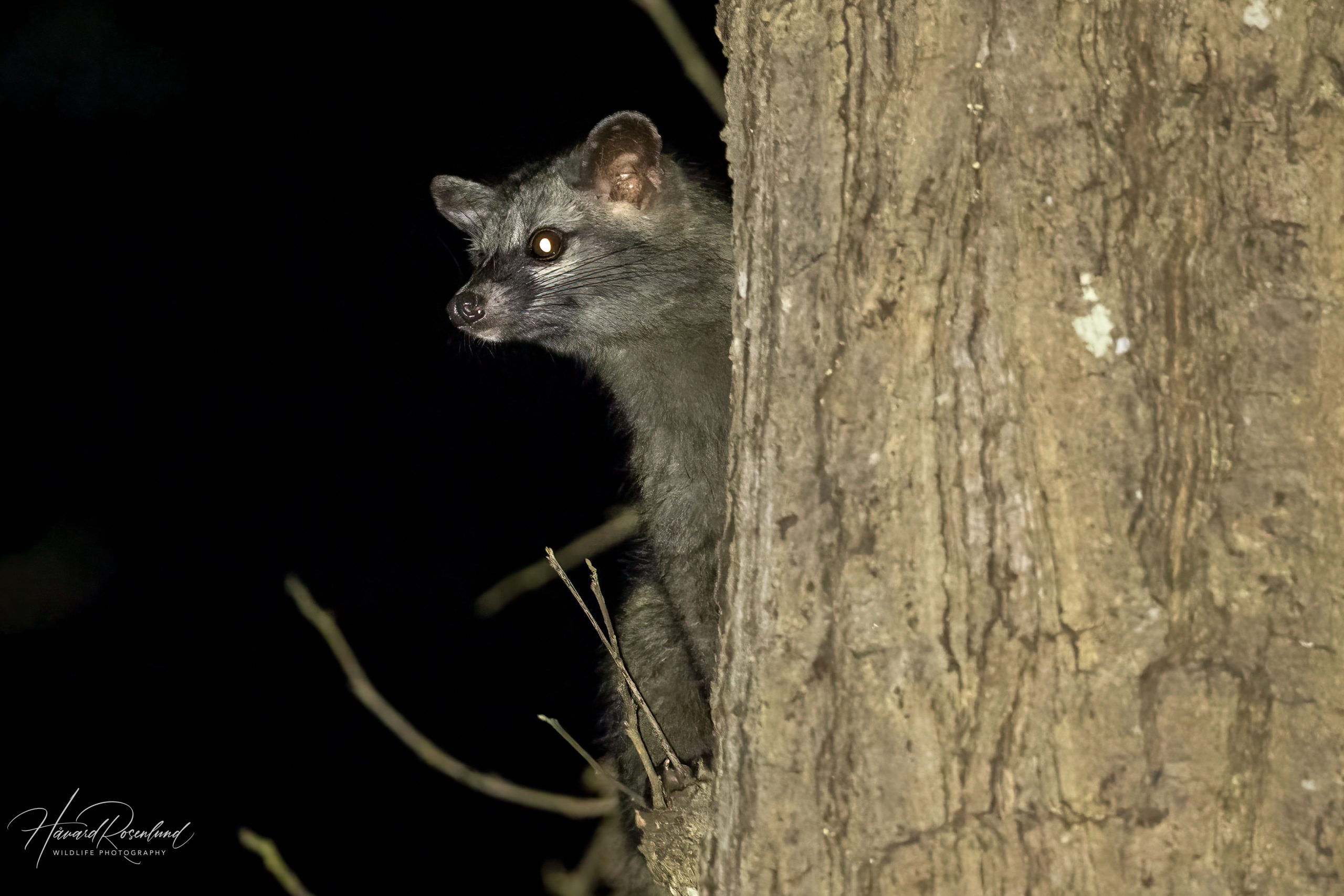
The northern palm civet (Paradoxurus hermaphroditus), formerly widely treated under the broader names Asian palm civet or common palm civet, is a medium-sized viverrid with an elongated body, short legs and a long tail that can approach the length of the head and body. Adults are commonly about 53–71 cm long excluding the tail and weigh roughly 2–5 kg. The coarse coat is usually grey-brown with darker spots or stripes along the body and a contrasting dark facial mask around the eyes and muzzle.
Despite belonging to the order Carnivora, the species is not primarily a meat-eater. Its build combines the sharp teeth of a small carnivore with excellent climbing ability and a strongly fruit-based diet. The long tail helps with balance while moving through trees, although the animal also spends considerable time on the ground.
Taxonomy
The name Asian or common palm civet was historically applied to a very widespread species extending across much of South and Southeast Asia and many offshore islands. A study published in 2015 combined mitochondrial and nuclear DNA with morphological evidence from 128 individuals across three Paradoxurus species and supported three major lineages within the old P. hermaphroditus concept. These are now generally treated as P. hermaphroditus, P. musangus and P. philippinensis. The Mammal Diversity Database follows this treatment, restricts P. hermaphroditus to the Asian mainland and uses Northern Palm Civet as its primary English name.
The species is currently listed from Bangladesh, Bhutan, China, India, Laos, Myanmar, Nepal, Pakistan, Thailand and Vietnam. Older sources reporting P. hermaphroditus from the Sunda Islands, Borneo or the Philippines may therefore refer to populations now assigned to P. musangus or P. philippinensis.
Habitat
Northern palm civets use a broad range of wooded habitats, including evergreen and deciduous forest, secondary growth, forest edges, plantations, orchards and rural landscapes with scattered trees. They can also live close to people and may rest or forage around gardens and buildings when enough cover is available.
The species is relatively tolerant of habitat modification but still depends on places that provide both food and secure daytime resting sites. Dense vines, tree cavities and other sheltered sites can be important for resting animals, while fruiting trees and structurally varied vegetation provide much of their food.
Diet
The diet is omnivorous but strongly dominated by fruit. A study published in 2011 analysed 94 scats collected from a rural site in Kerala between 2008 and 2010. Plant material occurred in 95.7% of samples, while animal material occurred in 18.1%. Eighteen fruit or seed species were identified, with papaya the most frequent. The results show a strongly fruit-based diet that is nevertheless flexible enough to include insects and small vertebrates.
This reliance on fruit gives the species an important ecological role as a seed disperser. Seeds often pass through the digestive tract intact and can be deposited away from the parent plant. Observations published in 2015 from Sinhgad Fort in Maharashtra documented northern palm civets dispersing seeds of the native rock banana (Ensete superbum). Such movements between fruiting plants allow the species to remain an important seed disperser even in fragmented landscapes close to people.
Behaviour
Northern palm civets are predominantly nocturnal. A camera-trap study published in 2019 from the human-dominated Auroville and Puducherry landscape recorded 92 independent palm-civet detections. Activity was concentrated at night, with one peak shortly after dusk and another from around midnight to dawn. Daytime is generally spent resting in trees, dense vegetation, cavities or sheltered structures. Their climbing ability makes trees important for both movement and refuge, but they also forage extensively on the ground.
Adults are usually solitary outside mating, and individuals communicate largely through scent. Strong-smelling glandular secretions and other scent marks advertise presence and may reduce the need for direct encounters between animals. Females remain with dependent young during the period of parental care.
Reproduction
Reproduction in the modern, narrowly defined species is still poorly documented. Gestation is thought to last roughly two months, and litters commonly contain two to five young. The young are born blind and remain dependent on the mother in a sheltered den or resting site.
The female provides the parental care. The young develop rapidly during their first months and begin accompanying the mother as their mobility and climbing ability improve. Many older accounts combined palm-civet populations that are now treated as separate species, so very precise life-history figures remain uncertain for the modern P. hermaphroditus.
Relationship with humans
Northern palm civets often live close to people and may visit orchards, gardens, roofs and other buildings while searching for fruit or shelter. They disperse seeds and consume insects and small vertebrates, but may also be regarded as nuisance animals when they enter houses or take cultivated fruit.
Palm civets are also famous for kopi luwak, coffee made from beans collected after coffee cherries have passed through a civet's digestive system. A welfare study published in 2016 examined 48 wild-caught palm civets kept at 16 tourist-oriented coffee plantations in Bali and found inadequate captive conditions across the industry. Those animals were identified as P. hermaphroditus under the older broad taxonomy; Bali populations fall outside the modern northern palm civet range and are now associated with P. musangus. The study therefore documents a major welfare problem in the wider palm-civet coffee trade rather than direct evidence about captive northern palm civets.
Status
The IUCN Red List assessment linked to the historical Asian palm civet concept classified that broader taxon as least concern. Under the current narrower taxonomy, the Mammal Diversity Database also lists the northern palm civet as least concern. Its broad mainland distribution, flexible diet and ability to use modified landscapes make it less vulnerable to habitat change than many more specialised small carnivores.
Local populations can still be affected by hunting, capture for the wildlife trade, persecution around homes and farms, and loss of secure resting habitat. Because the taxonomy has changed substantially, older range-wide population information should not automatically be assumed to describe trends of the modern, narrower species.
Image gallery
Loading map and observations…
Have you seen this species?
Independent species archive
Did you find this species page useful?
Wildlife Vagabond is independently built and maintained. Voluntary support helps cover hosting, maps, data storage and continued improvements to the species archive.
Support Wildlife VagabondSpecies content will remain freely available.
References
Information about the species’ global distribution and status is based primarily on global Red List data. See the references below for details.
- Carder, G., Proctor, H., Schmidt-Burbach, J., & D’Cruze, N. (2016). The animal welfare implications of civet coffee tourism in Bali. Animal Welfare, 25(2), 199-205. https://doi.org/10.7120/09627286.25.2.199
- International Union for Conservation of Nature. (n.d.). Asian Palm Civet (older broad species concept). The IUCN Red List of Threatened Species. https://www.iucnredlist.org/species/41693/45217835
- Jothish. (2011). Diet of the common palm civet in rural Kerala, India. https://www.researchgate.net/publication/285330989_Diet_of_the_common_palm_civet_Paradoxurus_hermaphroditus_in_a_rural_habitat_in_Kerala_India_and_its_possible_role_in_seed_dispersal
- Kulavmode, A. R., Hegde, V. M., & Kambale, A. A. (2015). A note on seed dispersal of Rock Banana Ensete superbum by Asian Palm Civet Paradoxurus hermaphroditus at Sinhgad fort, Maharashtra, India. Journal of the Bombay Natural History Society (JBNHS), 112(1), 25. https://doi.org/10.17087/jbnhs/2015/v112i1/92319
- Mammal Diversity Database. (n.d.). Paradoxurus hermaphroditus. American Society of Mammalogists. https://www.mammaldiversity.org/taxon/1006100/
- Selvan, K. M., Krishnakumar, B. M., Ramasamy, P., & Thinesh, T. (2019). Diel activity pattern of meso-carnivores in the suburban tropical dry evergreen forest of the Coromandel Coast, India. Journal of Threatened Taxa, 11(8), 13960-13966. https://doi.org/10.11609/jott.4850.11.8.13960-13966
- Veron, G., Patou, M.-L., Tóth, M., Goonatilake, M., & Jennings, A. P. (2015). How many species of Paradoxurus civets are there? New insights from India and Sri Lanka. Journal of Zoological Systematics and Evolutionary Research, 53(2), 161-174. https://doi.org/10.1111/jzs.12085
- Wilson, D. E., & Mittermeier, R. A. (2009). Paradoxurus hermaphroditus. In Handbook of the Mammals of the World – Volume 1: Carnivores (pp. 196–197). Lynx Edicions. https://doi.org/10.5281/zenodo.5714879