
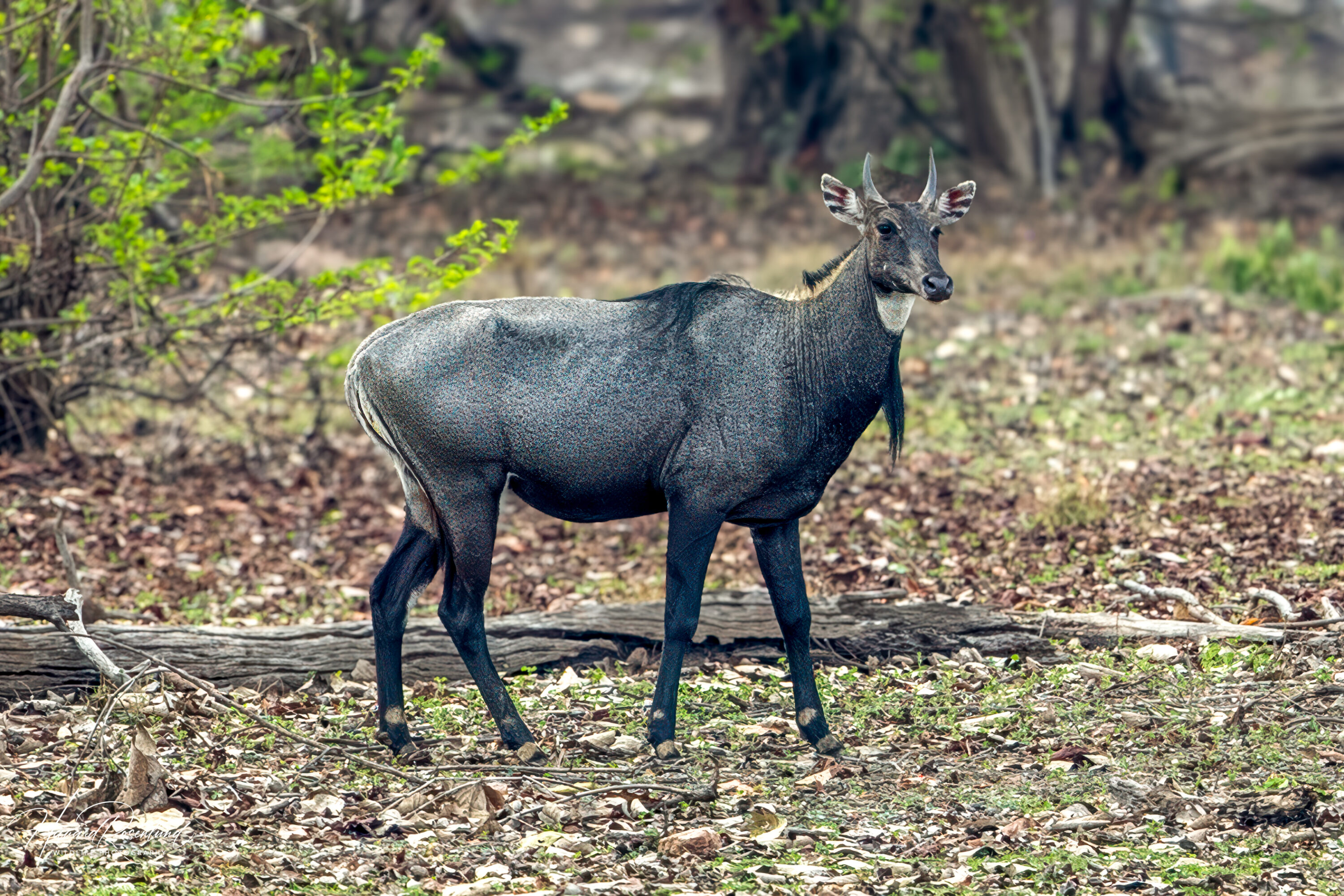
Nilgai
Boselaphus tragocamelus
At a glance
Habitat
- Scrub, grassy plains, dry open woodland and farmland; generally avoids dense forest
Diet
- Mixed feeder taking grasses, herbs, leaves, shoots, fruit and cultivated crops
Activity
- Mainly diurnal, with feeding concentrated in cooler morning and afternoon periods
Size
- Length: 120–150 cm at the shoulder Weight: about 120–300 kg
Range
- Indian subcontinent; introduced populations established in southern Texas and northern Mexico
Description
The nilgai (Boselaphus tragocamelus), or blue bull, is Asia's largest antelope and the only living species in the genus Boselaphus. It is a tall, heavy-bodied bovid with long legs, a sloping back and a deep neck. Adults stand roughly 120–150 cm at the shoulder.
The sexes look strikingly different. Adult males are usually blue-grey and can approach 300 kg, with a dark mane, throat tuft and short pointed horns. Females are smaller, usually tawny-brown and normally hornless. Both sexes carry contrasting white markings on the face, throat, lower legs and underside. The closest living relative is the four-horned antelope (Tetracerus quadricornis), the only other living member of the tribe Boselaphini; it is roughly one-ninth the mass and about half the height of a nilgai.
Habitat
Nilgai are animals of open and semi-open country. Scrub, thorn forest, grassy plains, dry open woodland and agricultural mosaics are typical habitats, while dense closed forest is generally avoided. Access to patches of shade and cover remains important, especially during the hottest part of the day.
The species tolerates substantial habitat modification and can persist close to cultivation. This flexibility helps explain why nilgai remain common across much of India even where natural vegetation has been broken into a mosaic of fields, scrub and woodland remnants.
Diet
Nilgai are flexible herbivores that both graze and browse. Grasses and herbs are taken alongside leaves, shoots, flowers and fruit from shrubs and trees, and the balance changes with season and local food availability.
Cultivated plants are readily eaten where farms overlap with nilgai habitat. Wheat, pulses and other crops can become important food sources locally, which is one reason the species can thrive in agricultural landscapes but also come into serious conflict with farmers.
Behaviour
Activity and risk-taking can change markedly between natural and agricultural habitats. A study published in 2016 at Tadoba-Andhari Tiger Reserve, based on observations made from 2012 to 2015, recorded 176 herds in forest and 321 on farms. Nilgai rested and foraged mainly in forest by day but entered cropland chiefly at night. Crop-raiding was strongly female-biased, while adult males and newborn calves were recorded on farms much less often. Vigilance was also far more frequent on farms than in forest, showing how strongly the animals adjust their behaviour to different kinds of risk.
Both sexes use communal dung piles as scent and communication sites. These latrines can be visited repeatedly by several individuals and help signal the presence of nilgai even when the animals themselves are moving separately.
Social behaviour
Nilgai are less strongly herd-forming than many other large antelopes. Females and young often associate in groups, while adult males are more likely to be solitary or form bachelor groups outside the breeding period. Group structure changes substantially through the year.
A study published in 2025 across 30 areas in Ludhiana District, Punjab, recorded 849 sightings of groups or solitary animals. Mean group size ranged from about 6.6 animals in summer to 13.64 in winter, and the largest recorded herd contained 65 individuals. Harem groups, consisting of an adult male with several females, were observed from autumn through spring, whereas groups without this structure dominated in summer and monsoon. Herd composition changed strongly with season but did not differ clearly between forest and agricultural habitat, illustrating how flexible the social organisation can be.
Predation
Nilgai are taken by several of India's large carnivores, including tigers (Panthera tigris), leopards (Panthera pardus) and Indian wolves (Canis lupus pallipes). Their importance as prey varies greatly between landscapes: adults are large and difficult to kill and are often taken less readily than medium-sized deer, while calves and younger animals are more vulnerable.
This makes nilgai different from prey such as sambar or chital, which can dominate large-carnivore diets in many reserves. Nilgai can nevertheless contribute substantially to predator diets where they are abundant; their role depends strongly on local prey communities and on which carnivores are present.
Reproduction
Breeding can occur throughout the year, although many populations show seasonal peaks. During courtship and competition, males emphasise the throat tuft and body posture, circle or parallel-walk with rivals and may spar, neck-wrestle or use their horns. In the 2025 Punjab study, harem groups were recorded from autumn through spring and calving was most prominent before winter, consistent with a long breeding season rather than one brief rut.
Gestation lasts about 243–247 days. One or two calves are usual, and twins are common in some populations. Newborn calves spend much of their early life concealed in vegetation before following the mother more openly as they become stronger and more mobile.
Cultural significance
The name nilgai comes from words commonly translated as “blue cow”, referring to the blue-grey colour of adult males and the animal's cattle-like appearance. That association has cultural consequences in parts of India, where the nilgai may be treated with greater tolerance because of the special status of cattle.
Attitudes are not uniform across the species' range. Where crop losses are severe, cultural tolerance can give way to strong conflict and pressure to reduce local nilgai numbers.
Relationship with humans
Nilgai frequently enter farmland, and crop-raiding can become a serious local conflict where populations are high. A study around Beer-Sonty Reserve Forest in Haryana found widespread reports of crop damage among interviewed residents and forestry workers, illustrating how strongly the species can affect livelihoods where agriculture borders suitable nilgai habitat.
Humans have also carried the species far beyond its natural range. Nilgai were introduced to ranches in southern Texas during the 20th century and have since established free-ranging populations extending into northern Mexico. Their large home ranges allow animals to move across ranch boundaries, and nilgai can carry cattle fever ticks and transport the parasites over considerable distances.
Status
The nilgai is classified as least concern on the IUCN Red List and remains widespread and common across much of India. Populations are smaller and more fragmented toward parts of the edge of the native range.
The species' ability to use scrub, open woodland and farmland gives it considerable resilience. Local populations can nevertheless be affected by hunting and habitat change, while severe crop damage can lead to culling in some areas.
Image gallery
Loading map and observations…
Have you seen this species?
Independent species archive
Did you find this species page useful?
Wildlife Vagabond is independently built and maintained. Voluntary support helps cover hosting, maps, data storage and continued improvements to the species archive.
Support Wildlife VagabondSpecies content will remain freely available.
References
Information about the species’ global distribution and status is based primarily on global Red List data. See the references below for details.
- Animal Diversity Web. (n.d.). Boselaphus tragocamelus. https://animaldiversity.org/accounts/Boselaphus_tragocamelus/
- Bayani, A., & Watve, M. (2016). Differences in behaviour of the nilgai (Boselaphus tragocamelus) during foraging in forest versus in agricultural land. Journal of Tropical Ecology, 32(6), 469-481. https://doi.org/10.1017/S0266467416000420
- Chopra, G., & Rai, D. (2009). A study on the ecology of Nilgai (Boselaphus tragocamelus Pallas) and its status as an unconventional pest of agriculture in and around Beer-Sonty reserve forest, Haryana, India. Journal of Applied and Natural Science, 1(2), 245-249. https://doi.org/10.31018/jans.v1i2.81
- International Union for Conservation of Nature. (n.d.). SSC Antelope Specialist Group – Nilgai (Boselaphus tragocamelus). The IUCN Red List of Threatened Species. https://www.iucnredlist.org/species/2893/115064758
- Leslie, D. M. (2008). Boselaphus Tragocamelus (Artiodactyla: Bovidae). Mammalian Species, 813, 1-16. https://doi.org/10.1644/813.1
- Moczygemba et al. (n.d.). 2012 – Home ranges of nilgai antelope in Texas. https://digitalcommons.unl.edu/icwdm_usdanwrc/1169/
- Oguya, B. R. O., & Eltringham, S. K. (1991). Behaviour of nilgai (Boselaphus tragocamelus) antelope in captivity. Journal of Zoology, 223(1), 91-102. https://doi.org/10.1111/j.1469-7998.1991.tb04751.x
- Rani, K., Babbar, B. K., & Dhillon, A. K. (2025). Population ecology and herd dynamics of blue bull Boselaphus tragocamelus in forest and agrarian lands of district Ludhiana Punjab. Scientific Reports, 15, 24005. https://doi.org/10.1038/s41598-025-08623-w