
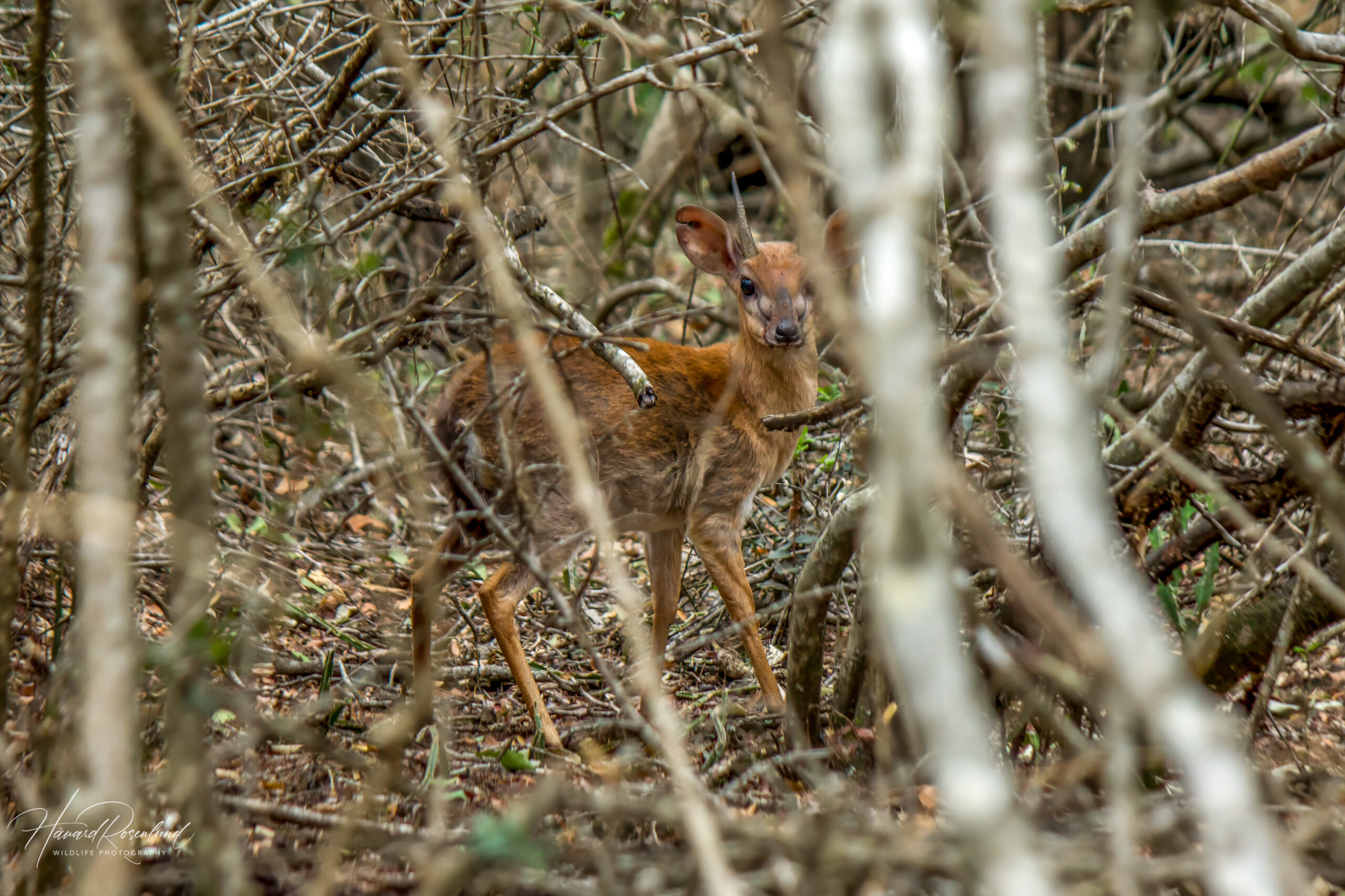
Suni
Nesotragus moschatus
At a glance
Habitat
- Dense undergrowth, thickets, woodland and forest
Diet
- Freshly fallen leaves, fruit, flowers, fungi and other selective browse
Activity
- Active by day and night; often most active around dusk, night and early morning
Size
- Length: 57–62 cm Weight: 4–6 kg
Range
- Eastern and southeastern Africa from Kenya to northern KwaZulu-Natal
Description
The suni (Nesotragus moschatus) is one of Africa’s smallest antelopes. Head-and-body length is about 57–62 cm, shoulder height roughly 30–43 cm and body mass around 4–6 kg. Females are usually slightly larger than males.
The coat varies from light brown to chestnut and becomes paler on the flanks, underparts and legs. Only males carry horns; these are straight, ridged and usually 8–13 cm long. The suni overlaps with the Natal red duiker (Cephalophorus natalensis) across parts of southeastern Africa, but is more delicately built and usually paler in colouration.
Taxonomy
The suni was long placed in Neotragus, and the older name Neotragus moschatus is still common in the literature. Genetic studies and comparisons of body form showed that species once grouped in this genus were not as closely related as previously thought. Nesotragus was therefore revived for the suni and Bates’s pygmy antelope (Nesotragus batesi). Mammal Diversity Database v2.5 follows this treatment.
Geographic variation within the suni remains incompletely resolved. Several named forms have been described, and some have even been proposed as separate species. MDD currently includes forms such as kirchenpaueri and livingstonianus within N. moschatus. Genetic studies have found clear differences between suni populations in different parts of Africa, including between some populations in the south. This means that the animals’ geographic origin should be considered when sunis are moved between protected areas.
Habitat
Sunis depend on dense vegetation and occur in forest undergrowth, thickets, woodland and evergreen or deciduous forest. In southern Mozambique and northern KwaZulu-Natal they are particularly associated with Maputaland’s fragmented sand forests and other dense woodland. Research in Tembe Elephant Park also shows that how dense and layered the vegetation is can be as important as the formal habitat type.
Dense low vegetation provides resting sites, concealment and feeding opportunities. The species can occur from the lowlands to high elevations in East Africa, but at the southern edge of its range suitable habitat is naturally patchy and increasingly fragmented.
Diet
Sunis are highly selective browsers, and grasses normally form only a small part of the diet. Recently fallen leaves are especially important, supplemented by fruit, flowers, fungi and other soft plant material. An analysis of rumen contents from East Africa found 84% broad-leaved plant material, 6% fruit, 6% grasses and other narrow-leaved plant material, and 4% stems.
Much of the animal’s water comes from food, allowing it to persist without frequent visits to open water. Sunis often collect recently fallen plant material from the forest floor, and around Kilimanjaro they have been observed following colobus monkeys and eating leaves and shoots dropped from the canopy.
Behaviour
Activity varies with locality and conditions. Sunis can be active by day and night, with many observations showing strong activity around dusk, overnight and in the early morning. They may be particularly active after rain or dense mist, while long resting periods are spent in sheltered shade within dense vegetation.
The coat blends closely with leaf litter and the forest floor. When danger approaches, a suni often remains motionless until the threat is close and then darts rapidly into thicker cover. A sharp bark is used as an alarm call. This combination of camouflage, freezing and a short explosive escape is well suited to an animal that rarely moves far from dense vegetation.
The short tail is black above and vivid white below and is frequently wagged from side to side. This conspicuous black-and-white movement is a characteristic signal of the species and can stand out surprisingly well even within dense vegetation.
Predation
The suni’s small size makes it prey for a range of predators. Suni remains are frequently found at crowned eagle (Stephanoaetus coronatus) nests, while martial eagles (Polemaetus bellicosus) and African rock pythons (Python sebae) are also important predators. Leopards (Panthera pardus) and other medium-sized and large carnivores may take sunis as well.
Camouflage and the characteristic strategy of first freezing and then darting into dense vegetation provide the main defence. The thick understorey preferred by sunis therefore serves both as habitat and as protection from predators.
Social behaviour
Sunis occur alone, in pairs and occasionally in small groups. In one KwaZulu-Natal study, 77% of sightings were of solitary adults and 12% were pairs. Males defend extremely small territories: in the same region, male territories of about 0.5–1.1 ha were recorded, while females used areas of about 0.9–4.6 ha that often lay almost entirely within a male’s territory. Male territories showed little overlap with one another.
Scent marking is unusually important in this species. The large scent glands in front of the eyes contain a deep pocket, and males may press the tip of a twig or stem into the gland so that it emerges coated with dark, strongly scented secretion. Such marks are concentrated along regularly used trails, while communal dung piles are often placed near territorial boundaries.
Pairs are commonly observed, but this does not necessarily imply an exclusive lifelong pair bond. A male may have one preferred female even where several females use his territory. Neighbouring males advertise ownership through scent and behaviour, and direct horn contests can occur when rivals meet.
Reproduction
Breeding can occur during much of the year, with seasonal peaks that vary geographically. Gestation lasts about six months; recorded pregnancies in captivity have ranged from 172 to 192 days. The female normally gives birth to one fawn weighing about 700–800 g.
The newborn remains hidden in thick vegetation while the mother returns periodically to nurse and groom it. The fawn begins nibbling vegetation within a few days and starts ruminating at around one month of age. Studies in southern Africa have found an average interval between births of about seven months, and females reach sexual maturity at around one year.
Captive work on the southern form N. m. zuluensis has provided much of the detailed information on courtship and reproductive behaviour, which remains difficult to observe in this secretive antelope in the wild. Captive sunis have lived for more than 13 years.
Cultural significance
The Zulu name for the suni, Nhlegane, is explained by SANBI as meaning “why is it beautiful?” According to folklore from northern Maputaland, the name is associated with King Shaka declaring the suni the most beautiful animal in his forest. The story is local folklore rather than documented natural history, but it shows that this tiny forest antelope also has a distinct place in the region’s cultural tradition.
Status
The suni is listed as Least Concern on the IUCN Red List. The global assessment published in 2016 estimated approximately 365,000 animals. This is an older population estimate and should not be read as a current count of the species.
The situation is very different at the southern edge of the range. The South African regional assessment classifies the suni as Endangered. Because the species is extremely difficult to count, the 2016 assessment gave a wide estimate of roughly 440–4,890 animals in the assessment region, corresponding to about 220–2,445 mature individuals.
Threats
In South Africa, habitat loss and degradation are major pressures because sunis depend on a dense shrub and understorey layer. Snares and hunting with dogs remove animals directly, while fragmentation can prevent movement between the remaining forest and thicket patches.
Large browsers can alter the same vegetation on which sunis depend. High densities of nyala (Tragelaphus angasii) and African bush elephants (Loxodonta africana) have been linked to reduced understorey and changes in sand forest. Tembe is therefore a particularly interesting management problem: protecting large herbivores and protecting the vegetation required by a tiny forest antelope are not always the same task.
Conservation
Tembe Elephant Park, Ndumo Game Reserve and other protected forest fragments in Maputaland are crucial strongholds at the southern edge of the species’ range. Tembe’s management has explicitly treated sand forest conservation as its highest biodiversity priority, followed by suni conservation; the species was also identified as one of the reasons for the park’s proclamation.
Conservation depends on keeping sand forest, thicket and woodland patches connected, limiting illegal hunting and making sure large herbivores do not reduce the understorey too heavily. Genetic studies have found clear differences between populations in southern and eastern Africa. This means that the origin of animals should be known before sunis are moved between protected areas.
A study published in 2025 compared my very own camera-trap surveys in Tembe from 2013–2014 with 2022–2023 and found that camera traps were more likely to record suni during the more recent period, despite continued elephant-driven habitat change. That does not remove concern over vegetation change, but it shows why long-term monitoring of both animals and habitat gives a better picture than a single short survey.
Image gallery
Loading map and observations…
National Red List status
| Country | Status | Assessment | Source |
|---|---|---|---|
| South Africa | ENEndangered | Red List of South African Species 2016 | SANBI – Red List of South African Species |
Have you seen this species?
Independent species archive
Did you find this species page useful?
Wildlife Vagabond is independently built and maintained. Voluntary support helps cover hosting, maps, data storage and continued improvements to the species archive.
Support Wildlife VagabondSpecies content will remain freely available.
References
Information about the species’ global distribution and status is based primarily on global Red List data. See the references below for details.
- Belton, L. E., Dalerum, F., & Van Rensburg, B. J. (2008). Factors associated with suni distribution in Tembe Elephant Park, South Africa: implications for management and conservation of a small antelope. African Journal of Ecology, 46(4), 631-636. https://doi.org/10.1111/j.1365-2028.2008.00945.x
- Hunnicutt, A., Matthews, W., Somers, M. J., & Child, M. F. (2016). A conservation assessment of <i>Nesotragus moschatus zuluensis</i>. South African National Biodiversity Institute and Endangered Wildlife Trust. https://speciesstatus.sanbi.org/assessment/last-assessment/2149/
- International Union for Conservation of Nature. (2016). Nesotragus moschatus. The IUCN Red List of Threatened Species. https://www.iucnredlist.org/species/14604/50191073
- Kingdon & Hoffmann. (2013). Nesotragus moschatus – Suni. In: Mammals of Africa, Volume VI. https://www.researchgate.net/publication/311546196_Nesotragus_moschatus_Suni
- Lawson, D. (1989). The food habits of suni antelopes (Neotragus moschatus) (Mammalia: Artiodactyla). Journal of Zoology, 217(3), 441-448. https://doi.org/10.1111/j.1469-7998.1989.tb02500.x
- Mammal Diversity Database. (n.d.). Nesotragus moschatus: current taxonomy and distribution. American Society of Mammalogists. https://www.mammaldiversity.org/taxon/1006243/
- Pretorius, Q., Pretorius, B., & Dannhauser, C. (1996). The reproductive behaviour of the suni <i>Neotragus moschatus zuluensis</i> in captivity. Koedoe, 39(1). https://doi.org/10.4102/koedoe.v39i1.289
- South African National Biodiversity Institute. (n.d.). Suni ecological information and cultural notes. https://speciesstatus.sanbi.org/taxa/detail/2149/
- Streicher, J. P., Ramesh, T., & Downs, C. T. (2025). A long-term reinvestigation using camera traps reveals the resilience of mammalian communities in protected areas of the Maputaland Conservation Unit, South Africa. Landscape Ecology, 40(7), 141. https://doi.org/10.1007/s10980-025-02156-3
- Swanepoel. (2019). Conservation genetics of the suni antelope Nesotragus moschatus. MSc dissertation, University of Pretoria. https://repository.up.ac.za/items/084b9f39-2d98-437d-8955-18cbe41b818f