
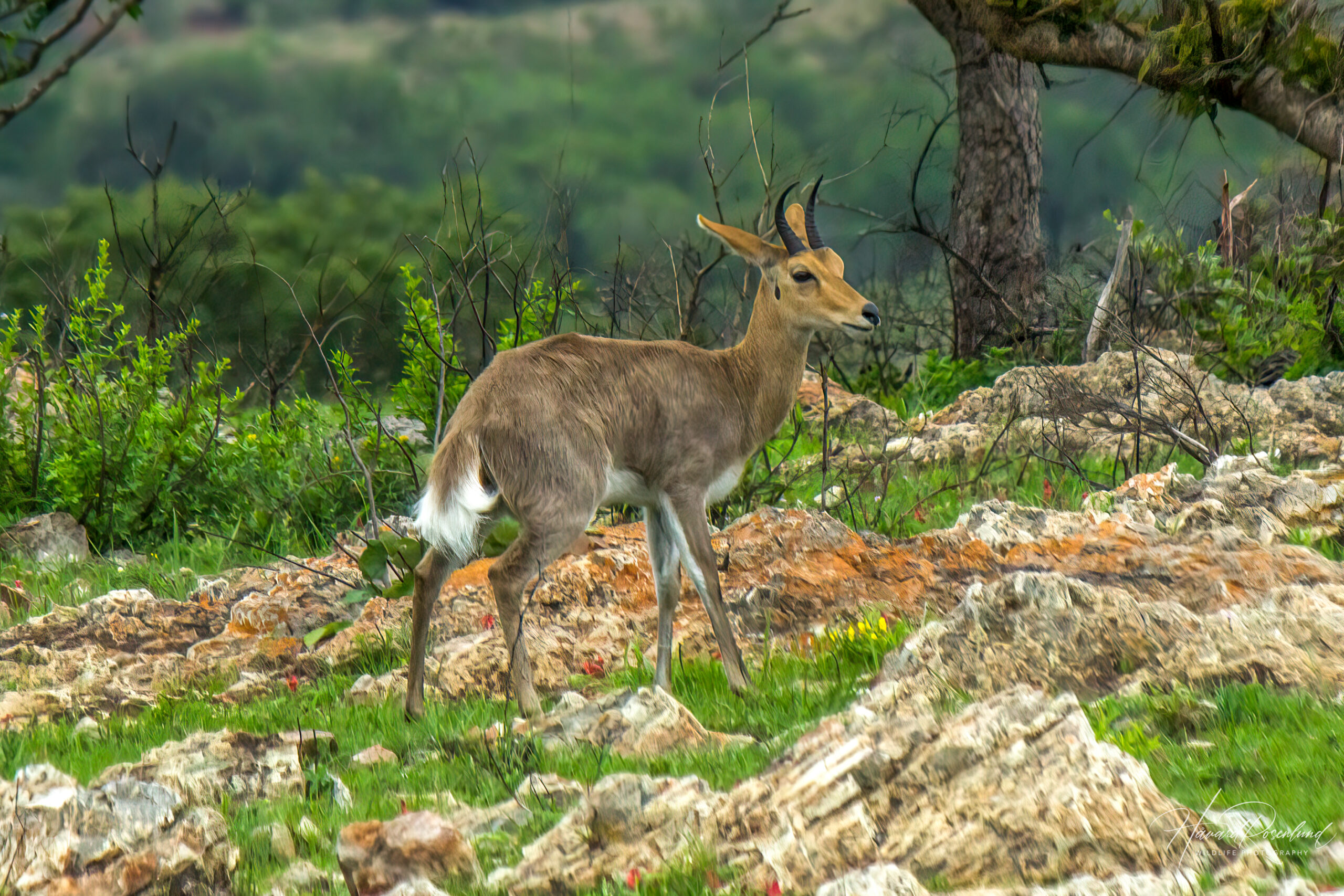
Mountain Reedbuck
Redunca fulvorufula
At a glance
Habitat
- Rocky hillsides, montane grassland and open upland woodland
Diet
- Grazer: mainly grasses, with some herbs and other low vegetation
Activity
- Most active in early morning and late afternoon
Size
- Length: 100–136 cm (head–body) Weight: 19–38 kg
Range
- Fragmented mountain populations in West, East and southern Africa
Description
The mountain reedbuck (Redunca fulvorufula) is the smallest of the three reedbuck species. It has a head-and-body length of roughly 100–136 cm, stands about 65–76 cm at the shoulder and weighs around 19–38 kg. Males are generally larger than females.
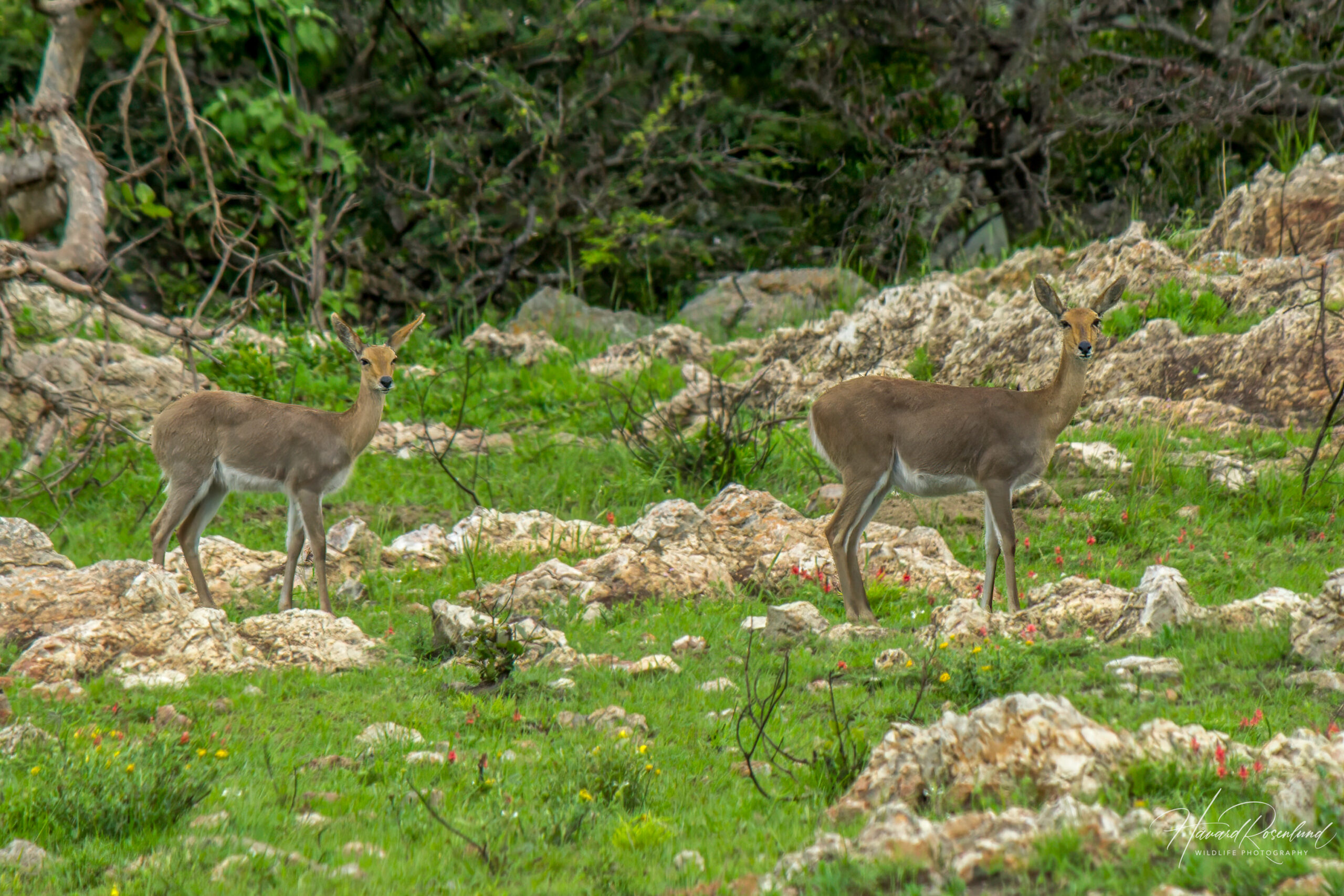
The coat is grey to greyish brown, with pale underparts and a white underside to the bushy tail. Both sexes have a dark glandular patch below each ear. Only males carry horns; these are short, strongly ridged and curve forward near the tips. Compared with the southern reedbuck (Redunca arundinum), the mountain reedbuck is smaller, shorter-legged and much more closely tied to rocky upland terrain.
Taxonomy
Three geographically separated forms are generally included within the species: the southern mountain reedbuck (Redunca fulvorufula fulvorufula), Chanler’s mountain reedbuck (R. f. chanleri) of East Africa and the Adamawa mountain reedbuck (R. f. adamauae) of Cameroon and Nigeria.
Groves & Grubb proposed treating some of these forms as separate species, but Mammal Diversity Database v2.5 retains both chanleri and adamauae within Redunca fulvorufula. The three forms are nevertheless geographically isolated from one another in widely separated mountain systems.
Habitat
Mountain reedbucks inhabit steep hillsides, rocky mountain grassland and open upland woodland, usually where grass, rugged terrain and nearby cover occur together. Their global distribution is naturally fragmented into separate mountain systems. Southern mountain reedbucks occur up to about 2,200 m in the Drakensberg, while Chanler’s mountain reedbuck has been recorded at about 5,000 m on Mount Kilimanjaro.
Slopes, rocky outcrops and rugged ground are important parts of the habitat. Research on East African mountain reedbucks found that access to steep slopes with good escape opportunities strongly influenced the quality of male territories. Animals therefore concentrate where good grazing occurs close to terrain that provides rapid escape from predators.
Diet
Mountain reedbucks are specialised grazers that feed mainly on grasses, supplemented by small amounts of herbs and other low vegetation. They are less inclined than many other antelopes to switch to completely different plant types when preferred grasses become scarce.
This can have important seasonal consequences. In South African grasslands the nutritional quality of the diet falls during the dry winter, and animals may lose substantial body mass rather than simply moving long distances to richer feeding grounds. Green forage supplies much of their moisture, but access to water becomes increasingly important under dry conditions.
Behaviour
Mountain reedbucks can be active at any time of day, but feeding is concentrated in the early morning and late afternoon and may continue after dark. The hottest hours are commonly spent resting in shade, among rocks or on slopes with good visibility.
When danger is detected, the first response is often to crouch or lie still and rely on concealment rather than immediately running. If forced to flee, the animals bound across steep ground and often give a sharp whistle. Such vocalisations are used both as alarm signals and by territorial males, which also use posture and scent marking to communicate with other individuals.
Social behaviour
Females and young usually form small, fluid family groups of roughly three to six animals, although temporary aggregations of up to about 30 have been recorded. Membership is not rigid, and animals may move between neighbouring groups. Young males form bachelor groups after leaving female groups.
Mature males, usually from about two and a half years of age, become solitary and territorial. Rather than permanently guarding a harem, a male defends good habitat and checks females moving through his territory to determine whether they are in oestrus.
Home ranges
Mountain reedbucks are relatively sedentary. Individuals and family groups use stable home ranges, while adult males defend permanent territories whose size changes with grass quality, cover and population density.
A male territory may overlap the home ranges of several female groups. Territories in southern African studies are commonly around 15–48 ha, while family home ranges can overlap several male territories. This allows females to move between different males while remaining within familiar upland habitat.
Predation
Leopards (Panthera pardus) and caracals (Caracal caracal) are documented predators of mountain reedbuck in southern Africa, and young animals may also be vulnerable to smaller predators such as black-backed jackals (Lupulella mesomelas). Increased predation by medium-sized carnivores has been proposed as one possible contributor to some local declines, but the evidence remains limited.
The importance of predation varies markedly between populations. In a long-term study at Sterkfontein Dam Nature Reserve in South Africa, 43 mountain reedbuck deaths were recorded, and 32 resulted from hypothermia following heavy snowfall in September 2001. This represented about 51% of the population at the time. For a small and relatively sedentary mountain antelope, extreme weather can therefore produce much greater mortality than predators in some years.
Reproduction
Breeding patterns vary geographically. Chanler’s mountain reedbuck in East Africa can reproduce throughout the year, but births peak during the March–May rainy season. Southern populations are more seasonal, with a clear birth peak from October to December around the summer rains.
After a gestation of about eight months, the female gives birth to one calf. The newborn remains hidden in dense grass or other cover for up to about four weeks, relying on stillness and concealment while the mother returns to nurse it.
Females may enter their first oestrus from around one year of age, although maturity varies with condition. Males can become sexually mature during their second year but are normally driven from their birth groups before they can compete successfully with territorial adults. They spend a period in bachelor groups and generally establish territories from about two and a half years of age.
Longevity in the wild is poorly documented, but AnAge lists animals living to about 12 years in the wild and a documented maximum of 15 years in captivity.
Relationship with humans
Mountain reedbucks occur on both protected and private land and are part of private wildlife management and regulated trophy hunting in southern Africa. Provincial permit systems regulate legal hunting, and animals are also moved between suitable private properties and reserves.
These practices can support conservation where habitat is maintained and harvesting is sustainable, but they also require careful population monitoring. A species that naturally remains within relatively small home ranges can be depleted quickly if local harvest is too high, and animals moved to new sites need follow-up to determine whether new populations actually persist.
Status
The mountain reedbuck is listed as Endangered on the IUCN Red List. The global assessment published in 2017 estimated roughly 16,000 animals in widely separated populations and documented a major overall decline. In South Africa, the population was estimated to have declined by about 55% over the preceding 15 years.
The southern mountain reedbuck (Redunca fulvorufula fulvorufula) is also regionally Endangered in South Africa, Lesotho and Eswatini. The regional assessment used 2013 data to estimate at least 10,214–13,669 mature animals across protected and private land, while long-term counts in protected areas indicated a decline of roughly 61–73% between 1998 and 2013.
Threats
Habitat degradation, human settlement and illegal hunting are major pressures across the fragmented range. Expanding settlements, poaching and hunting with dogs are among the main drivers of the decline in South Africa. Disturbance and competition from domestic livestock can reduce access to good grassland in other parts of the range.
Drought is another important concern because mountain reedbucks are reluctant to abandon familiar home ranges when forage deteriorates. Prolonged dry periods can reduce body condition, reproduction and survival.
Conservation
Conservation depends on maintaining connected areas of rocky grassland that provide both grazing and terrain with good escape opportunities. Protected mountain landscapes remain essential, but large numbers also occur on private land, making long-term cooperation with landowners important.
Legal hunting should be based on local population monitoring rather than broad regional estimates, and animals moved to new areas need follow-up to determine whether new populations actually persist. Reducing illegal hunting with dogs and limiting livestock disturbance in important mountain habitats are priorities in areas where the species is declining.
The three main regional forms are geographically isolated and may differ genetically in important ways. Better genetic research on these populations would help guide the movement of animals and reduce the risk of mixing populations that have been separated for long periods.
Image gallery
Loading map and observations…
National Red List status
| Country | Status | Assessment | Source |
|---|---|---|---|
| South Africa | ENEndangered | Red List of South African Species 2016 | SANBI – Red List of South African Species |
Have you seen this species?
Independent species archive
Did you find this species page useful?
Wildlife Vagabond is independently built and maintained. Voluntary support helps cover hosting, maps, data storage and continued improvements to the species archive.
Support Wildlife VagabondSpecies content will remain freely available.
References
Information about the species’ global distribution and status is based primarily on global Red List data. See the references below for details.
- AnAge. (n.d.). Redunca fulvorufula: longevity and life-history data. https://genomics.senescence.info/species/entry.php?species=Redunca_fulvorufula
- Dunbar, R. I. M., & Roberts, S. C. (1992). Territory Quality in Mountain Reedbuck (Redunca fulvorufula chanleri): Distance to Safety. Ethology, 90(2), 134-142. https://doi.org/10.1111/j.1439-0310.1992.tb00827.x
- International Union for Conservation of Nature. (2017). Redunca fulvorufula. The IUCN Red List of Threatened Species. https://www.iucnredlist.org/species/19391/50193881
- Mammal Diversity Database. (2026). Redunca fulvorufula. American Society of Mammalogists. https://www.mammaldiversity.org/taxon/1006252/
- Rowe-Rowe. (1983). Habitat preferences of Drakensberg antelopes. https://journals.co.za/doi/pdf/10.10520/AJA03794369_2031
- South African National Parks. (n.d.). Mountain Reedbuck. https://www.sanparks.org/conservation/parks/marakele-national-park/primary-consumers-herbivores/mountain-reedbuck
- Taylor, A., Avenant, N., Schulze, E., Viljoen, P., & Child, M. F. (2016). A conservation assessment of <i>Redunca fulvorufula fulvorufula</i>. South African National Biodiversity Institute and Endangered Wildlife Trust. https://speciesstatus.sanbi.org/assessment/last-assessment/2203/
- Taylor, W. A., & Skinner, J. D. (2006). A review of the social organisation of mountain reedbuck,Redunca fulvorufula, and grey rhebok, Pelea capreolus, in relation to their ecology. Transactions of the Royal Society of South Africa, 61(1), 8-10. https://doi.org/10.1080/00359190609519188
- Taylor, W. A., Skinner, J. D., & Krecek, R. C. (2006). The activity budgets and activity patterns of sympatric grey rhebok and mountain reedbuck in a highveld grassland area of South Africa. African Journal of Ecology, 44(4), 431-437. https://doi.org/10.1111/j.1365-2028.2006.00650.x
- Taylor, W. A., Skinner, J. D., Williams, M. C., & Krecek, R. C. (2006). Population dynamics of two sympatric antelope species, grey rhebok (Pelea capreolus) and mountain reedbuck (Redunca fulvorufula), in a highveld grassland region of South Africa. Journal of Zoology, 268(4), 369-379. https://doi.org/10.1111/j.1469-7998.2006.00067.x
- Wilson, D. E., & Mittermeier, R. A. (2011). Chanler’s Mountain Reedbuck. In Handbook of the Mammals of the World – Volume 2: Hoofed Mammals (pp. 624–625). Lynx Edicions. https://doi.org/10.5281/zenodo.6636814