
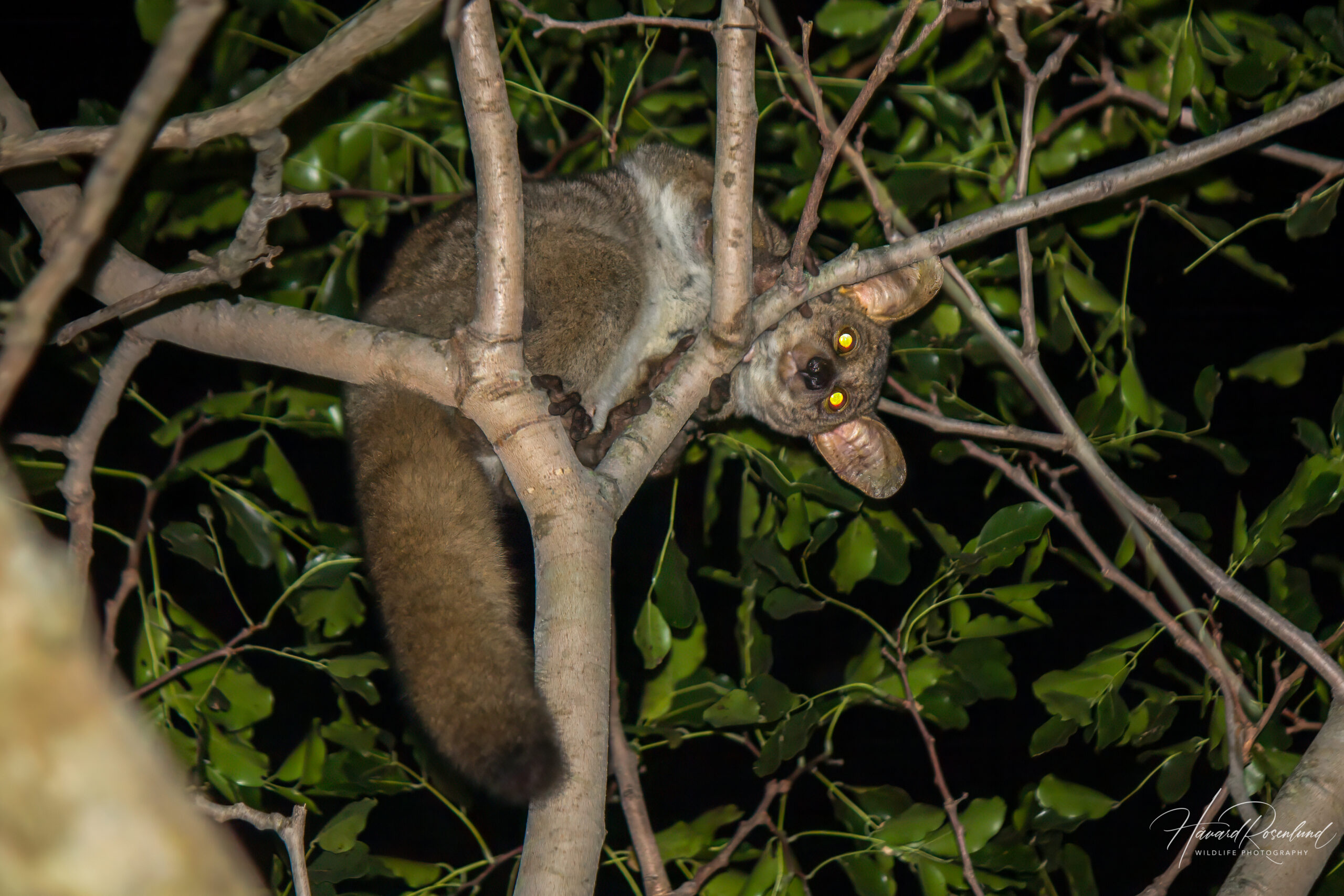
Thick-tailed Greater Galago
Otolemur crassicaudatus
At a glance
Habitat
- Coastal, riverine and montane forest, miombo woodland and wooded savanna
Diet
- Fruit, tree gum, insects and other invertebrates; occasional small vertebrates
Activity
- Strictly nocturnal
Size
- Length: 32–47 cm Weight: 1.0–2.0 kg
Range
- Eastern and southern Africa
Description
The thick-tailed greater galago, or thick-tailed bushbaby (Otolemur crassicaudatus), is a nocturnal primate and the largest living galago. It has a rounded head, very large mobile ears, forward-facing eyes and a thick, bushy tail that is slightly longer than the body. The hands and feet have broad gripping pads and nails that provide secure purchase on bark and branches.
Head-and-body length is usually about 32–40 cm but can approach 47 cm, while the tail may reach roughly 55 cm. Adults generally weigh about 1.0–2.0 kg, with males larger than females. The dense coat varies geographically from grey or silvery brown to dark brown, with paler underparts. The large eyes gather the limited light available at night, while the ears can move independently to pinpoint faint sounds.
Taxonomy
The taxonomy of the greater galagos has changed repeatedly. Mammal Diversity Database v2.5 uses a broad Otolemur crassicaudatus and treats names associated with several geographic forms, including monteiri, as synonyms within this species. Other primate treatments have sometimes recognised more than one species in this complex.
The variation in names reflects genuine geographic differences in coat colour and body form, but boundaries between forms have not always been easy to define. This page follows the broad MDD treatment while retaining the regional variation as part of the species’ biology.
Habitat
Thick-tailed greater galagos inhabit coastal, riverine, montane and evergreen forest, miombo woodland, forest–savanna mosaics and well-wooded gardens. In drier regions they are often concentrated along rivers, where trees provide connected routes, shelter and reliable food. By day they sleep in tree hollows, dense creepers, old nests or other protected sites, commonly around 5–12 m above the ground.
Diet
The diet changes strongly with season and locality. Tree gum, fruit and insects are especially important, supplemented by flowers, seeds and other invertebrates; small vertebrates such as reptiles or birds may occasionally be taken. Gum can be a dependable resource when fruit and insects are less abundant.
Research in northern South Africa shows that food availability changes markedly through the year and influences the animals’ stress levels. Season therefore shapes both the resources available to galagos and how demanding conditions are.
Behaviour
The species is strictly nocturnal and usually begins moving soon after dusk. Smaller galagos are famous for spectacular long jumps, but this heavier species spends more time climbing and moving on all fours through the canopy. It can still make powerful leaps across gaps or when escaping danger, using the long tail for balance.
Individuals often follow familiar routes between sleeping sites and feeding trees. Field studies show that travelling occupies a large share of the active night, while only about one fifth of active time may be spent directly foraging. The large ears are constantly turned towards rustling insects and possible predators, while scent and memory help an animal navigate the same complicated network of branches night after night. South African field observations have recorded some individuals travelling as far as about 2 km within a study area.
Predation is difficult to observe because both galagos and many of their predators are active at night. Large owls, snakes and mammalian carnivores are potential predators. Caracal predation (Caracal caracal) was documented in Limpopo in 2018, the first confirmed case of the species being taken by a caracal in South Africa.
Social behaviour
Thick-tailed greater galagos usually search for food alone, but they are not simply solitary animals. Female home ranges frequently overlap, and a male’s larger range may encompass those of several females. Adults meet at rich gum trees, fruiting trees and sleeping sites, while related females and young may share daytime sleeping sites.
Urine, secretions from a chest gland and other scent marks identify frequently used routes and convey social information. Vocalisations include clicks, croaks, barks and a loud carrying call that can sound surprisingly human in the darkness. Such baby-like cries are commonly linked to the English name “bushbaby”, although several galago species make similar calls.
Young animals spend considerable time playing, chasing and wrestling. These interactions help them develop the balance, grip and judgement needed to move safely through the canopy.
Reproduction
Breeding timing varies across the species’ wide distribution and is not everywhere restricted to the same month. Females come into oestrus and are receptive for only a short period, while males compete for access through calling, scent marking and direct encounters. After a gestation of about 130–135 days, the female gives birth to one to three young, with twins common in many populations.
Newborns are initially left in a protected nest or “parked” on a secure branch while the mother forages nearby. She transports them in her mouth when moving to a new sleeping site. As the young grow, they begin following her through the trees and learn the locations of feeding routes and safe resting places. Juveniles commonly remain associated with their mother until they are close to sexual maturity. Females reach sexual maturity at about two years, while males generally mature somewhat later.
Cultural significance
The haunting night calls of bushbabies have contributed to supernatural stories and beliefs in parts of Africa, but these traditions vary greatly between communities rather than forming one universal African belief. A documented case from Limpopo in 2015 shows that such beliefs can have direct consequences for the animals: a thick-tailed greater galago was intentionally attacked with dogs after a local person believed it to be a tokoloshe, a malevolent supernatural being found in several southern African belief traditions.
Their strange nocturnal voices, large reflective eyes and hidden nocturnal lives have made galagos culturally conspicuous even where they are seldom seen clearly.
Status
The thick-tailed greater galago remains listed as Least Concern globally on the IUCN Red List. It has a wide distribution from East Africa through the miombo belt to Angola, Eswatini and eastern South Africa and occurs in many protected areas.
The 2025 Regional Mammal Red List for South Africa, Eswatini and Lesotho assessed the species as Near Threatened regionally. Southern populations lie near the edge of the global range and are often restricted to naturally fragmented strips of forest and woodland, making connections between local habitats especially important.
Threats
Habitat loss and degradation are the main long-term pressures in the southern part of the range. Roads, fences and power lines can break canopy connections and force a tree-dwelling animal to descend to the ground, increasing exposure to vehicles, dogs and other hazards.
Domestic dogs are an increasingly well-documented threat around farms, settlements and scattered housing. A 2022 study compiled several cases from northern South Africa in which dogs killed thick-tailed greater galagos, sometimes without eating them. The species is also captured locally for bushmeat, traditional medicine and the pet trade, although the scale and effects on populations remain poorly understood.
Conservation
Conservation depends largely on keeping wooded habitat connected. Protecting mature trees, river corridors, canopy links between forest patches and safe sleeping sites is particularly important in the fragmented southern part of the range.
Reducing the impact of free-ranging dogs and planning roads, fences and power infrastructure so that tree-dwelling mammals can move safely between habitat patches can also lower local mortality. Because the species is still globally widespread, these measures are mainly about preventing regional populations from becoming progressively more isolated and vulnerable.
Image gallery
Loading map and observations…
National Red List status
| Country | Status | Assessment | Source |
|---|---|---|---|
| South Africa | NTNear Threatened | 2025 Regional Mammal Red List of South Africa, Lesotho and Eswatini | Endangered Wildlife Trust – Thick-tailed Bushbaby: 2025 Regional Red List assessment |
Have you seen this species?
Independent species archive
Did you find this species page useful?
Wildlife Vagabond is independently built and maintained. Voluntary support helps cover hosting, maps, data storage and continued improvements to the species archive.
Support Wildlife VagabondSpecies content will remain freely available.
References
Information about the species’ global distribution and status is based primarily on global Red List data. See the references below for details.
- African Primates. (2022). Domestic dogs as a threat to thick-tailed bushbabies in South Africa. https://repository.up.ac.za/server/api/core/bitstreams/f37e67c8-b2ea-4924-8cdd-845eaa6fd0af/content
- Cuozzo, F., Halajian, A., Sauther, M., Rampedi, K., & Millette, J. (2021). First report of the thick-tailed bushbaby (Otolemur crassicaudatus) being preyed upon by an endemic carnivore (Caracal caracal) in South Africa. African Zoology, 56(3), 231-235. https://doi.org/10.1080/15627020.2021.1949389
- EWT. (2026). Fact sheet: 2025 Regional Mammal Red List of South Africa, Eswatini and Lesotho. https://ewt.org/wp-content/uploads/2026/01/Fact-Sheet_Mammal-Red-List.pdf
- International Union for Conservation of Nature. (n.d.). Otolemur crassicaudatus (Thick-tailed Greater Galago). The IUCN Red List of Threatened Species. https://www.iucnredlist.org/species/15643/17963699
- Long, C., Tordiffe, A., Sauther, M., Cuozzo, F., Millette, J., Ganswindt, A., & Scheun, J. (2021). Seasonal drivers of faecal glucocorticoid metabolite concentrations in an African strepsirrhine primate, the thick-tailed greater galago (Otolemur crassicaudatus). Conservation Physiology, 9(1), coab081. https://doi.org/10.1093/conphys/coab081
- Mammal Diversity Database. (2026). Otolemur crassicaudatus: current taxonomy and distribution. American Society of Mammalogists. https://www.mammaldiversity.org/taxon/1001049/
- South African National Biodiversity Institute. (n.d.). Brown greater galago: biology, behaviour and life cycle. https://www.sanbi.org/animal-of-the-week/brown-greater-galago/
- South African National Biodiversity Institute. (n.d.). Otolemur crassicaudatus regional assessment (2016). https://speciesstatus.sanbi.org/assessment/last-assessment/2164/