
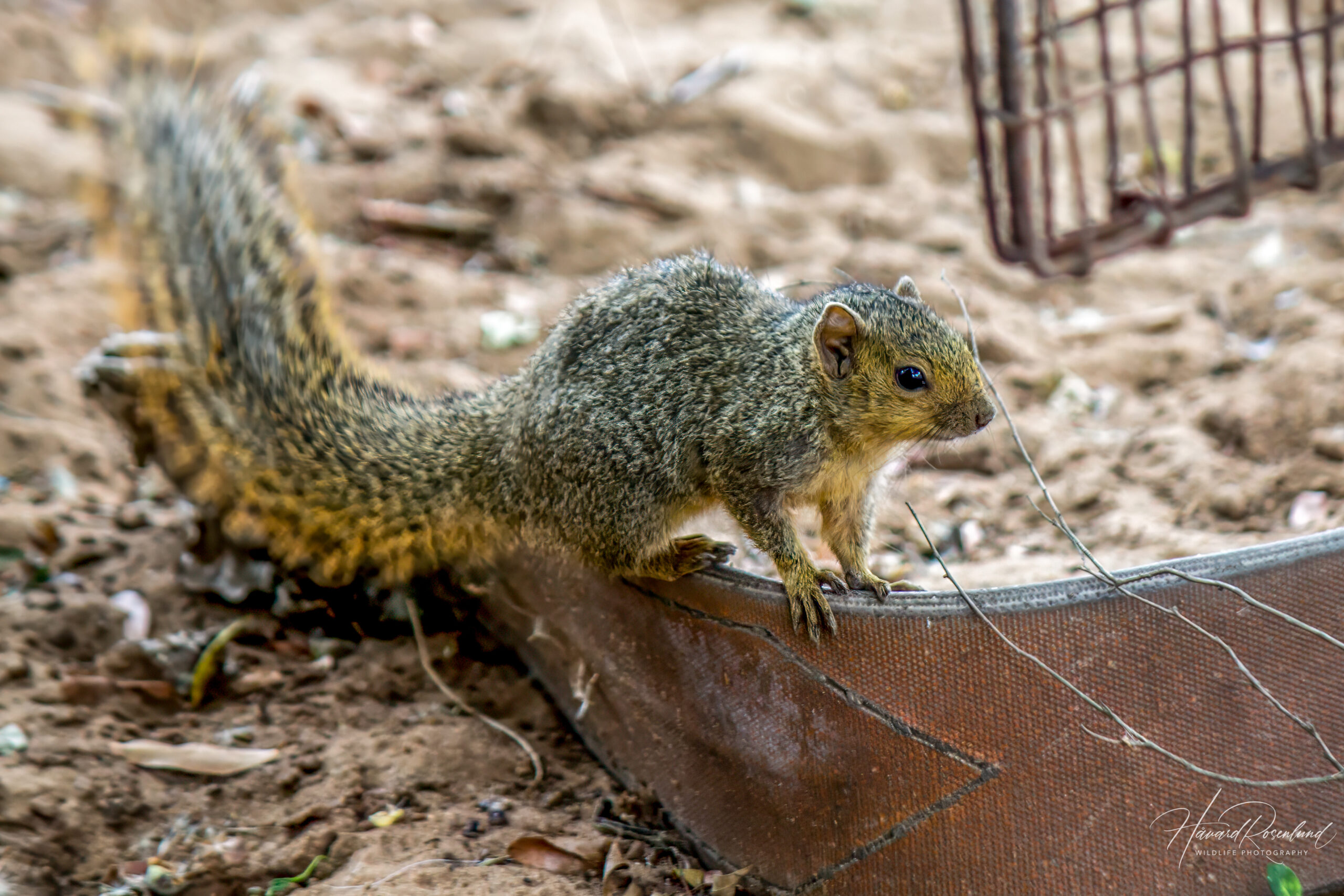
Red Bush Squirrel
Paraxerus palliatus
At a glance
Habitat
- Coastal, sand, riverine, evergreen and montane forest, woodland and dense thicket
Diet
- Fruit, seeds, nuts, buds, bark, leaves, fungi and insects
Activity
- Diurnal
Size
- Length: about 35–43 cm including tail Weight: roughly 200–370 g
Range
- Patchily distributed from southern Somalia along eastern Africa to KwaZulu-Natal
Description
The red bush squirrel or red-bellied coast squirrel (Paraxerus palliatus) is an arboreal forest squirrel distributed in a patchy coastal and near-coastal band from southern Somalia to KwaZulu-Natal in South Africa. Total length is roughly 35–43 cm, about half of which is tail, and adults weigh approximately 200–370 g.
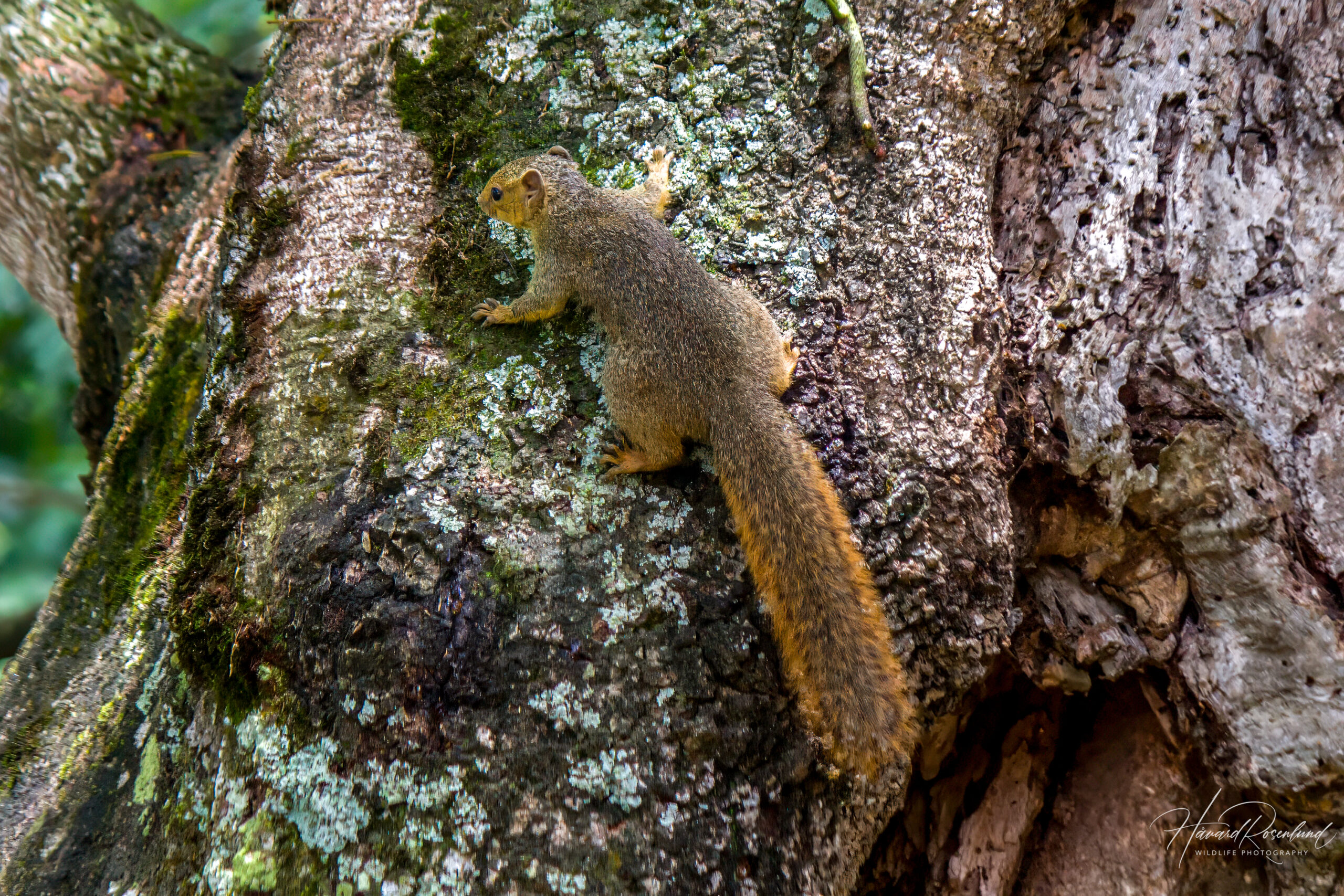
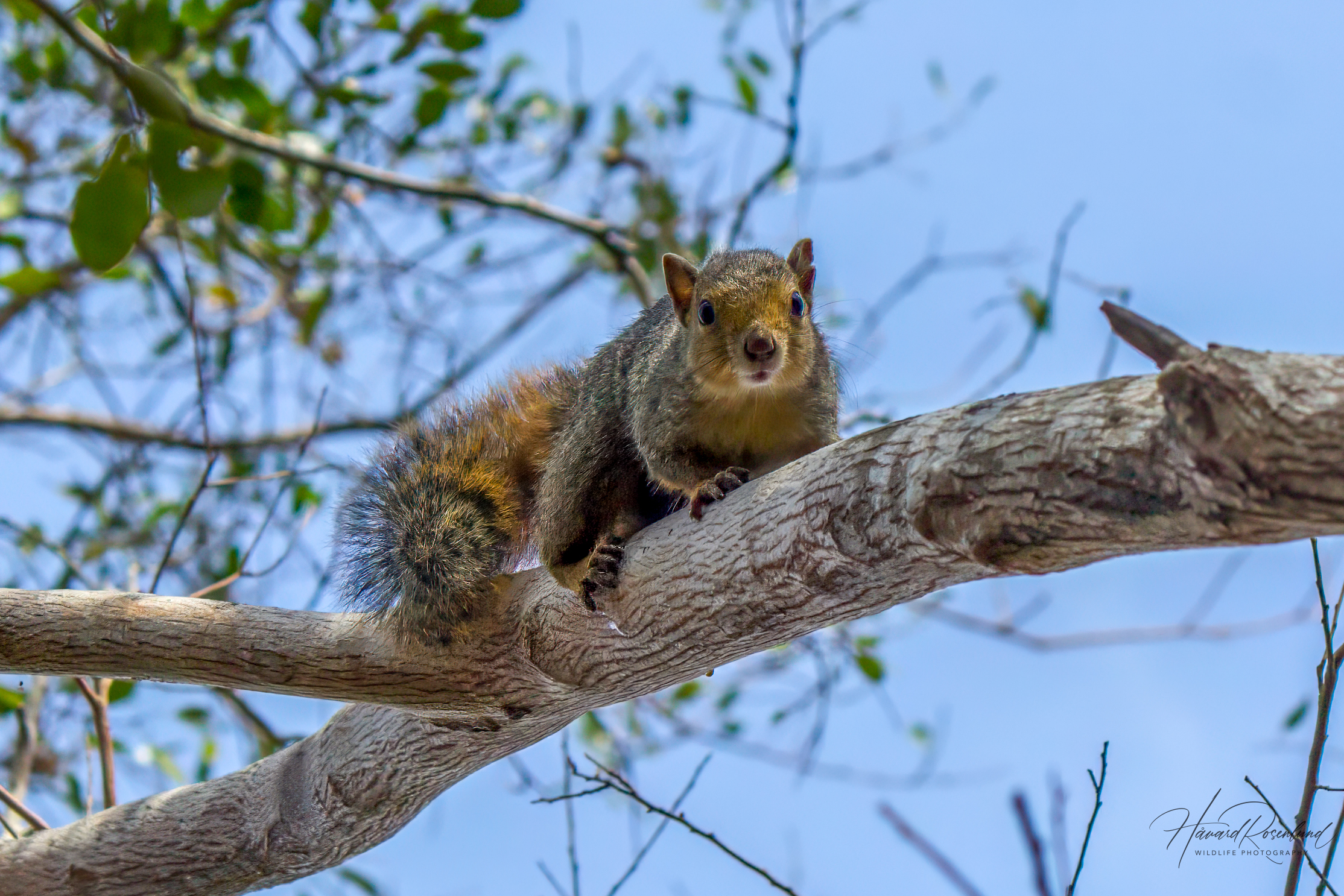
Colour varies strongly across the range. The back is usually grey-brown to dark brown, while the face, legs, underparts and bushy tail range from orange to deep reddish brown. Animals from cool, moist montane forest tend to be larger and darker than those from dry coastal forest.
Taxonomy
The Mammal Diversity Database currently retains the red bush squirrel as one widespread species. The 2016 South African assessment nevertheless described it as a species complex in need of genetic revision because isolated populations differ greatly in size and pelage.
Two southern forms have traditionally been named, both found in KwaZulu-Natal. The Ngoye form (Paraxerus palliatus ornatus) is a large, dark squirrel isolated in Ngoye Forest. The smaller Tonga form (Paraxerus palliatus tongensis) occurs in the coastal forests of Maputaland and around iSimangaliso. Their distinctiveness has not yet been confirmed through comprehensive molecular research.
Habitat
The species inhabits coastal forest, sand forest, riverine forest, evergreen woodland, montane forest and dense thicket. Its distribution is naturally patchy and has become more fragmented where forest has been cleared or degraded.
Diet
Fruit, seeds and nuts form much of the diet, supplemented by flower buds, bark, leaves, fungi, lichens and insects.
Foraging
Red bush squirrels search for food both in trees and on the forest floor, picking fruit and seeds from branches and investigating bark and foliage for insects and fungi. Food may be stored in the ground or in crevices for later use, and forgotten caches can contribute to seed dispersal in the forest.
Behaviour
Red bush squirrels are diurnal and mainly solitary, but their home ranges overlap. The southern forms show clear differences in space use. A study published in 1980 found average home ranges of about 4.3 ha in male Tonga squirrels and 0.7 ha in females, while the corresponding averages in the Ngoye form were about 3.2 and 2.2 ha. They are not rigidly territorial in dense forest, where visibility is limited.
Communication includes tail flicking, body jerks, murmuring, rattling calls and loud barks. Alarm calls alert nearby squirrels to predators. Individuals use tree hollows and other sheltered cavities for sleeping and may occasionally share a site in loose groups.
Reproduction
Reproduction in the southern populations is seasonal, mainly from August to March. Gestation lasts about 59–65 days, and litters normally contain one or two young. The relatively long gestation and small litter produce more developed newborns than in many temperate tree squirrels.
A study published in 1985 found that young of the southern forms remain in the nest for about 18–27 days, shorter than in many temperate tree squirrels. They are weaned after roughly six weeks and remain associated with the mother or family area for several months before dispersing. Most females appear to produce one litter during this period.
Status
The red bush squirrel is classified globally as least concern on the IUCN Red List, based on the assessment published in 2016. It remains common in several protected forests and is widespread through eastern Africa, but no current global population estimate is available.
The 2016 regional assessment for South Africa, Lesotho and Eswatini classified the species as near threatened. It estimated approximately 97,395–155,015 mature animals within the assessment region and considered the population to be declining because of continuing forest loss and fragmentation. The isolated Ngoye Forest population was assessed separately as vulnerable and estimated at about 13,392–15,120 mature animals.
Forest clearance, degradation at protected-area edges, fire, fuelwood harvesting and isolation of small forest patches are the principal regional concerns. Maintaining connected coastal, sand and scarp forest is especially important.
Image gallery
Loading map and observations…
National Red List status
| Country | Status | Assessment | Source |
|---|---|---|---|
| South Africa | NTNear Threatened | Red List of South African Species 2016 | SANBI – Red List of South African Species |
Have you seen this species?
Independent species archive
Did you find this species page useful?
Wildlife Vagabond is independently built and maintained. Voluntary support helps cover hosting, maps, data storage and continued improvements to the species archive.
Support Wildlife VagabondSpecies content will remain freely available.
References
Information about the species’ global distribution and status is based primarily on global Red List data. See the references below for details.
- International Union for Conservation of Nature. (2016). Paraxerus palliatus (Red Bush Squirrel). The IUCN Red List of Threatened Species. https://www.iucnredlist.org/species/16210/115132374
- Louw, S., Coverdale, B., & Child, M. F. (2016). A conservation assessment of <i>Paraxerus palliatus</i>. South African National Biodiversity Institute and Endangered Wildlife Trust. https://ewt.org/wp-content/uploads/2022/11/49.-Red-Squirrel-Paraxerus-palliatus_NT.pdf
- Mammal Diversity Database. (n.d.). Paraxerus palliatus: current taxonomy and distribution. American Society of Mammalogists. https://www.mammaldiversity.org/taxon/1001827/
- South African National Biodiversity Institute. (n.d.). Paraxerus palliatus regional assessment and bibliography. https://speciesstatus.sanbi.org/assessment/last-assessment/2178/
- Viljoen, S., & Du Toit, S. H. C. (1985). Postnatal Development and Growth of Southern African Tree Squirrels in the Genera Funisciurus and Paraxerus. Journal of Mammalogy, 66(1), 119-127. https://doi.org/10.2307/1380963
- Viljoen, S. (1983). Activity parameters relative to habitat in four southern African tree squirrels. South African Journal of Zoology, 18(2), 134-138. https://doi.org/10.1080/02541858.1983.11447826
- Viljoen. (1980). A comparative study on the biology of Paraxerus palliatus tongensis and P. p. ornatus in Zululand. https://repository.up.ac.za/handle/2263/83188