
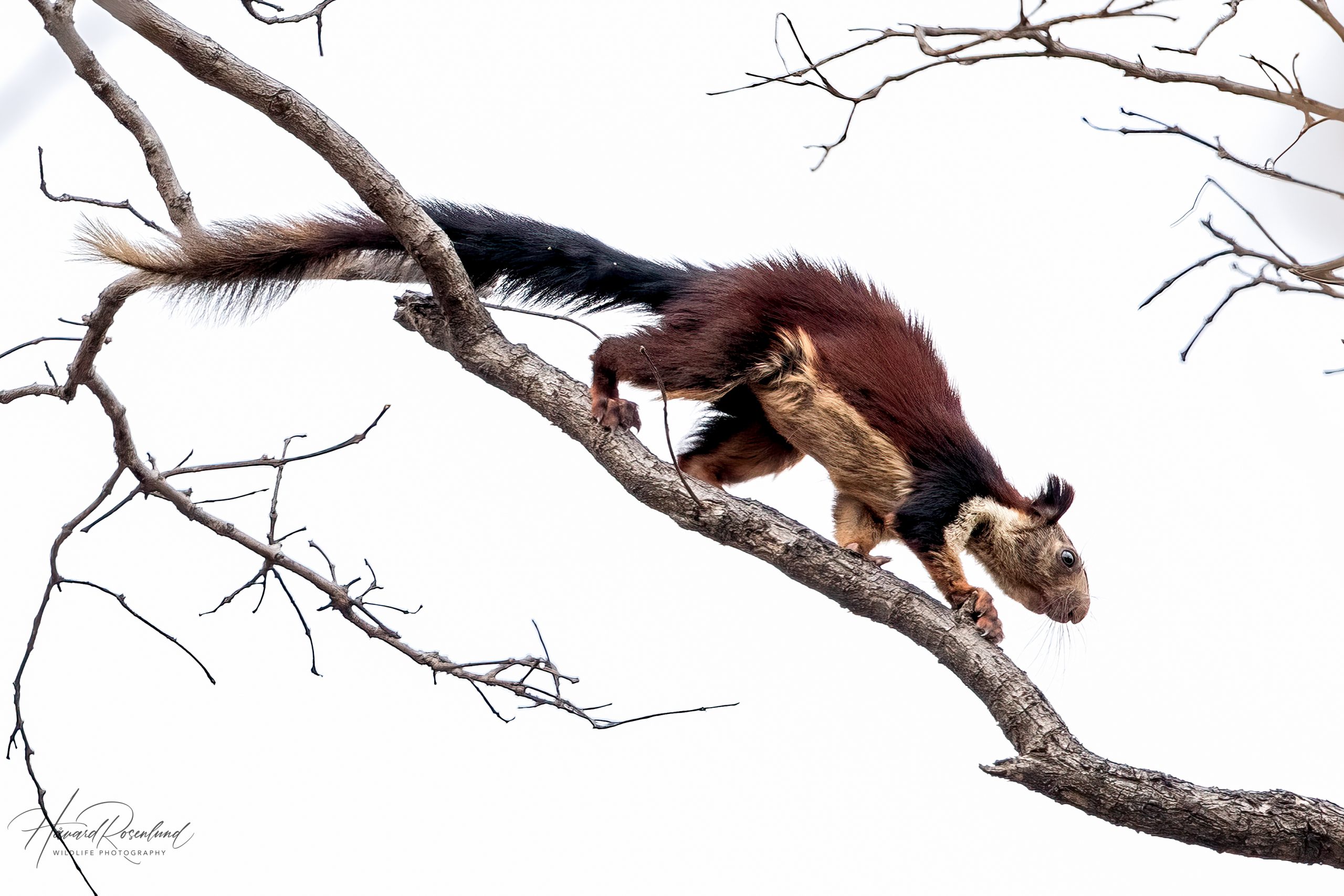
Indian Giant Squirrel
Ratufa indica
At a glance
Habitat
- Evergreen, semi-evergreen and moist or dry deciduous forest with connected canopy
Diet
- Mainly fruit, seeds, flowers, buds, leaves and other plant material
Activity
- Diurnal; strongest activity usually in the morning and late afternoon
Size
- Length: 25–46 cm head–body; tail about as long Weight: 1.5–2 kg
Range
- Peninsular and central India
Description
The Indian giant squirrel (Ratufa indica), also known as the Malabar giant squirrel, is a large and striking tree squirrel found only in India. Head-and-body length is about 25–46 cm, with a tail of roughly similar length, and adults generally weigh around 1.5–2 kg.
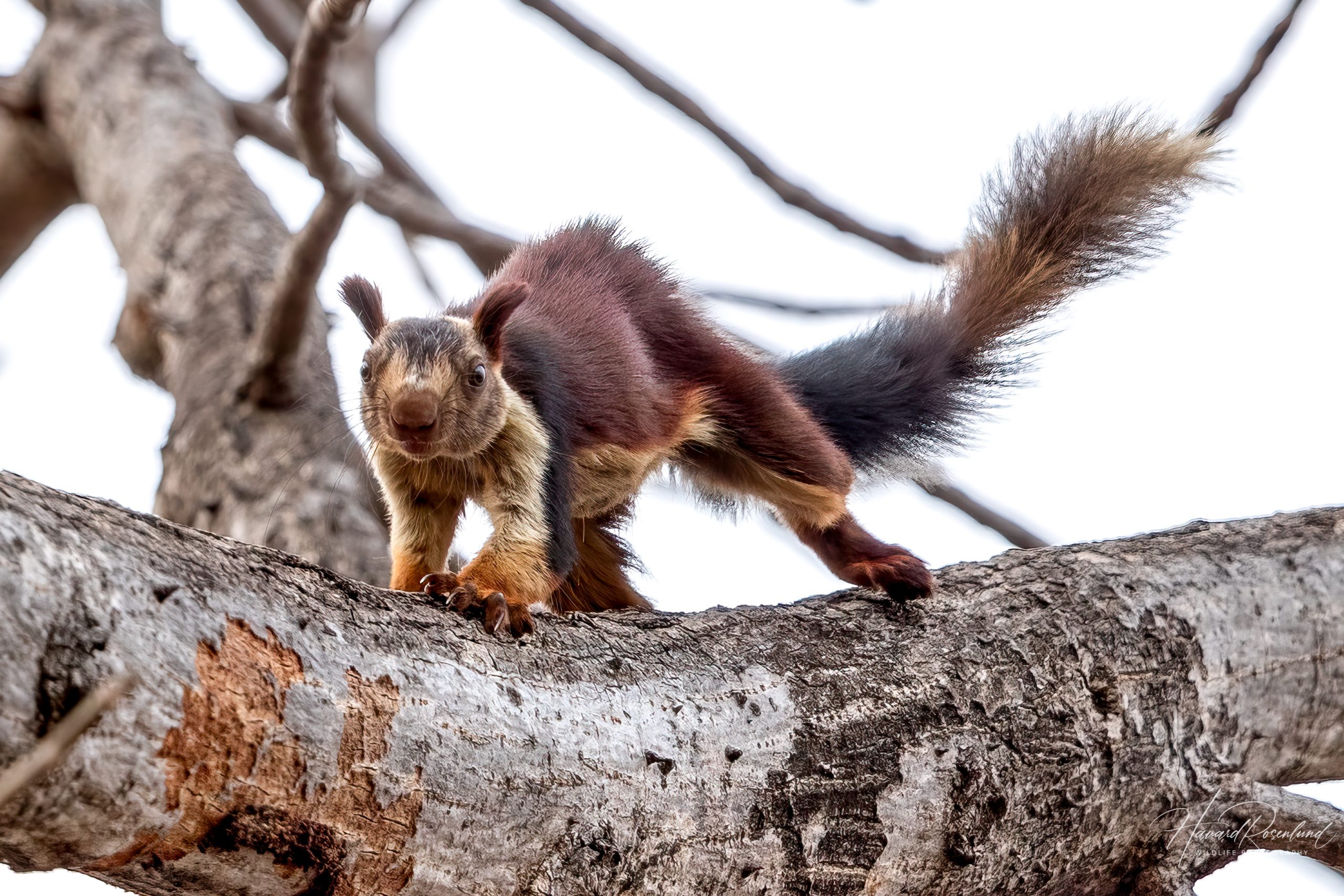
Coat colour varies greatly across its range and between recognised geographic forms. Deep maroon, reddish brown, black, cream and sometimes purplish tones can occur, usually in bold contrasting patches. Powerful claws, broad gripping feet and a long balancing tail are all adaptations for moving through the forest canopy.
Habitat
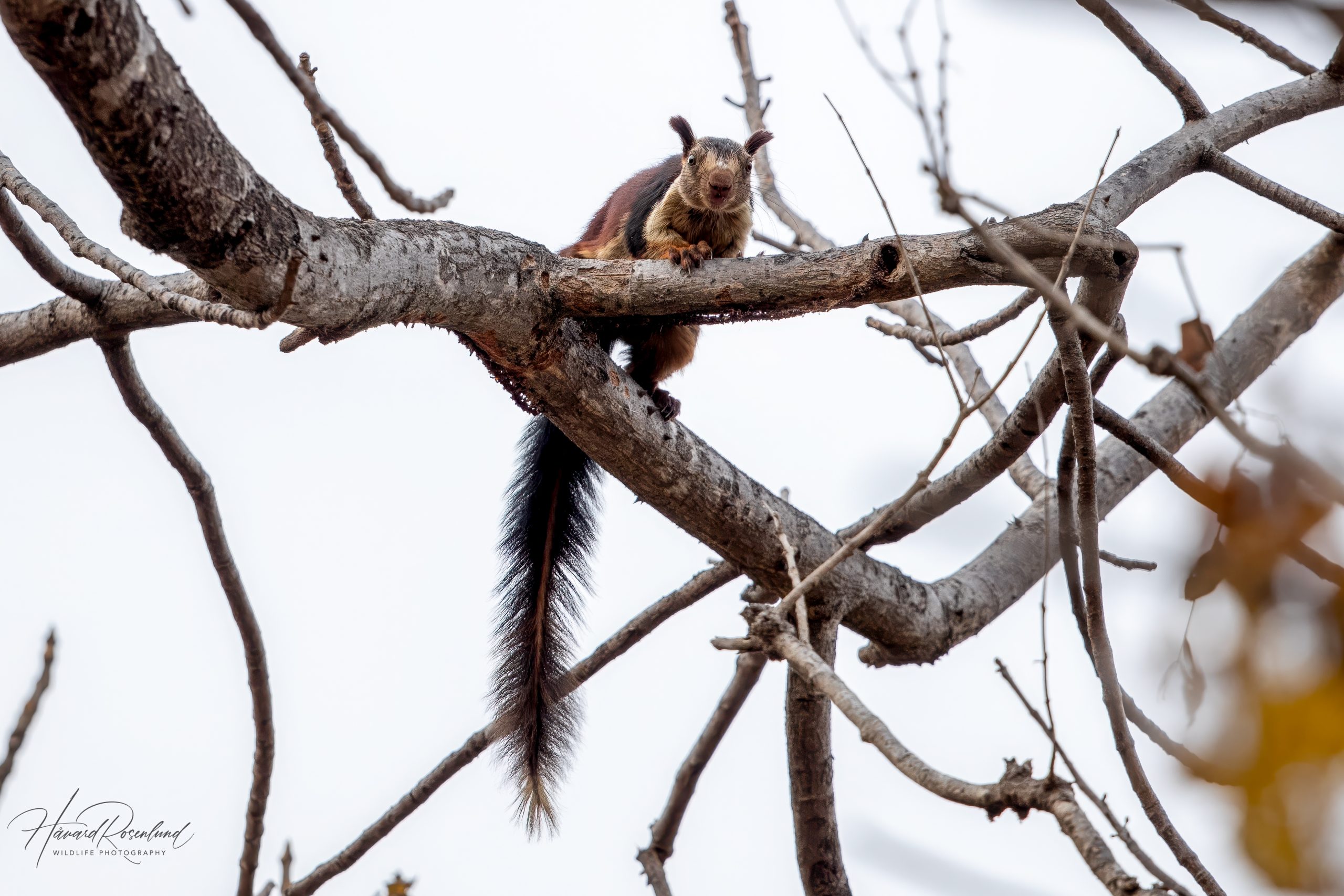
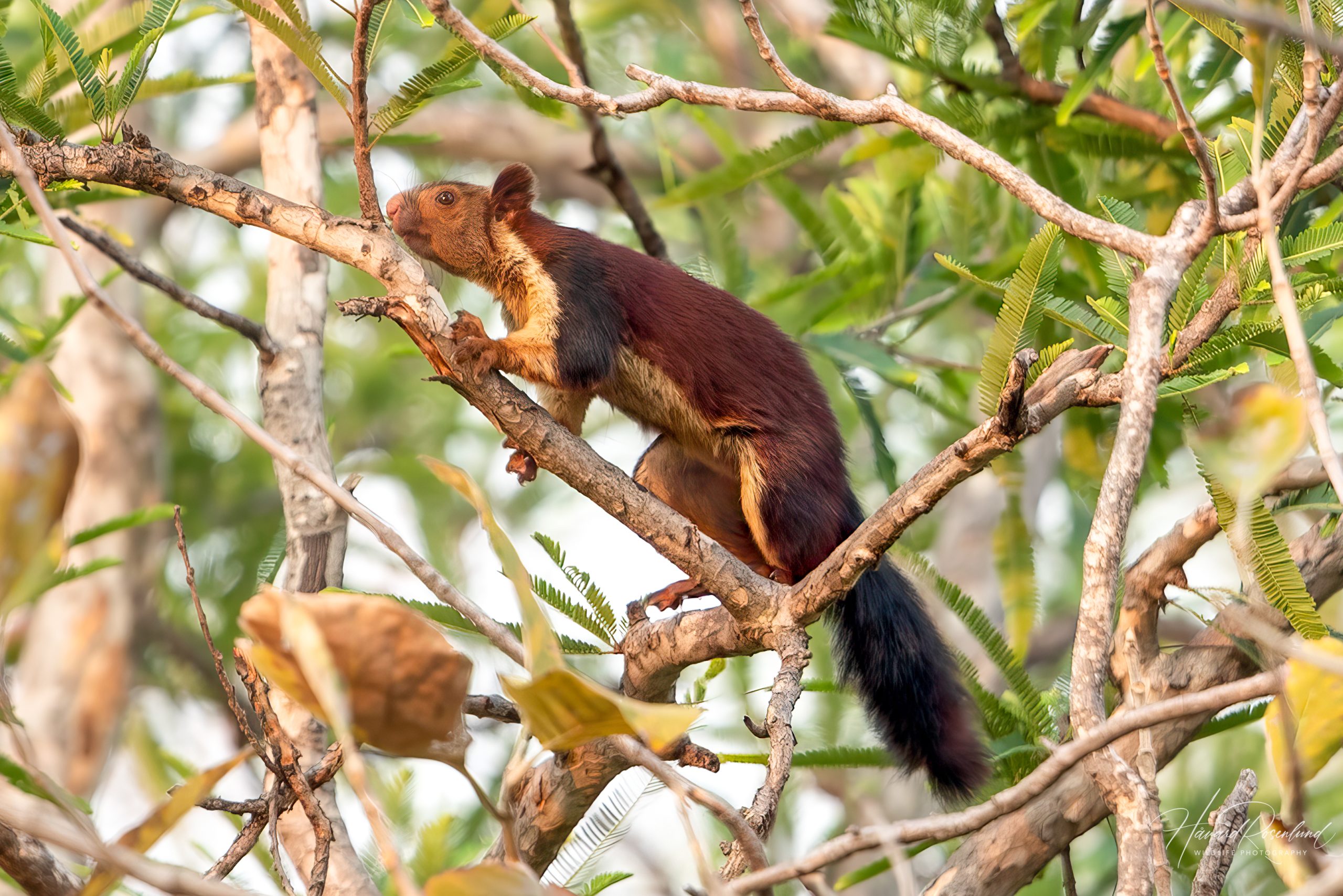
Indian giant squirrels inhabit evergreen, semi-evergreen and moist or dry deciduous forests across peninsular and central India. They spend almost their entire lives in trees and are most successful where mature forest provides large trees and continuous or closely connected crowns.
A 2025 study in Goa found that squirrels selected mature, tall and thick-trunked trees for nesting, with canopy connectivity and branch structure also influencing nest sites. Another 2025 study in the Palani Hills found 70 nests in exotic timber plantations, 73% of them in eucalyptus. Nest sites were concentrated closer to native rainforest, showing some flexibility in nest-site use where suitable trees and connections to native forest remain.
Diet
The diet is mainly plant-based and changes with what is available through the year. Fruit, seeds, flowers, buds, leaves, bark and soft plant tissue are all eaten, while insects, bird eggs and other animal food are taken occasionally.
Food is handled with the forefeet while the squirrel balances on a branch or sits upright. Indian giant squirrels can also store food. A study published in 2007 from Bhimashankar Wildlife Sanctuary in the Western Ghats documented an unusual form of arboreal larder-hoarding: seeds from six tree and liana species were stored inside nests high in the canopy during the fruiting season. Such stores make food gathered during periods of abundance available later.
Behaviour
Indian giant squirrels are active by day and usually live alone, although pairs may associate during breeding. Field studies commonly find a strong morning activity peak and a smaller rise in activity later in the afternoon, with more resting during the hottest part of the day.
They rarely need to descend to the ground. Powerful limbs allow them to cross gaps in the canopy with long jumps. Leaps of up to about 6 m have been reported. Loud calls are used for alarm and long-distance communication. Individuals may maintain several large dreys within a home range and use them for rest and refuge as well as breeding. Connected crowns provide travel routes, access to multiple shelters and several escape directions when predators approach.
Reproduction
Reproduction is less well documented than the species' feeding and nesting ecology, and timing appears to vary between regions. Breeding may occur during more than one period of the year, and males compete for access to females.
The female raises the young in a large spherical canopy nest built from leafy twigs. Litters usually contain one or two young, although three have been recorded. The young are born dependent on the female and remain associated with the nest until they become increasingly mobile in the canopy. Reliable species-specific figures for gestation, weaning and lifespan in the wild remain limited.
Status
The Indian giant squirrel is classified as least concern on the IUCN Red List. The population trend is considered decreasing, with forest loss, degradation, fragmentation and hunting affecting populations locally. Because this squirrel depends so strongly on trees, loss of large nesting trees and breaks in canopy connectivity can be particularly important.
A study published in 2025 from Satkosia Wildlife Sanctuary in Odisha estimated an average density of 38.7 squirrels per km², indicating a locally strong population, and also documented daily activity, feeding and nesting behaviour. This local result shows that the species can occur at high densities in suitable forest, while mature trees and connected canopy remain important across the range.
Image gallery
Loading map and observations…
Have you seen this species?
Independent species archive
Did you find this species page useful?
Wildlife Vagabond is independently built and maintained. Voluntary support helps cover hosting, maps, data storage and continued improvements to the species archive.
Support Wildlife VagabondSpecies content will remain freely available.
References
Information about the species’ global distribution and status is based primarily on global Red List data. See the references below for details.
- Animal Diversity Web. (n.d.). Ratufa indica. https://animaldiversity.org/accounts/Ratufa_indica/
- Aravind, P., Ganguli, S. P., D’Souza, S., & Rajamani, N. (2025). Exotic timber plantations as nesting sites for the endemic Indian Giant Squirrel Ratufa indica in the Palani Hills, Western Ghats, India. Global Ecology and Conservation, 64, e03916. https://doi.org/10.1016/j.gecco.2025.e03916
- Baskaran, N., Venkatesan, S., Mani, J., Srivastava, S. K., & Desai, A. A. (2011). Some aspects of the ecology of the Indian Giant Squirrel Ratufa indica (Erxleben, 1777) in the tropical forests of Mudumalai Wildlife Sanctuary, southern India and their conservation implications. Journal of Threatened Taxa, 3(7), 1899-1908. https://doi.org/10.11609/JoTT.o2593.1899-908
- International Union for Conservation of Nature. (n.d.). Ratufa indica. The IUCN Red List of Threatened Species. https://www.iucnredlist.org/species/19378/22262028
- Mammal Diversity Database. (n.d.). American Society of Mammalogists – Mammal Diversity Database: Ratufa indica. American Society of Mammalogists. https://www.mammaldiversity.org/taxon/1001608/
- Palei, H. S., Sahu, H. K., & Nayak, A. K. (2015). Population Density, Diurnal Activity Pattern and Food Preference of Indian Giant SquirrelRatufa indicain Similipal Tiger Reserve, Eastern India. Mammal Study, 40(4), 257-263. https://doi.org/10.3106/041.040.0406
- Pradhan, A. K., Shrotriya, S., Rout, S. D., & Dash, P. K. (2017). Nesting and feeding habits of the Indian giant squirrel (Ratufa indica) in Karlapat wildlife sanctuary, India. Animal Biodiversity and Conservation, 40(1), 63–69. https://doi.org/10.32800/abc.2017.40.0063
- Sethy, P. G. S., Deuti, K., & Tripathy, B. (2025). Status of the giant squirrel, <i>Ratufa indica</i> (Erxleben, 1777) in Satkosia Wildlife Sanctuary, Odisha. Records of the Zoological Survey of India, 13-24. https://doi.org/10.26515/rzsi/v125/i1S/2025/172951
- Somanathan, H., Mali, S., & Borges, R. M. (2007). Arboreal larder-hoarding in the tropical Indian giant squirrel Ratufa indica. Écoscience, 14(2), 165–169. https://doi.org/10.2980/1195-6860(2007)14[165:ALITTI]2.0.CO;2
- Yadav, A. K., Dias, S. J., & Porob, P. C. (2025). Factors influencing nesting tree selection by the Indian giant squirrel (Ratufa indica) in the forest areas of Bondla Zoological Park, Goa, India. Mammalian Biology, 105(6), 709-719. https://doi.org/10.1007/s42991-025-00512-z