
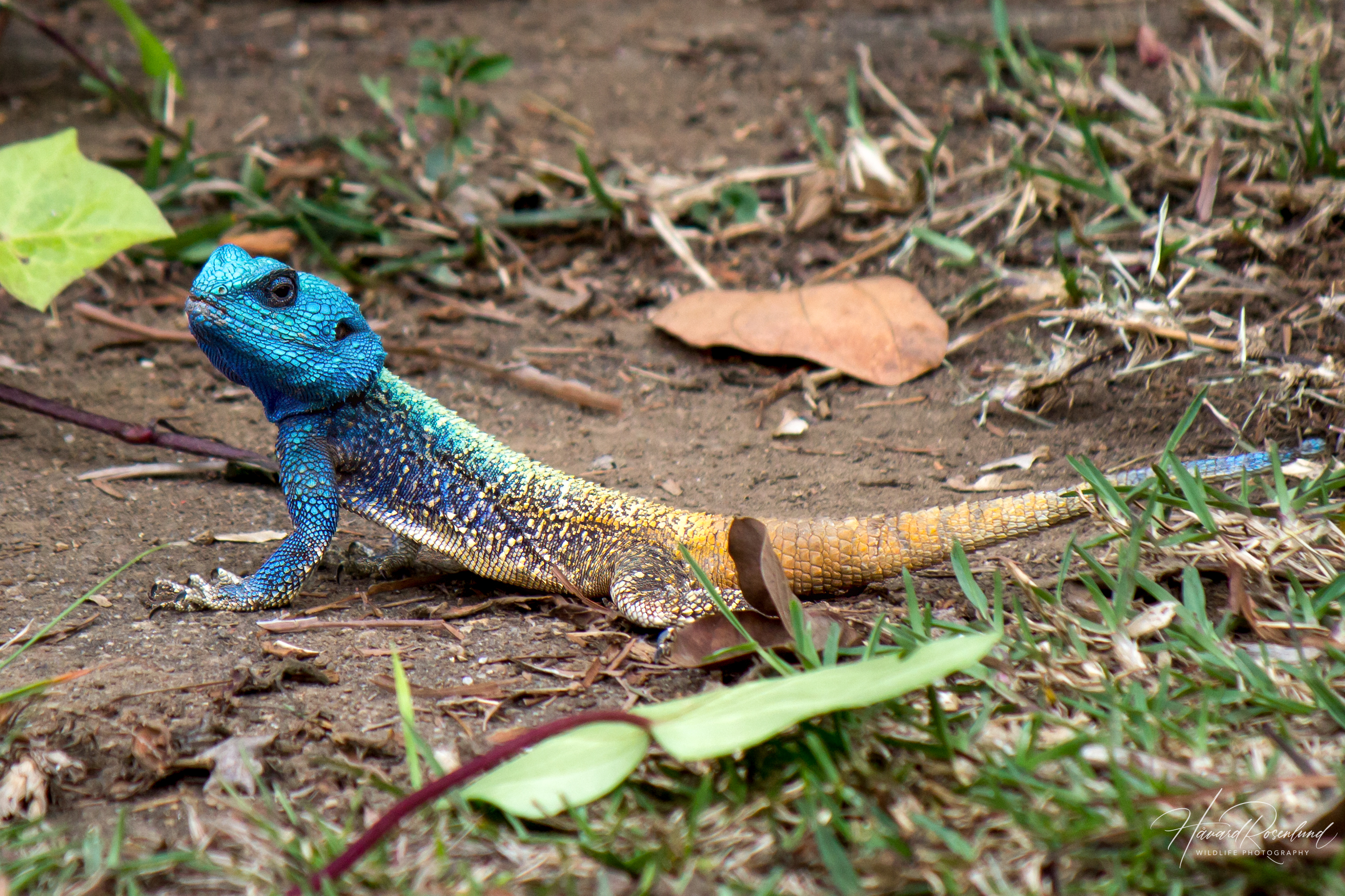
Southern Tree Agama
Acanthocercus atricollis
At a glance
Habitat
- Tree-rich savanna, woodland, forest edges and urban areas
Diet
- Arthropods, especially ants, beetles and orthopterans
Activity
- Diurnal; basking and ambush-foraging
Size
- Length: body up to about 16.7 cm Weight: —
Range
- South Africa, Eswatini, Botswana, Zimbabwe, Malawi, Mozambique and Kenya; exact limits remain uncertain
Description
The southern tree agama (Acanthocercus atricollis) is a robust, mostly arboreal agama of southern and southeastern Africa. Adults have a long tail and a spiny ridge along the back. The largest snout-to-vent length reported from southern African populations is about 16.7 cm, excluding the tail.
Mature males develop a striking blue head and throat and have proportionally larger heads than females of the same body size, while females and juveniles are more subdued in olive, brown or grey. The enlarged male head reflects strong competition between territorial males, while the vivid breeding colours provide conspicuous visual signals.
Taxonomy
The name Acanthocercus atricollis once covered a much broader assemblage of blue-headed tree agamas across eastern, central and southern Africa. An integrative taxonomic revision published in 2018 showed that this widespread form was a species complex and elevated several former subspecies to full species.
No subspecies are currently recognised within A. atricollis. Populations formerly included under this name in parts of Namibia, Angola and elsewhere are now assigned to other species. Older field guides and range maps can therefore show a substantially broader distribution than applies under current species limits.
Habitat
Southern tree agamas occur mainly in tree-rich savanna, woodland and forest-edge habitats. Trees provide elevated basking sites, lookout points, feeding stations and refuges, and animals spend much of their time on trunks and branches.
They also use gardens and urban areas where trees or human-made structures provide similar vertical surfaces and shelter. Individuals descend to the ground to cross between trees or exploit prey, but the species remains strongly associated with elevated structures.
Diet
The diet includes a broad spectrum of arthropods. Ants dominate numerically, while larger prey such as orthopterans and beetles contribute much more of the food volume. Millipedes and several other arthropod groups are also taken, making the species less narrowly specialised than the high number of ants alone might suggest.
Juveniles eat proportionally more ants and fewer large prey items than adults. As body and head size increase, larger beetles and orthopterans make up a greater share of the diet.
Hunting
The southern tree agama is a classic ambush forager. A South African field study published in 2002 found that adults spent only about 4% of their time moving, instead waiting from a perch and making short attacks when prey came within range.
Elevated trunks and branches serve as hunting lookouts as well as basking sites. Long periods of stillness are interrupted by sudden short movements when prey is detected, while individuals may also descend to the ground to exploit available arthropods.
Behaviour
Adult males defend territories and can engage in direct combat with rivals. Elevated trunks and branches are also used for basking and displaying, and males maintain relatively stable activity areas.
During the breeding season males move more widely as they patrol and interact with females and competing males.
Reproduction
Reproduction is seasonal. The same South African study found that male reproductive activity peaked around August–September, while females developed enlarged follicles from August into December. Females appeared to produce only one clutch within a breeding season.
Mean clutch size in the same material was about 11.3 eggs and increased with female body size. The eggs are laid on land, and the hatchlings receive no parental care and are independent from the time they emerge.
Relationship with humans
Southern tree agamas can adapt well to some urban environments. A study published in 2021 in Pietermaritzburg found the species at high density in built-up areas, using brick walls, buildings and other structures for basking, shelter and movement much as it uses tree trunks and branches in natural habitats.
Urban survival therefore depends strongly on habitat structure. Buildings can provide useful vertical surfaces, but suitable refuges, basking sites and enough arthropod prey are still required.
Status
The southern tree agama is classified as least concern on the IUCN Red List. It remains widespread under its revised species limits and tolerates a range of natural and human-modified habitats.
No major range-wide threat is currently recognised, although local populations can be affected by removal of trees, persecution or changes that eliminate suitable basking and refuge sites.
Image gallery
Loading map and observations…
Have you seen this species?
Independent species archive
Did you find this species page useful?
Wildlife Vagabond is independently built and maintained. Voluntary support helps cover hosting, maps, data storage and continued improvements to the species archive.
Support Wildlife VagabondSpecies content will remain freely available.
References
Information about the species’ global distribution and status is based primarily on global Red List data. See the references below for details.
- International Union for Conservation of Nature. (2020). Acanthocercus atricollis. The IUCN Red List of Threatened Species. https://www.iucnredlist.org/species/110132395/20519412
- Reaney, L. T., & Whiting, M. J. (2002). Life on a limb: ecology of the tree agama (Acanthocercus a. atricollis) in southern Africa. Journal of Zoology, 257(4), 439-448. https://doi.org/10.1017/S0952836902001048
- Singh, N., Price, C., & Downs, C. T. (2021). Aspects of the ecology and behaviour of a potential urban exploiter, the southern tree agama, Acanthocercus atricollis. Urban Ecosystems, 24(5), 905-914. https://doi.org/10.1007/s11252-020-01078-z
- The Reptile Database. (2026). Acanthocercus atricollis – current taxonomy and distribution. https://reptile-database.reptarium.cz/species?genus=Acanthocercus&species=atricollis
- Wagner, P., Greenbaum, E., Bauer, A. M., Kusamba, C., & Leaché, A. D. (2018). Lifting the blue-headed veil – integrative taxonomy of theAcanthocercus atricollisspecies complex (Squamata: Agamidae). Journal of Natural History, 52(13-16), 771-817. https://doi.org/10.1080/00222933.2018.1435833
- Whiting, M. J., Chetty, K., Twine, W., & Carazo, P. (2009). Impact of human disturbance and beliefs on the tree agama Acanthocercus atricollis atricollis in a South African communal settlement. Oryx, 43(4), 586–590. https://doi.org/10.1017/S0030605309990160