
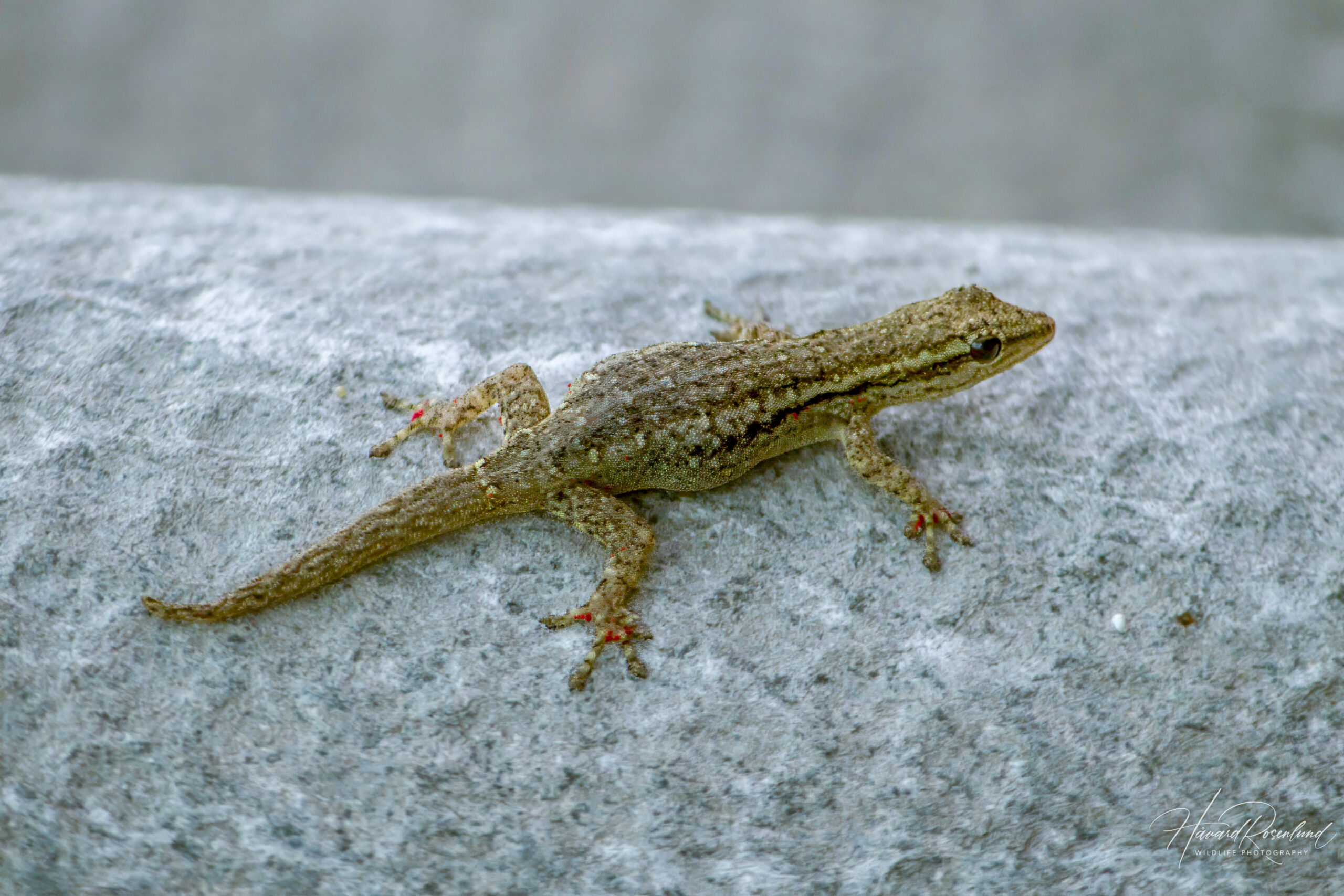
Cape Dwarf Gecko
Lygodactylus capensis
At a glance
Habitat
- Savanna, woodland, forest, scrub and human-modified habitats
Diet
- Insectivore; especially ants and termites
Activity
- Diurnal
Size
- Length: ~7–8 cm Weight: ~0.9 g
Range
- Eastern, central and southern Africa; introduced populations also occur beyond the native range within South Africa
Description
The Cape dwarf gecko (Lygodactylus capensis), also widely called the common dwarf gecko, is a tiny, slender gecko of eastern, central and southern Africa. Adults are about 4 cm in snout–vent length and roughly 7–8 cm in total length. The upperparts vary from grey and brown to olive, often with a pale line running from behind the eye along the flank, while the underside is much lighter.
Unlike the mostly nocturnal image many people have of geckos, this species is active by day. Broad adhesive pads beneath the toes allow it to move rapidly over trunks, rocks, walls and other steep or smooth surfaces, while modified scales beneath the tail tip provide additional grip.
Taxonomy
Lygodactylus capensis is currently treated as a monotypic species, with no recognised subspecies. Several forms formerly included as subspecies have already been recognised as separate species.
The present classification may still hide further diversity. The very widespread L. capensis complex probably contains additional undescribed or unrecognised species, so its boundaries may change as genetic and morphological work continues.
Habitat
Cape dwarf geckos inhabit savanna, woodland, forest and scrub, usually climbing on tree trunks, branches, rocks and other above-ground surfaces. They are especially successful in relatively warm, well-vegetated environments where small arthropods are abundant.
The species also adapts exceptionally well to gardens, towns and buildings. Walls, fences, ornamental vegetation and planted trees provide suitable climbing surfaces and feeding areas, allowing the gecko to live in close association with people.
Diet
Cape dwarf geckos are insectivorous and take very small arthropods, with ants and termites making up most of the diet. Other small insects and arthropods are also taken.
Much feeding takes place on trunks, branches, walls and other vertical surfaces. The adhesive feet allow the gecko to pursue small prey quickly without returning to the ground, while its tiny body size gives access to narrow cracks and fine branches that larger lizards cannot exploit as easily.
Behaviour
Cape dwarf geckos are active by day and move rapidly over trunks, branches, rocks and walls. When threatened they may freeze against the surface or dart around the opposite side of a trunk, branch or rock, keeping the object between themselves and the danger.
They are also capable jumpers. Individuals with intact tails and those that had recently shed the tail both made successful jumps of up to about nine times their snout–vent length. Tail loss therefore had little effect on maximum jumping distance, although the tail may still help control landing and movement on vertical surfaces. Escape running is affected differently: a study published in 2009 found that tailless geckos ran more slowly and covered shorter distances during strenuous escape exercise.
Like many lizards, the species can deliberately shed the tail through autotomy when attacked. The tail later regenerates, including the specialised adhesive tip. Tail loss is common and regeneration rapid, showing how important autotomy can be as an escape strategy despite the temporary costs to locomotion.
Reproduction
Breeding can continue throughout the year where conditions are suitable. Females lay one, more often two, hard-shelled eggs in protected cracks, beneath loose bark or in similar sheltered sites. Several females may use the same place, so communal egg-laying sites can accumulate many eggs.
Sexual maturity is reached quickly, at around eight months. The eggs may take roughly two to five months to hatch, depending on conditions. Hatchlings receive no parental care and are independent from emergence.
Introduced populations
Within South Africa, the Cape dwarf gecko has spread far beyond parts of its native northeastern range. Records of isolated populations since the 1980s show repeated long-distance jumps caused by human transport, with new colonies appearing mainly in towns and other places separated from the natural range.
Plants, building materials and other transported goods are likely pathways because the geckos and their eggs can hide in small crevices. A study published in 2019 found that the species had rapidly expanded its range, persisted at invaded sites and was continuing to spread across South Africa. Numerous introduced subpopulations are now known, especially in urban areas.
This expansion does not mean that the gecko is alien throughout South Africa. It is indigenous in a substantial part of the country and invasive only where human transport has carried it beyond its native range.
Status
The Cape dwarf gecko is classified as least concern on the IUCN Red List. It has a broad African distribution and is common in many natural and human-modified habitats.
Its ability to live in settlements and establish introduced populations shows considerable ecological tolerance, and no major threat is known across its range.
Image gallery
Loading map and observations…
Have you seen this species?
Independent species archive
Did you find this species page useful?
Wildlife Vagabond is independently built and maintained. Voluntary support helps cover hosting, maps, data storage and continued improvements to the species archive.
Support Wildlife VagabondSpecies content will remain freely available.
References
Information about the species’ global distribution and status is based primarily on global Red List data. See the references below for details.
- Fleming, P. A., & Bateman, P. W. (2012). Autotomy, tail regeneration and jumping ability in Cape dwarf geckos (Lygodactylus capensis) (Gekkonidae). African Zoology, 47(1), 55-59. https://doi.org/10.1080/15627020.2012.11407523
- Fleming, P. A., Verburgt, L., Scantlebury, M., Medger, K., & Bateman, P. W. (2009). Jettisoning Ballast or Fuel? Caudal Autotomy and Locomotory Energetics of the Cape Dwarf GeckoLygodactylus capensis(Gekkonidae). Physiological and Biochemical Zoology, 82(6), 756-765. https://doi.org/10.1086/605953
- International Union for Conservation of Nature. (n.d.). Cape Dwarf Gecko. The IUCN Red List of Threatened Species. https://www.iucnredlist.org/species/196917/45061082
- Rebelo, A. D., Bates, M. F., Burger, M., Branch, W. R., & Conradie, W. (2019). Range expansion of the Common Dwarf Gecko, Lygodactylus capensis: South Africa’s most successful reptile invader. Herpetology Notes, 12, 643–650. https://www.biotaxa.org/hn/article/view/46230
- South African National Biodiversity Institute. (n.d.). SANBI Biodiversity Advisor – Lygodactylus capensis. https://biodiversityadvisor.sanbi.org/search/detail/81031
- The Reptile Database. (n.d.). Lygodactylus capensis. https://reptile-database.reptarium.cz/Lygodactylus/capensis