
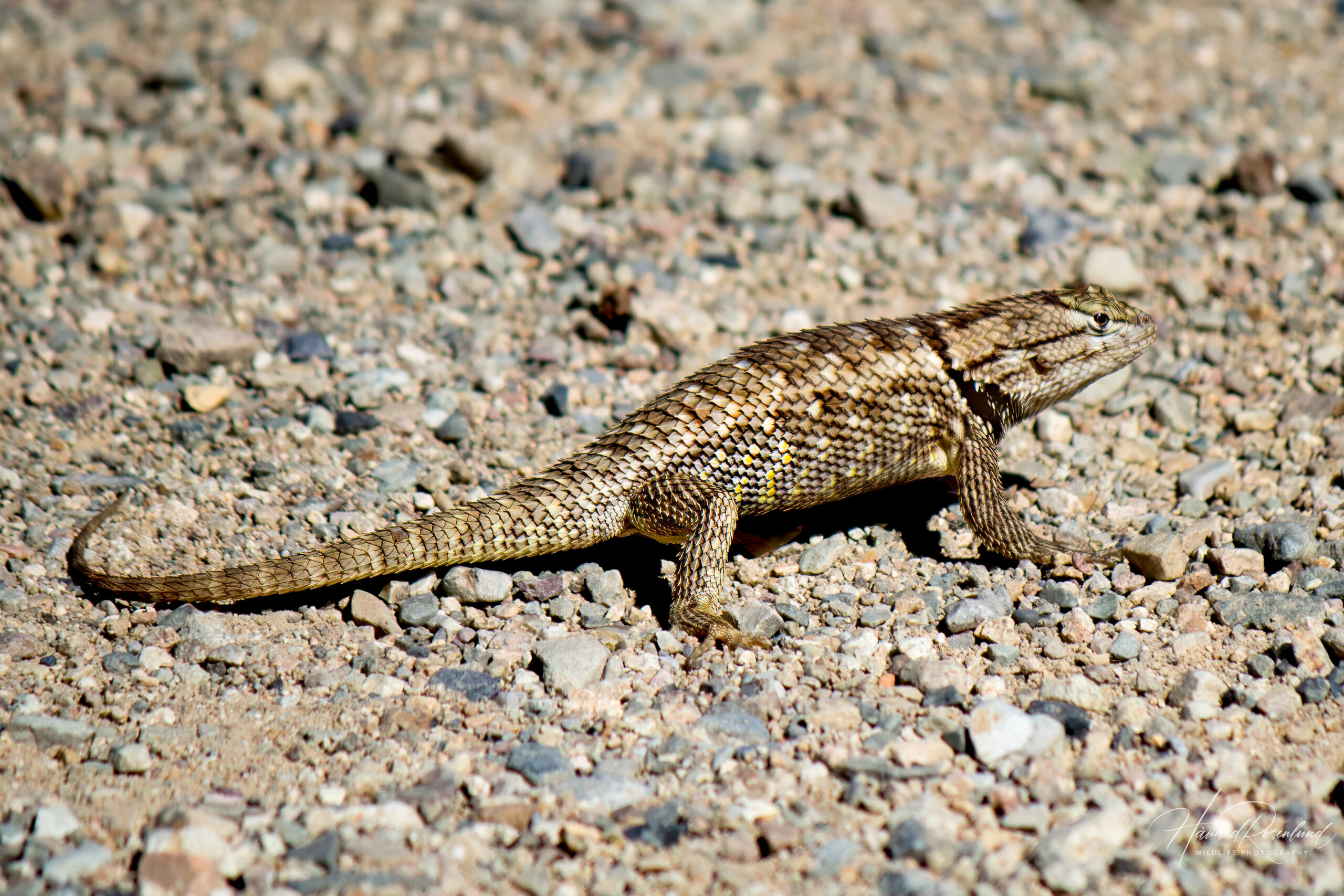
Desert Spiny Lizard
Sceloporus magister
At a glance
Habitat
- Desert scrub, semidesert grassland, rocky slopes, canyons, chaparral and open woodland.
Diet
- Mainly arthropods such as ants, beetles, caterpillars, spiders and centipedes; also small lizards and some plant material.
Activity
- Diurnal; basks in the morning and shifts between sun, shade and refuges as temperatures change.
Size
- Length: Up to about 14 cm snout–vent length, with a tail of similar length Weight: —
Range
- Primarily the Sonoran Desert under narrow current treatments; taxonomy of the northern Mojave, Great Basin and Colorado Plateau lineage remains disputed.
Description
The desert spiny lizard (Sceloporus magister) is a large, robust spiny lizard of the arid southwestern United States and adjacent Mexico. Adults can reach about 14 cm from snout to vent, with a tail of roughly similar length. Large, pointed and strongly keeled overlapping scales give the body its characteristically rough appearance.
Ground colour is usually grey, tan or brown, often with orange or yellow scales scattered along the sides. Adult males of the Sonoran form can develop a broad purple patch along the middle of the back as well as bright blue-green patches on the throat and belly; these colours are much weaker or absent in females. A dark wedge-shaped mark at each shoulder is another useful field character.
Taxonomy
The desert spiny lizard belongs to a taxonomically difficult complex. Genomic research published in 2024 found three major lineages north of Mexico: one in the Sonoran Desert, one across the Mojave Desert, Great Basin and Colorado Plateau, and a more strongly isolated lineage in the Chihuahuan Desert. The study retained these lineages within Sceloporus magister but found the Chihuahuan lineage particularly distinct.
Current classifications interpret the result differently. The 2025 SSAR list recognises the Chihuahuan lineage as the separate twin-spotted spiny lizard (S. bimaculosus) and treats the Sonoran and northern lineages as S. m. magister and S. m. uniformis. The Reptile Database instead recognises both S. bimaculosus and S. uniformis as separate species and treats S. magister as monotypic. The animals photographed on this page in the Sonoran Desert belong to the Sonoran S. magister lineage under all of these treatments.
Habitat
Desert spiny lizards inhabit desert scrub, semidesert grassland, rocky slopes and canyons, chaparral and open woodland. Although strongly associated with dry country, they are often surprisingly arboreal and may spend much of the day on tree trunks and branches.
Rock piles, wood piles, crevices and packrat nests provide important shelter from predators and extreme temperatures. In the Sonoran Desert, individuals readily use both natural vertical surfaces and structures around human settlements when suitable cover remains nearby.
Diet
The diet consists mainly of arthropods, including ants, beetles, caterpillars, spiders and centipedes. Small lizards are also taken, and some plant material is eaten.
Desert spiny lizards combine active searching with watching from elevated perches. The same rocks, trunks and branches used for basking and lookout can therefore serve as starting points for short attacks on prey.
Behaviour
Desert spiny lizards are diurnal and regulate body temperature largely through behaviour. They bask on sunlit rocks, trunks and branches, then retreat into shade, crevices, burrows or dense packrat nests as conditions become too hot or when danger approaches.
Preferred body temperature follows a clear daily rhythm and is higher during the light period than at night. Body colour can also shift somewhat lighter or darker with environmental conditions, but this is only one part of a broader thermoregulatory system. During colder parts of the year the lizards become inactive in protected retreats.
Reproduction
Reproduction occurs mainly in spring and summer. Males become more conspicuously coloured and use visual displays and territorial interactions when competing for access to females.
Females can produce one or two clutches during the warm season, with roughly 2–12 eggs reported per clutch in populations traditionally assigned to the species. Eggs are deposited in protected sites in the ground, and hatchlings begin appearing from late spring into summer. The young are independent and receive no parental care.
Status
The desert spiny lizard is classified as least concern on the IUCN Red List. That assessment predates the recent taxonomic changes and covers a broader species concept than S. magister in some current classifications.
Local populations can be reduced where desert scrub, mature trees, rock cover and other structures used for basking and refuge are removed. The Sonoran lineage remains widespread in suitable habitat, but older range and population information can include northern or Chihuahuan populations now treated separately by some authorities.
Image gallery
Loading map and observations…
Have you seen this species?
Independent species archive
Did you find this species page useful?
Wildlife Vagabond is independently built and maintained. Voluntary support helps cover hosting, maps, data storage and continued improvements to the species archive.
Support Wildlife VagabondSpecies content will remain freely available.
References
Information about the species’ global distribution and status is based primarily on global Red List data. See the references below for details.
- Engbretson, G. A., & Hutchison, V. H. (1976). Parietalectomy and thermal selection in the lizard Sceloporus magister. Journal of Experimental Zoology, 198(1), 29-38. https://doi.org/10.1002/jez.1401980105
- International Union for Conservation of Nature. (n.d.). Desert Spiny Lizard. The IUCN Red List of Threatened Species. https://www.iucnredlist.org/species/64123/12746824
- Pavón-Vázquez, C. J., Rana, Q., Farleigh, K., Crispo, E., Zeng, M., Liliah, J., Mulcahy, D., Ascanio, A., Jezkova, T., Leaché, A. D., Flouri, T., Yang, Z., & Blair, C. (2024). Gene Flow and Isolation in the Arid Nearctic Revealed by Genomic Analyses of Desert Spiny Lizards. Systematic Biology, 73(2), 323-342. https://doi.org/10.1093/sysbio/syae001
- Society for the Study of Amphibians and Reptiles. (2025). Scientific and Standard English Names, 9th edition. https://webapps.fhsu.edu/cnah/taxon.aspx?taxon=Sceloporus_magister
- The Reptile Database. (n.d.). Sceloporus magister. https://reptile-database.reptarium.cz/species?genus=Sceloporus&species=magister