
Greater Earless Lizard
Cophosaurus texanus
At a glance
Habitat
- Rocky desert slopes, bajadas, canyon margins and arid scrub, often with creosote and mesquite
Diet
- Generalist predator feeding mainly on insects, spiders and other arthropods; small lizards are also taken
Activity
- Diurnal
Size
- Length: 4.7–8.9 cm body length; tail adds roughly similar length Weight: —
Range
- Southwestern United States and northern Mexico, from Arizona and New Mexico through western Texas and adjoining Mexican states
Description
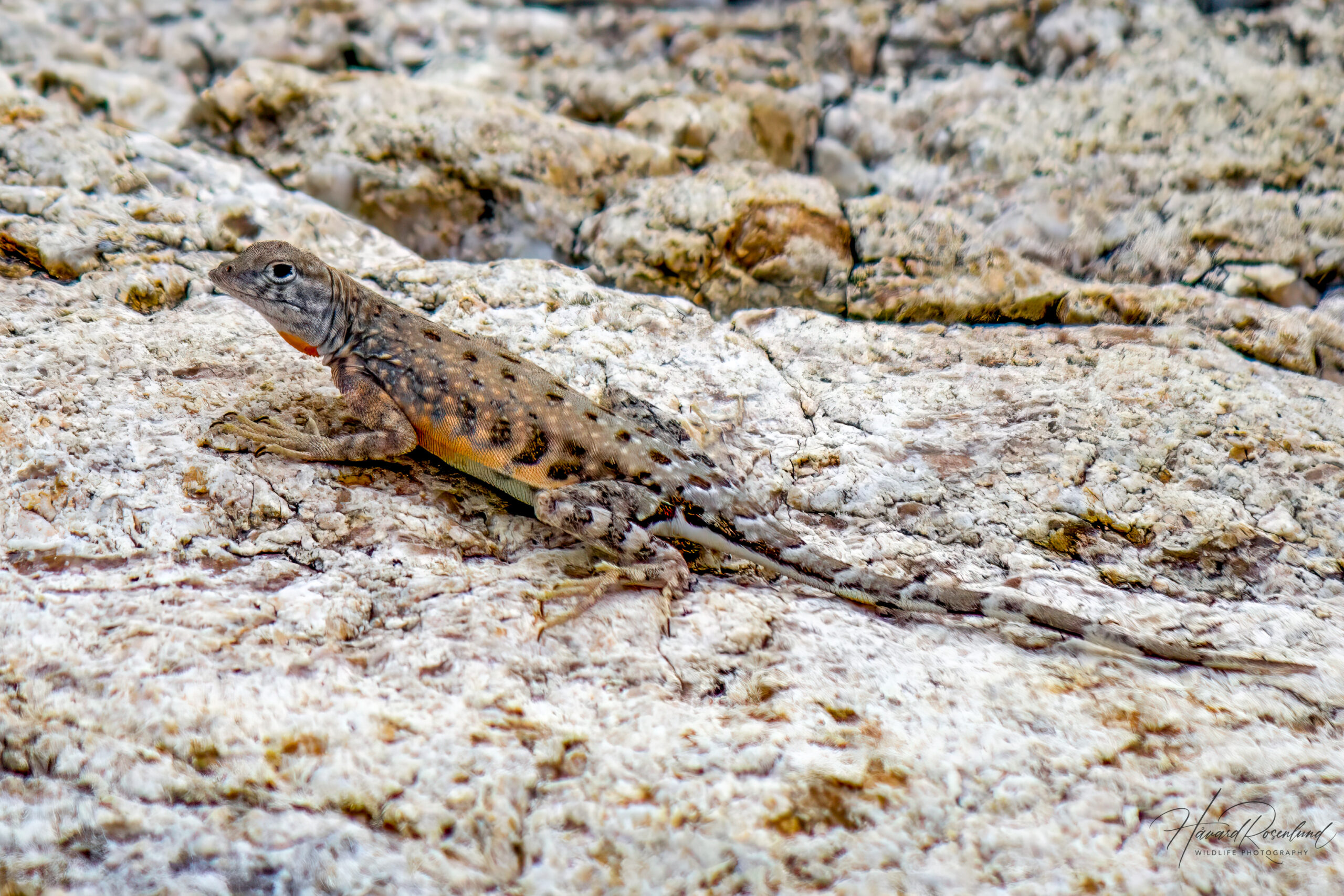
The greater earless lizard (Cophosaurus texanus) is a fast, ground-dwelling desert lizard of the southwestern United States and northern Mexico. Adults reach about 4.7–8.9 cm from snout to vent, with a long tail adding roughly a similar length. Despite the name, the lizard is not deaf: the ear is present internally, but there is no visible external ear opening. An anatomical study published in 2026 suggests that the loss of the external tympanum in earless sand lizards may be linked to substrate use during burrowing and could affect how low-frequency vibrations are transmitted through the ground.
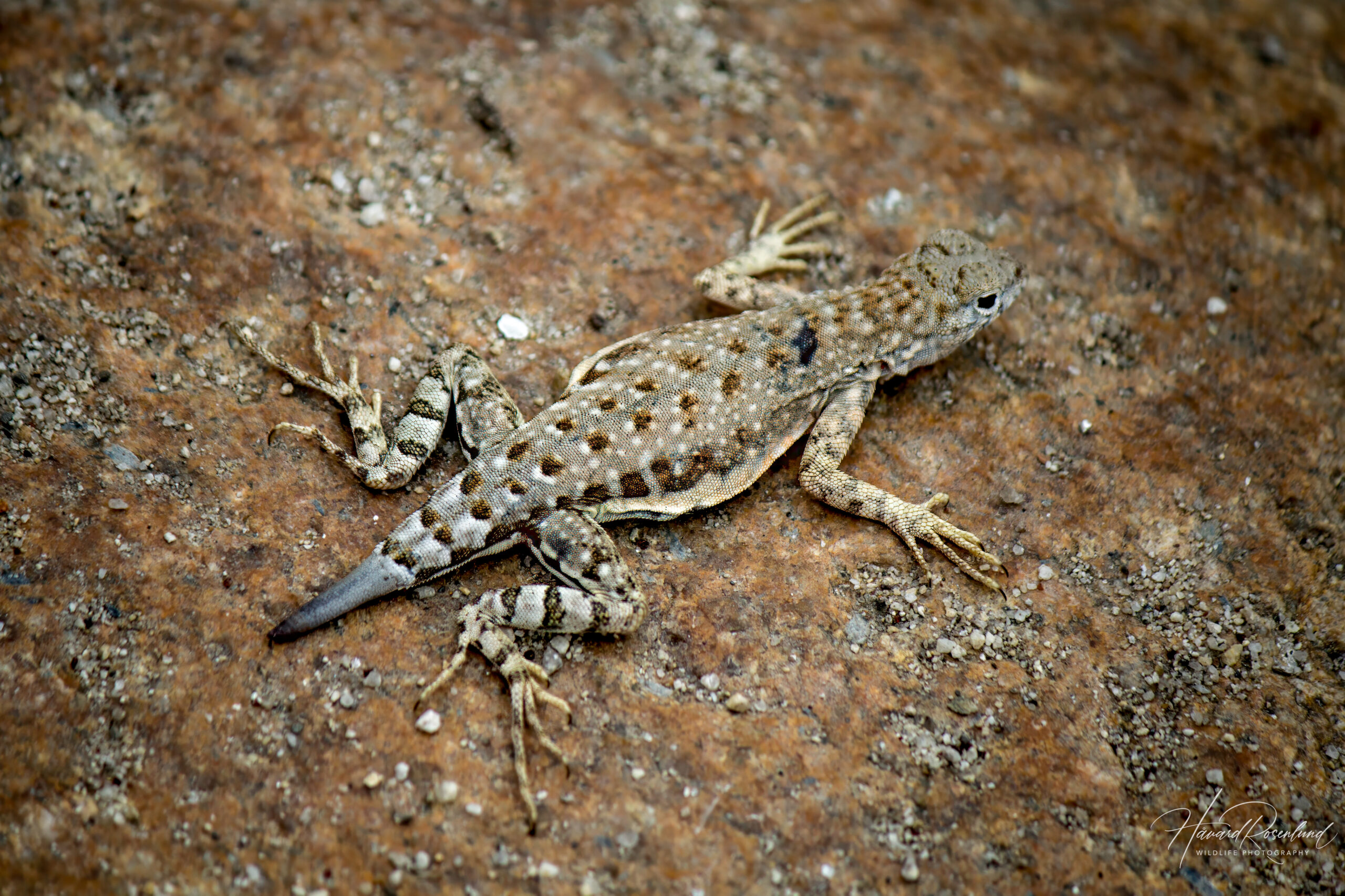
The body is flattened and usually grey, tan or brown with darker markings that blend into rocky ground. Males are larger and more colourful, with dark bars near the hind limbs bordered by blue on the belly. During the breeding season females can develop a conspicuous pink throat and peach to orange colour along the sides. The strongly banded black-and-white underside of the tail is one of the species' most distinctive features.
Taxonomy
Three subspecies are currently recognised: Cophosaurus texanus texanus, C. t. scitulus and C. t. reticulatus. Their distributions are strongly geographic, with the nominate form centred mainly in Texas and Oklahoma, reticulatus in Sonora, Mexico, and scitulus across Arizona and adjoining parts of the Southwest and northern Mexico.
A genomic study published in 2026 found four strongly differentiated lineages across most of the sampled range, with little gene flow between them. The nominate C. t. texanus was nested among lineages currently assigned to C. t. scitulus, showing that the present subspecies arrangement does not fully reflect the evolutionary history of the complex. The existing subspecies names remain in use, but the complex will probably require formal taxonomic revision.
The animals photographed on this page near Tucson lie within the Arizona range of C. t. scitulus. The type locality of that subspecies is Cañada del Oro, about 16 miles north of Tucson, making the subspecific context particularly relevant to these observations.
Habitat
Greater earless lizards favour open, rocky desert terrain, especially bajadas, canyon margins, riparian slopes and other places where scattered vegetation leaves plenty of exposed ground for running. In Arizona they often occur at somewhat higher or rockier sites than the superficially similar zebra-tailed lizard (Callisaurus draconoides).
Southwestern populations are strongly associated with creosote and mesquite habitats. Open ground is important for rapid movement and visual signalling, while rocks, shrubs and uneven terrain provide shade and refuge.
Diet
Greater earless lizards are generalist predators that take a wide variety of arthropods. Ants, beetles, grasshoppers, moth larvae, spiders and other invertebrates are eaten, and small lizards may also be taken.
They forage mainly on the ground during warm daylight hours, moving across open rocky surfaces in search of small prey. Much of the animal's water requirement can be obtained from prey, an important advantage in its arid environment.
Behaviour
Visual signalling is unusually important in this species. Greater earless lizards use push-ups, body postures and tail movements in interactions with other lizards, but their most conspicuous display can be directed at predators. When approached, a lizard may arch its boldly banded tail over the back and wave it from side to side before sprinting away. This can act as a pursuit-deterrent signal by showing that the predator has been detected.
The tail also contributes to locomotor performance, and tail loss significantly reduces sprint speed. During normal activity the lizards regulate body temperature by shifting between exposed basking sites and shade or shelter as conditions change.
Reproduction
Breeding begins in spring and continues into summer, with timing varying across the broad range. Females can mature during their first year; in southwestern populations most were sexually mature at around 10–11 months. The bright seasonal colours of both sexes are most evident during this period.
Females lay eggs in the ground and can produce more than one clutch in a season. Clutch size varies with locality and female size, but 2–9 eggs has been reported across southwestern populations. Hatchlings are fully independent and receive no parental care.
Status
The greater earless lizard is classified as least concern on the IUCN Red List. It has a broad distribution across arid southwestern North America and can be locally common in suitable rocky habitat.
Population density varies substantially between places and years, particularly with rainfall and habitat conditions. Local loss and fragmentation of rocky desert habitat can reduce suitable areas, but no major range-wide threat is currently recognised.
Image gallery
Loading map and observations…
Have you seen this species?
Independent species archive
Did you find this species page useful?
Wildlife Vagabond is independently built and maintained. Voluntary support helps cover hosting, maps, data storage and continued improvements to the species archive.
Support Wildlife VagabondSpecies content will remain freely available.
References
Information about the species’ global distribution and status is based primarily on global Red List data. See the references below for details.
- Blair, C., Pavón-Vázquez, C. J., Rana, Q., Farleigh, K., Crispo, E., Panzera, T., de Medeiros Magalhães, F., White, B., & Garcia-Vazquez, U. O. (2026). Isolation and divergence of Greater Earless Lizards (Phrynosomatidae: Cophosaurus) in western North America support multiple diversification processes and a complex demographic history. Molecular Phylogenetics and Evolution, 214, 108442. https://doi.org/10.1016/j.ympev.2025.108442
- International Union for Conservation of Nature. (n.d.). Greater Earless Lizard. The IUCN Red List of Threatened Species. https://www.iucnredlist.org/species/64062/12733140
- Jenkins, K. M., & de Queiroz, K. (2026). Functional implications of ear loss in sand lizards. The Anatomical Record, ar.70284. https://doi.org/10.1002/ar.70284
- National Park Service. (n.d.). Saguaro National Park Lizards. https://www.nps.gov/sagu/learn/nature/lizards.htm
- Punzo, F. (1982). Tail autotomy and running speed in the lizards Cophosaurus texanus and Uma notata. Journal of Herpetology, 16(3), 329–331. https://doi.org/10.2307/1563731
- Punzo, F. (2007). Life history, demography, diet and habitat associations in the southwestern earless lizard, Cophosaurus texanus scitulus from northern and southern limits of its geographical range. Amphibia-Reptilia, 28(1), 65-76. https://doi.org/10.1163/156853807779798974
- Smith, D. D., Medica, P. A., & Sanborn, S. R. (1987). Ecological comparison of sympatric populations of sand lizards (<i>Cophosaurus texanus</i> and <i>Callisaurus draconoides</i>). Great Basin Naturalist, 47(2), 175–185. https://scholarsarchive.byu.edu/gbn/vol47/iss2/1/
- The Reptile Database. (n.d.). Cophosaurus texanus, current taxonomy and subspecies. https://reptile-database.reptarium.cz/Cophosaurus/texanus