
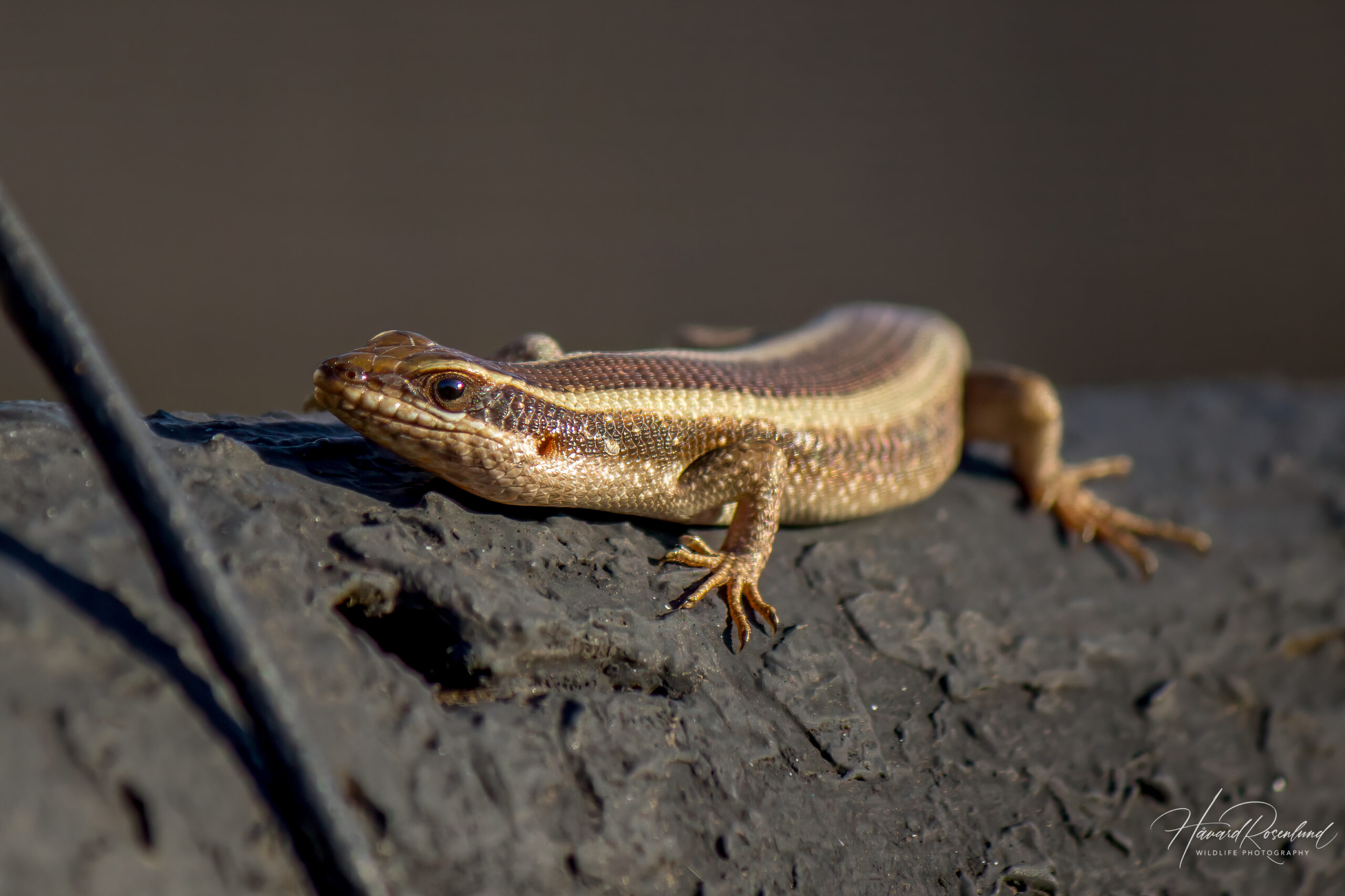
African Striped Skink
Trachylepis striata
At a glance
Habitat
- Savanna, woodland, bushland, rocky ground, forest edges and human-modified habitats
Diet
- Insects and other arthropods; ants can form a substantial part of the diet
Activity
- Diurnal; active ground forager that also climbs well
Size
- Length: 16–23 cm total length Weight: around 20 g
Range
- Widely distributed in eastern, central and southern Africa under current species limits
Description
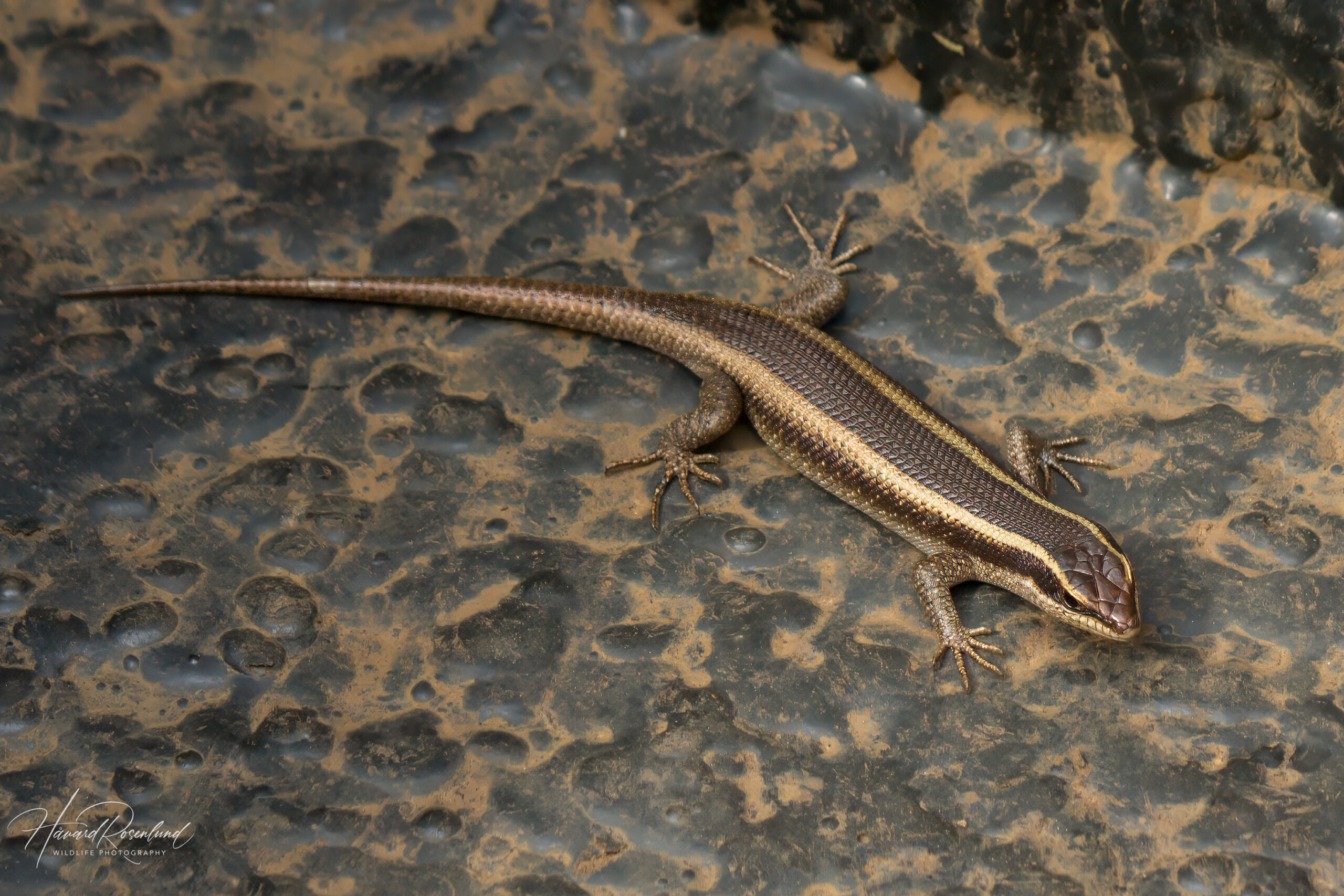
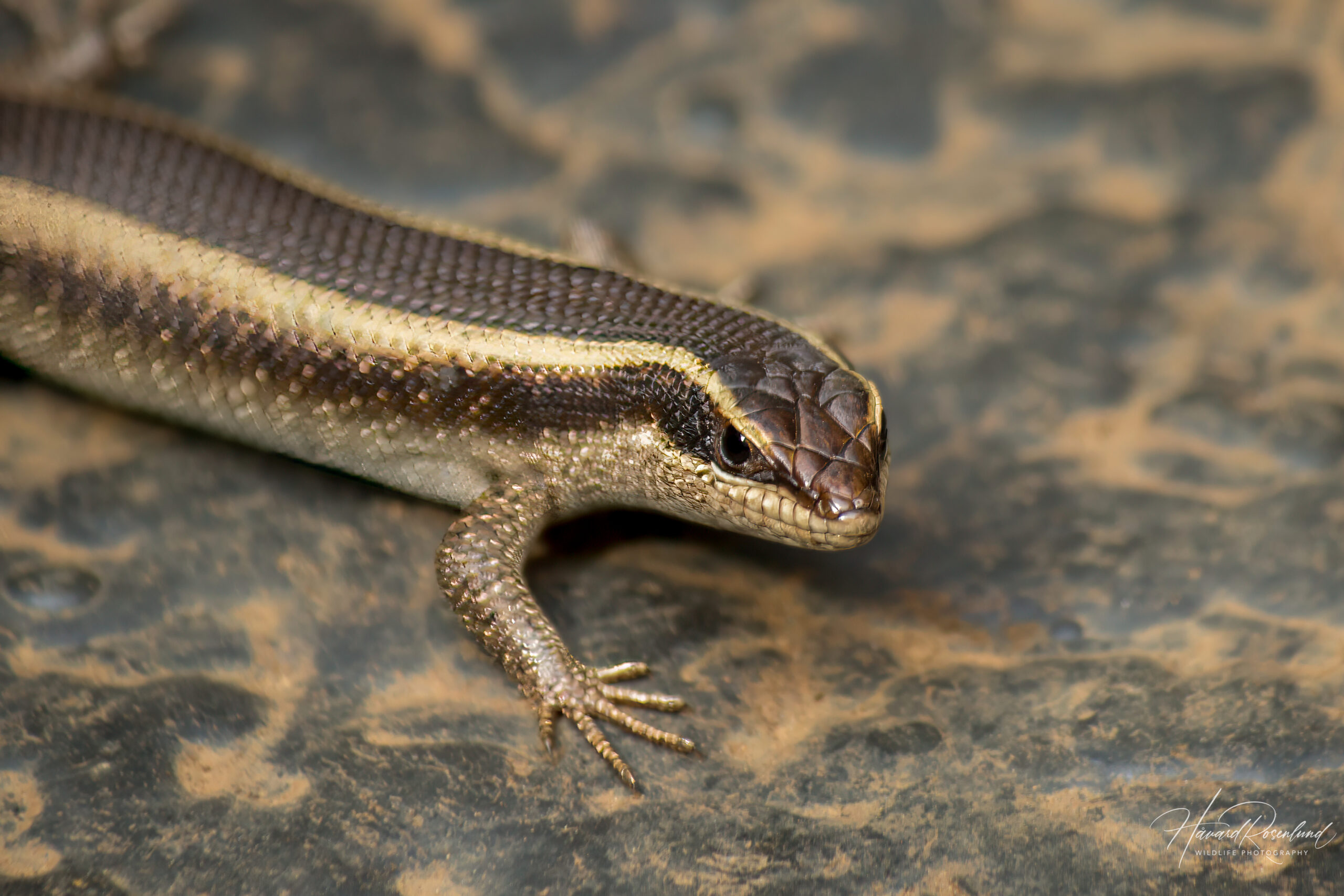
The African striped skink (Trachylepis striata) is a medium-sized, smooth-scaled skink found across a broad part of eastern, central and southern Africa. Adults are usually around 16–23 cm in total length, with the tail making up more than half of this. The body is bronze, brown or olive with pale longitudinal stripes, although the number and strength of the stripes vary and they may become less distinct in older animals.
Like many Trachylepis skinks, it has a streamlined body, well-developed limbs and a transparent window in the lower eyelid. This allows the eye to remain partly protected while the animal can still detect movement around it. Identification can be complicated where other striped Trachylepis occur, especially because older sources used T. striata for a broader group of populations than is recognised today.
Taxonomy
The name Trachylepis striata once covered a broader complex of striped skinks than it does today. Several populations formerly treated as subspecies have since been recognised as full species, including Trachylepis punctatissima and Trachylepis sparsa. Older field guides and ecological studies can therefore refer to a wider distribution or to variation that is no longer considered part of T. striata.
The complex may not yet be completely resolved. A molecular phylogeny published in 2019 found that samples identified as T. striata did not all belong to a single exclusive lineage, so further taxonomic work may still alter species limits. Trachylepis striata nevertheless remains recognised as a distinct species.
Habitat
African striped skinks use a broad range of habitats, including savanna, woodland, bushland, rocky slopes, forest edges and gardens. They are particularly common where sunny basking sites lie close to logs, rocks, vegetation or crevices that provide rapid shelter.
The species tolerates considerable habitat modification and readily uses walls, buildings and planted vegetation in settlements. This flexibility does not mean that cover is unimportant: a mosaic of warm exposed surfaces and nearby refuges allows the skink to regulate body temperature while remaining close to escape sites.
Diet
The diet is dominated by small arthropods such as beetles, ants, termites and other insects. Ants can make up about 10–30% of the diet, depending on the population and available prey.
African striped skinks are active foragers rather than strict ambush predators. They move through leaf litter, over logs and among low vegetation, investigating small gaps and surfaces for prey as they travel.
Behaviour
The species is diurnal and often basks in exposed positions during the morning before activity increases. Individuals repeatedly move between sun and shade as conditions change, using behavioural thermoregulation to keep body temperature within a useful range.
When disturbed, African striped skinks accelerate rapidly toward cover and readily climb logs, tree trunks, walls and other steep surfaces. Their speed, climbing ability and willingness to use artificial structures help them remain common around gardens and buildings as well as in natural savanna and woodland.
Reproduction
African striped skinks are live-bearing rather than egg-laying. The reproductive mode is often described as ovoviviparity: embryos are retained within the female and rely heavily on yolk before the young are born alive. Several young can be produced in a brood.
A study published in 1991 near Zomba in Malawi showed how strongly rainfall can shape reproduction. At a wetter site a high proportion of females were reproductive throughout the year. At a drier site reproductive activity declined during the dry season and broods were smaller. Females there also retained more fat early in the dry season, suggesting that more energy was directed toward adult survival when conditions became less favourable.
Status
The African striped skink is classified as least concern on the IUCN Red List. It remains widespread across eastern, central and southern Africa and occurs in both natural and substantially modified habitats.
No major threat is known across the species' entire range. Local populations can nevertheless be affected where habitat conversion removes both ground cover and the sunny, varied refuges used for basking, foraging and escape.
Image gallery
Loading map and observations…
Have you seen this species?
Independent species archive
Did you find this species page useful?
Wildlife Vagabond is independently built and maintained. Voluntary support helps cover hosting, maps, data storage and continued improvements to the species archive.
Support Wildlife VagabondSpecies content will remain freely available.
References
Information about the species’ global distribution and status is based primarily on global Red List data. See the references below for details.
- Cavalcanti, L. B. Q., Costa, G. C., Colli, G. R., Pianka, E. R., Vitt, L. J., & Mesquita, D. O. (2024). Myrmecophagy in lizards: evolutionary and ecological implications. Zoological Journal of the Linnean Society, 202(1), zlad175. https://doi.org/10.1093/zoolinnean/zlad175
- Chapple, D. G., Slavenko, A., Tingley, R., Farquhar, J. E., Camaiti, M., Roll, U., & Meiri, S. (2023). Built for success: Distribution, morphology, ecology and life history of the world’s skinks. Ecology and Evolution, 13(12), e10791. https://doi.org/10.1002/ece3.10791
- International Union for Conservation of Nature. (n.d.). African Striped Skink (Trachylepis striata). The IUCN Red List of Threatened Species. https://www.iucnredlist.org/species/199764/2610367
- Patterson, J. W. (1990). Female reproductive cycles in two subspecies of the tropical lizard Mabuya striata. Oecologia, 84(2), 232-237. https://doi.org/10.1007/BF00318277
- Patterson, J. W. (1991). Rainfall and reproduction in females of the tropical lizard Mabuya striata striata. Oecologia, 86(3), 419-423. https://doi.org/10.1007/BF00317611
- The Reptile Database. (2026). Trachylepis striata – current taxonomy, distribution and reproductive mode. https://reptile-database.reptarium.cz/Trachylepis/striata
- Weinell, J. L., Branch, W. R., Colston, T. J., Jackman, T. R., Kuhn, A., Conradie, W., & Bauer, A. M. (2019). A species-level phylogeny of Trachylepis (Scincidae: Mabuyinae) provides insight into their reproductive mode evolution. Molecular Phylogenetics and Evolution, 136, 183-195. https://doi.org/10.1016/j.ympev.2019.04.002