
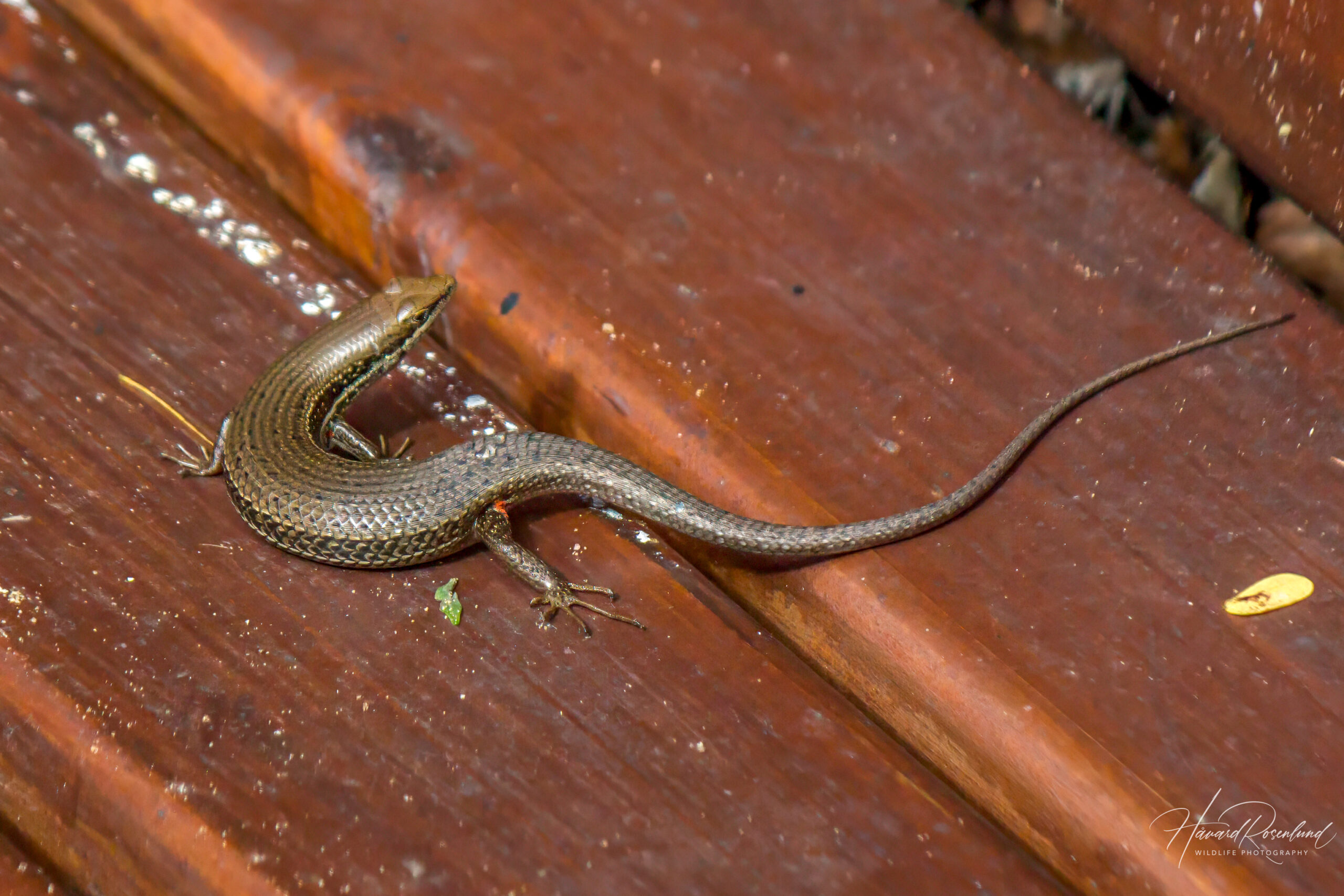
Eastern Sand Skink
Trachylepis depressa
At a glance
Habitat
- Sandy coastal plain, dune scrub, sandveld and other vegetated sandy soils
Diet
- Small invertebrates, mainly insects and other arthropods
Activity
- Diurnal; often shelters below the surface
Size
- Length: ~17 cm total length Weight: —
Range
- Southern Mozambique, southeastern Zimbabwe and northeastern South Africa
Description
The eastern sand skink (Trachylepis depressa), also called the eastern coastal skink, is a small, distinctly flattened skink adapted to life on and just below sandy ground. The back is usually brown to grey-brown, with a dark stripe running from behind the eye toward the hindlimb and a paler stripe below it. The underside is cream-coloured, while the dorsal scales are keeled and give the back a subtly ridged texture.
The flattened head and body help the skink move through loose substrate. A specimen from central Mozambique measured 16.7 cm in total length, including a 9.6 cm tail. The species was formerly placed in the broad genus Mabuya but is now classified in Trachylepis.
Habitat
The eastern sand skink is closely associated with sandy lowlands of southeastern Africa. It occurs in vegetated coastal dunes, dune scrub, sandy bushveld and other habitats on loose sandy or alluvial soils. Its known range extends from coastal KwaZulu-Natal and the northeastern South African lowveld into southern Mozambique, with records also from farther inland in the region.
Along the coast it occurs in dune scrub and other sandy vegetation, including the sandy Mozambique coastal plain of northern KwaZulu-Natal. Loose substrate is a central part of the habitat because it provides both feeding ground and immediate refuge below the surface.
Diet
The species feeds on small invertebrates, mainly insects and other arthropods. It searches for prey in and around sandy ground, litter and low vegetation. The relative importance of different prey groups is still poorly known.
Burrowing
The eastern sand skink is a shallow burrower. When disturbed it can disappear rapidly beneath loose sand rather than relying only on vegetation or surface cover. This provides immediate shelter from predators and harsh surface conditions and is one of the clearest adaptations linking the species to sandy habitat.
Burrowing does not protect it from every disturbance. A study published in 2020 found eastern sand skinks among the most numerous reptile casualties after a prescribed spring fire in Tembe Elephant Park. Twenty individuals were recorded in the surveyed area, equivalent to an estimated 25 animals per hectare. Most were not visibly burned. The deaths may instead have resulted from asphyxiation, extreme heat or gases affecting animals sheltering close below the surface. Although this was a local fire, it shows a vulnerability that is easy to overlook in a sand-burrowing reptile.
Reproduction
Eastern sand skinks are oviparous, with females laying eggs rather than giving birth to live young. Little else is known about their breeding, and reliable species-specific figures for clutch size, incubation and breeding timing are not yet available.
Status
The eastern sand skink is classified as least concern on the IUCN Red List. It occurs in sandy habitats of southeastern Africa and is not considered globally threatened.
Intense fires can cause substantial local mortality, but no major threat is currently recognised across the species’ range.
Image gallery
Loading map and observations…
Have you seen this species?
Independent species archive
Did you find this species page useful?
Wildlife Vagabond is independently built and maintained. Voluntary support helps cover hosting, maps, data storage and continued improvements to the species archive.
Support Wildlife VagabondSpecies content will remain freely available.
References
Information about the species’ global distribution and status is based primarily on global Red List data. See the references below for details.
- Bates. (2018). Catalogue of reptiles from Mozambique in the collection of the National Museum, Bloemfontein, South Africa. https://nationalmuseumpublications.co.za/catalogue-of-reptiles-from-mozambique-in-the-collection-of-the-national-museum-bloemfontein-south-africa-2/
- International Union for Conservation of Nature. (n.d.). Trachylepis depressa. The IUCN Red List of Threatened Species. https://www.iucnredlist.org/species/110230203/147705789
- Jordaan, P. R., Steyl, J. C. A., Hanekom, C. C., & Combrink, X. (2020). Fire-associated reptile mortality in Tembe Elephant Park, South Africa. Fire Ecology, 16(1), 3. https://doi.org/10.1186/s42408-019-0066-4
- The Reptile Database. (n.d.). Trachylepis depressa. https://reptile-database.reptarium.cz/species?genus=Trachylepis&species=depressa