
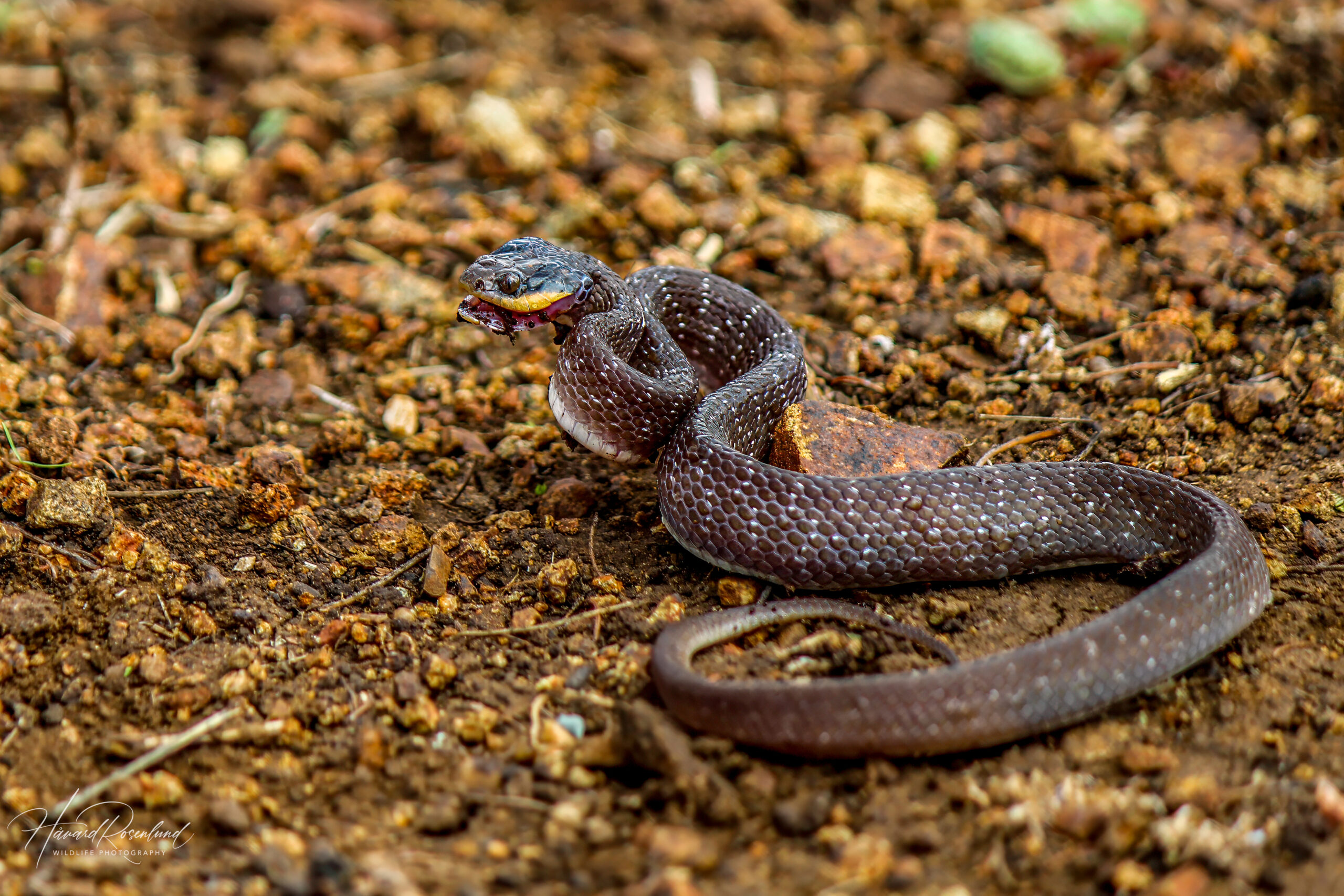
Red-lipped Snake
Crotaphopeltis hotamboeia
At a glance
Habitat
- Moist savanna, grassland, marsh edges, lowland forest, gardens and other damp habitats
Diet
- Mainly frogs and toads; also small lizards and occasional small rodents
Activity
- Nocturnal
Size
- Length: usually 30–70 cm; occasionally up to about 1 m Weight: —
Range
- Widespread across sub-Saharan Africa outside the driest regions
Description
The red-lipped snake or herald snake (Crotaphopeltis hotamboeia) is a small to medium-sized African snake. Adults are commonly about 30–70 cm long, although large individuals can approach 1 m.
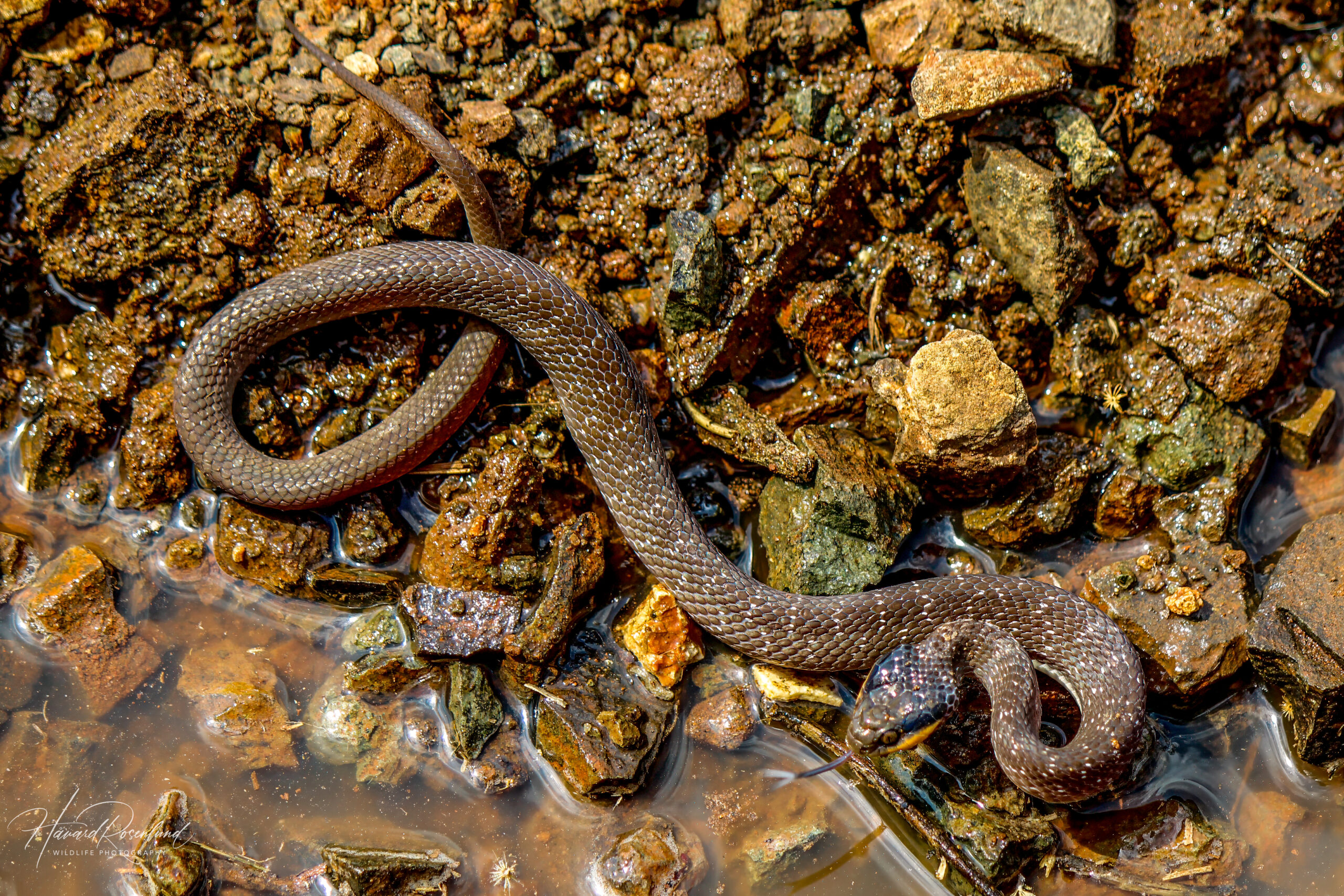
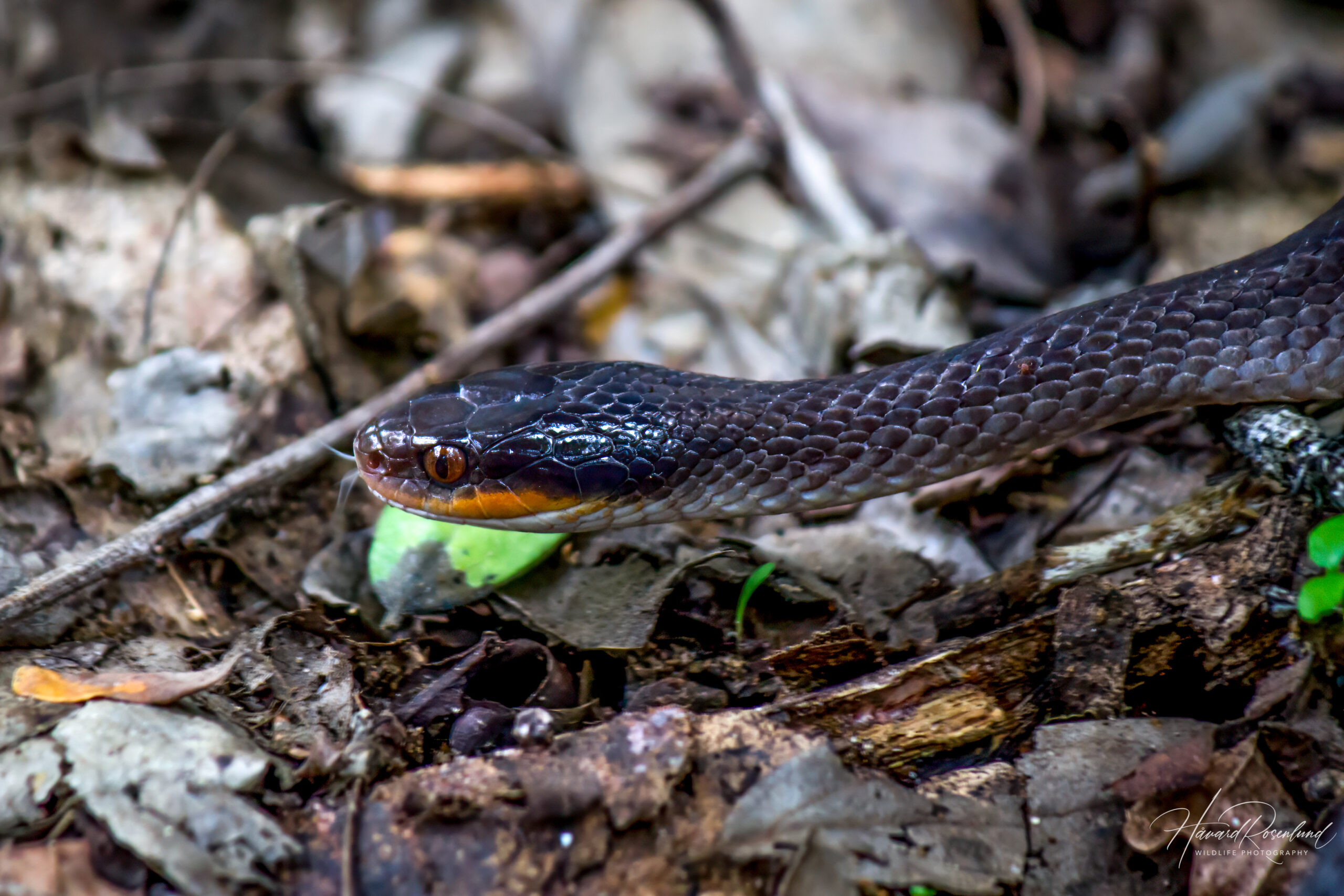
Colour varies considerably. The body may be grey, brown, olive or nearly black, often with scattered white spots that can form narrow crossbars in juveniles. The head is darker than the body, with glossy black or bluish-black patches behind the eyes. The upper lip may be red, orange, yellow, white or dark, so the black temporal patches are more reliable for identification than lip colour.
Habitat
Red-lipped snakes occur in moist savanna, grassland, marsh edges, lowland forest and other damp environments. They also enter gardens, where they shelter beneath rocks, logs, garden debris and compost heaps. The species is widespread across sub-Saharan Africa but generally avoids the driest arid regions.
Diet
Frogs and toads dominate the diet, supplemented by small lizards and occasional small rodents. The species can swallow amphibians that appear remarkably large compared with its own head and body.
It hunts mainly at night through damp ground vegetation and around wetlands. Prey is seized and held while mild venom delivered through enlarged rear teeth begins to take effect.
Behaviour
The species is nocturnal and usually spends the day concealed under logs, rocks, vegetation or other cover. When threatened, it can flatten the head, raise the front of the body, hiss and make repeated strikes.
The defensive display can look dramatic, but the snake usually tries to escape when given space. It should not be handled, even though it poses little medical danger to people.
Reproduction
The species lays eggs. Females deposit about six to nineteen eggs in leaf litter or another warm, sheltered site in early summer. Incubation lasts approximately 61–64 days, and hatchlings are usually about 13–18 cm long. Individuals have been recorded living for 10–15 years.
Venom
The red-lipped snake is rear-fanged and mildly venomous. Its venom is adapted for subduing prey and the species poses no serious threat to people or domestic animals. A prolonged bite may cause slight local swelling.
Any bite from an unidentified snake, or a bite followed by increasing symptoms, should nevertheless be assessed by medical professionals.
Relationship with humans
Red-lipped snakes often occur in gardens and around houses because damp shelter and frogs can be abundant there. Their defensive behaviour and variable dark colour can lead people to assume that they are dangerous.
Individuals are therefore sometimes killed unnecessarily. Leaving the snake an escape route and avoiding handling is safer for both people and the animal, especially when identification is uncertain.
Status
The red-lipped snake is classified as least concern on the IUCN Red List. It has a very large range, is common in many suitable habitats and can persist in gardens and other modified landscapes.
No major decline is known for the species as a whole. Local populations may be affected by wetland and grassland degradation, road mortality and deliberate killing.
Image gallery
Loading map and observations…
Have you seen this species?
Independent species archive
Did you find this species page useful?
Wildlife Vagabond is independently built and maintained. Voluntary support helps cover hosting, maps, data storage and continued improvements to the species archive.
Support Wildlife VagabondSpecies content will remain freely available.
References
Information about the species’ global distribution and status is based primarily on global Red List data. See the references below for details.
- African Snakebite Institute. (n.d.). Herald or Red-lipped Snake: identification, nocturnal behaviour and medical importance. https://www.africansnakebiteinstitute.com/snake/herald-or-red-lipped-snake/
- Biodiversity Explorer. (n.d.). Crotaphopeltis hotamboeia: identification, ecology, reproduction and longevity. Iziko Museums of South Africa. https://www.biodiversityexplorer.info/reptiles/squamata/serpentes/colubridae/crotaphopeltis_hotamboeia.htm
- Engelbrecht, H. M., Branch, W. R., Greenbaum, E., Burger, M., Conradie, W., & Tolley, K. A. (2020). African Herald snakes,Crotaphopeltis, show population structure for a widespread generalist but deep genetic divergence for forest specialists. Journal of Zoological Systematics and Evolutionary Research, 58(4), 1220-1233. https://doi.org/10.1111/jzs.12361
- International Union for Conservation of Nature. (n.d.). Crotaphopeltis hotamboeia (Red-lipped Snake). The IUCN Red List of Threatened Species. https://www.iucnredlist.org/species/13264994/13265005
- Keogh, J., Branch, W. R., & Shine, R. (2000). Feeding ecology, reproduction and sexual dimorphism in the colubrid snake Crotaphopeltis hotamboeia in southern Africa. African Journal of Herpetology, 49(2), 129-137. https://doi.org/10.1080/21564574.2000.9635439
- South African National Biodiversity Institute. (n.d.). Crotaphopeltis hotamboeia: identification, distribution, diet, reproduction and behaviour. https://biodiversityadvisor.sanbi.org/search/detail/80878
- The Reptile Database. (n.d.). Crotaphopeltis hotamboeia: taxonomy and distribution. https://reptile-database.reptarium.cz/Crotaphopeltis/hotamboeia