
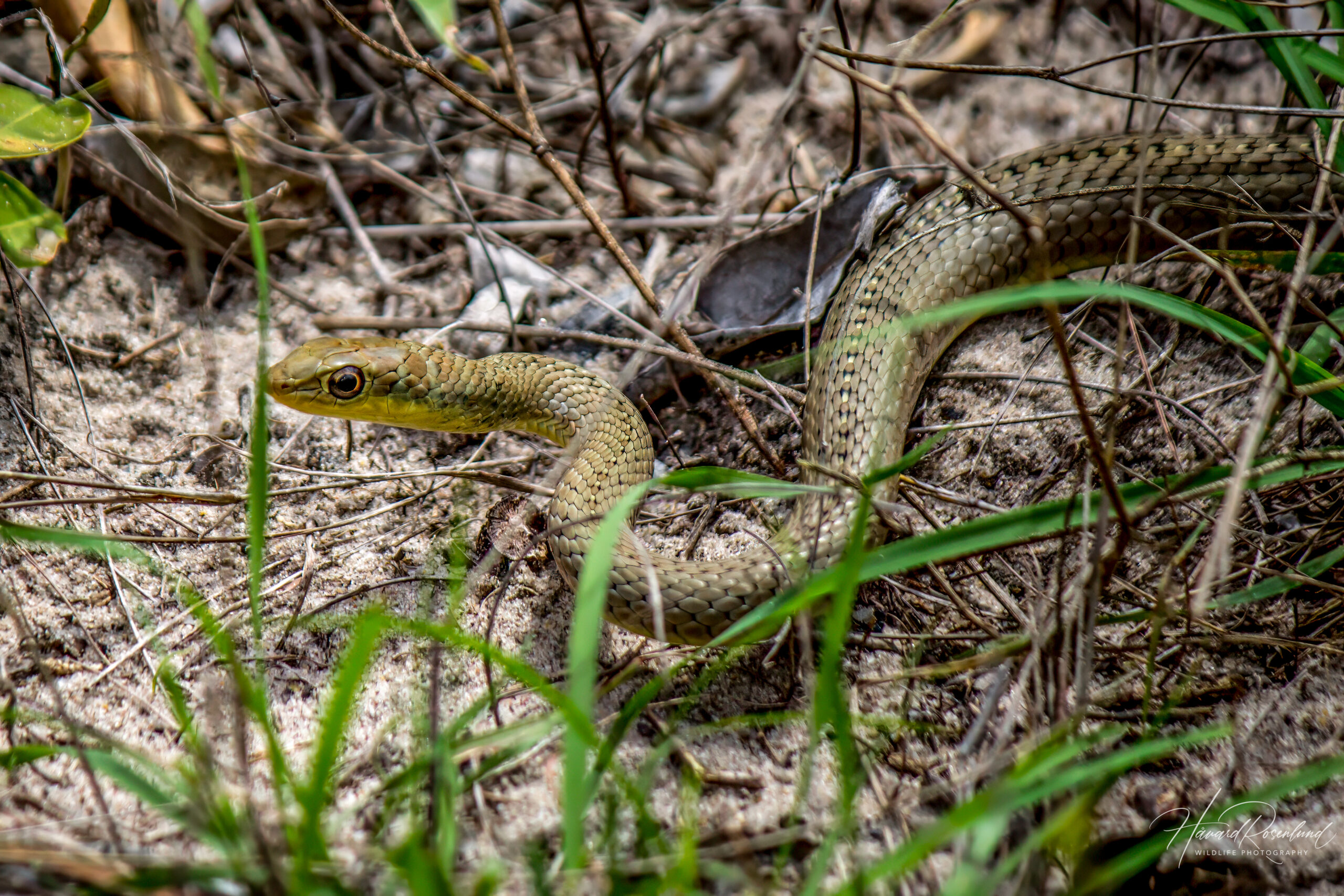
Short-snouted Grass Snake
Psammophis brevirostris
At a glance
Habitat
- Grassland, savanna, scrub, semi-arid country and riverine habitats
Diet
- Mainly lizards, especially skinks; other small vertebrates are taken opportunistically
Activity
- Diurnal
Size
- Length: usually 40–60 cm; occasionally much larger Weight: —
Range
- Central and eastern parts of southern Africa
Description
The short-snouted grass snake or short-snouted whip snake (Psammophis brevirostris) is a slender, fast-moving snake of southern Africa. Most adults are around 40–60 cm long, but some exceed one metre and may reach about 1.2 m.
Colour and pattern are highly variable. The upper body is often sandy brown, olive or grey-brown, with pale spots or narrow lines along the back and lighter flanks. Some individuals have scattered dark scales on the neck and chin, while the underside ranges from white to yellowish. Scales around the eye are often pale or yellowish, including the scale immediately in front of the eye.
It can be confused with the olive grass snake (Psammophis mossambicus), which is generally larger and often shows a more uniform olive-brown appearance. The individual photographed on this page shows how difficult the distinction can be: I initially misidentified it as an olive grass snake before the identification was later corrected by experts.
Habitat
The species occurs in grassland, savanna, scrub, semi-arid landscapes and riverine habitats. It is mainly terrestrial but may climb into low shrubs to bask or escape.
Diet
Lizards dominate the diet, especially skinks. A study published in 2006 found that P. brevirostris fed predominantly on skinks. Other snakes and small rodents are also recorded as prey but are taken less often.
Short-snouted grass snakes are active visual hunters by day, moving quickly through grass and low vegetation to locate and pursue small lizards.
Behaviour
The species is diurnal and usually solitary. It spends much of its active period moving through open ground and vegetation and may climb into low shrubs to bask or avoid danger.
When threatened, it normally attempts to escape rapidly. A restrained individual may bite, but flight is usually the first defence. Snakes grasped by the tail may twist violently, and part of the tail has been reported to break off during the escape attempt.
Reproduction
The species lays eggs. Females produce about four to fifteen eggs during summer and may lay more than one clutch in favourable conditions. The eggs are deposited in a sheltered site and receive no parental care. Lifespan is estimated at around 10 years.
Venom
The short-snouted grass snake is rear-fanged and mildly venomous. Its venom helps subdue small prey, but the species is not regarded as medically dangerous to people.
It should not be handled. Any bite from an unidentified snake, or a bite followed by worsening symptoms, should be assessed by medical professionals.
Status
The short-snouted grass snake is classified as least concern on the IUCN Red List. It has a broad southern African distribution and occurs in several habitat types, including protected areas and modified landscapes.
The population is considered stable, and no major threat is known for the species as a whole. Local animals may nevertheless be killed through fear, harmed by road traffic or affected by habitat conversion.
Image gallery
Loading map and observations…
Have you seen this species?
Independent species archive
Did you find this species page useful?
Wildlife Vagabond is independently built and maintained. Voluntary support helps cover hosting, maps, data storage and continued improvements to the species archive.
Support Wildlife VagabondSpecies content will remain freely available.
References
Information about the species’ global distribution and status is based primarily on global Red List data. See the references below for details.
- African Snakebite Institute. (n.d.). Short-snouted Grass Snake: identification, behaviour and medical importance. https://www.africansnakebiteinstitute.com/snake/short-snouted-grass-snake/
- Biodiversity Explorer. (n.d.). Psammophis brevirostris: identification, diet and reproduction. Iziko Museums of South Africa. https://www.biodiversityexplorer.info/reptiles/squamata/serpentes/colubridae/psammophis_brevirostris.htm
- International Union for Conservation of Nature. (n.d.). Psammophis brevirostris (Short-snouted Grass Snake). The IUCN Red List of Threatened Species. https://www.iucnredlist.org/species/44979961/147700114
- Shine et al. (n.d.). Sexual dimorphism, reproductive biology, and dietary habits of psammophiine snakes from southern Africa. https://researchers.mq.edu.au/en/publications/sexual-dimorphism-reproductive-biology-and-dietary-habits-of-psam/
- South African National Biodiversity Institute. (n.d.). Psammophis brevirostris: population, threats and conservation. https://speciesstatus.sanbi.org/assessment/last-assessment/2854/
- The Reptile Database. (n.d.). Psammophis brevirostris: taxonomy, distribution and reproduction. https://reptile-database.reptarium.cz/species?genus=Psammophis&species=brevirostris