
Puff Adder
Bitis arietans
At a glance
Habitat
- Savanna, grassland, scrub, open woodland, farmland and semi-arid country
Diet
- Small mammals, ground birds, lizards, amphibians and occasional other snakes
Activity
- Mostly nocturnal and crepuscular; also basks by day
Size
- Length: usually 70–110 cm; exceptionally up to about 1.8 m Weight: large adults may exceed 5 kg
Range
- Most of sub-Saharan Africa, parts of North Africa and the southwestern Arabian Peninsula
Description
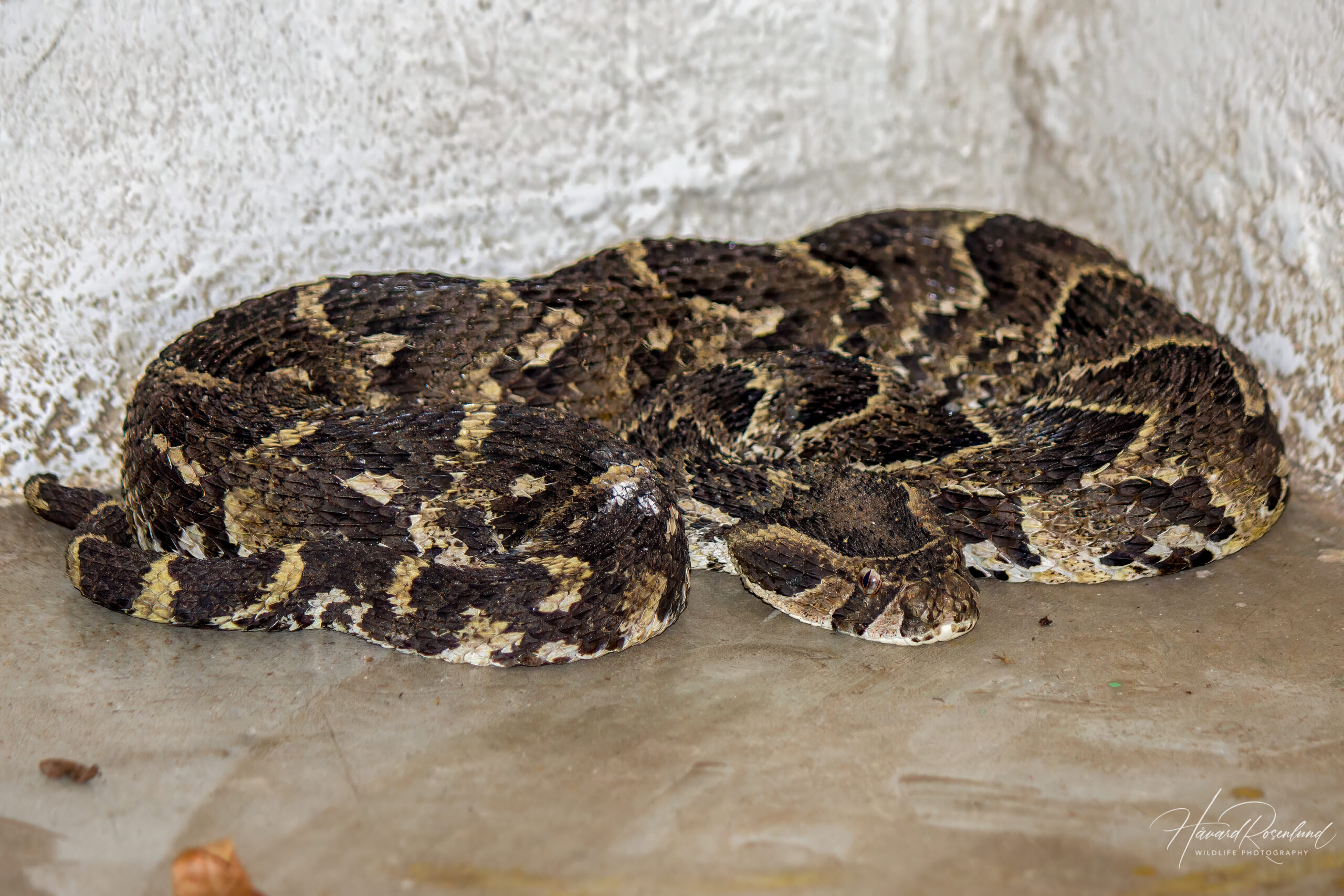
The puff adder (Bitis arietans) is a heavy-bodied viper found across much of Africa and parts of the southwestern Arabian Peninsula. Adults are commonly about 70–110 cm long. In southern Africa the largest reliably recorded animals are around 1.3 m, while individuals from elsewhere in Africa have reportedly reached about 1.8 m. Large adults can weigh more than 5 kg.
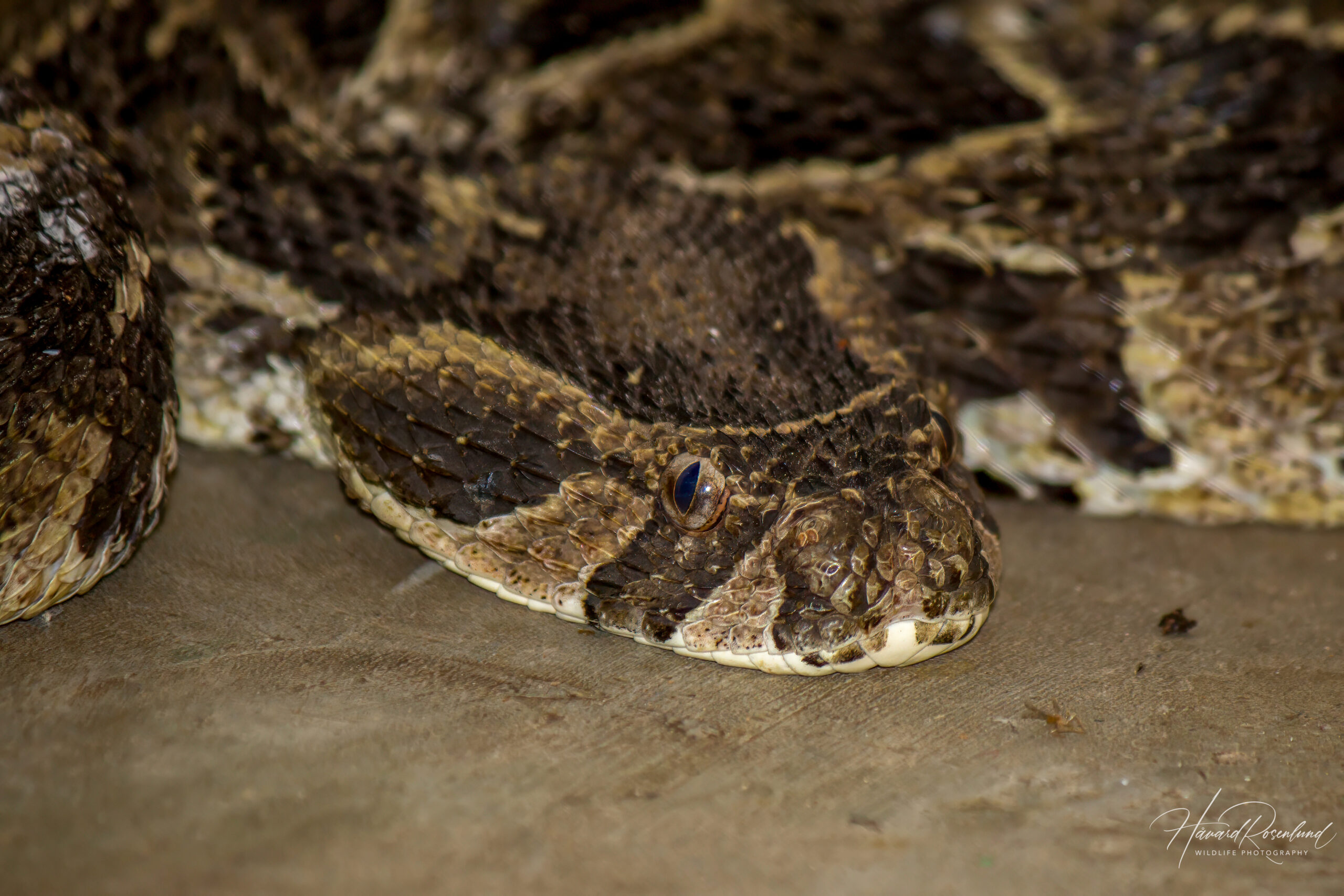
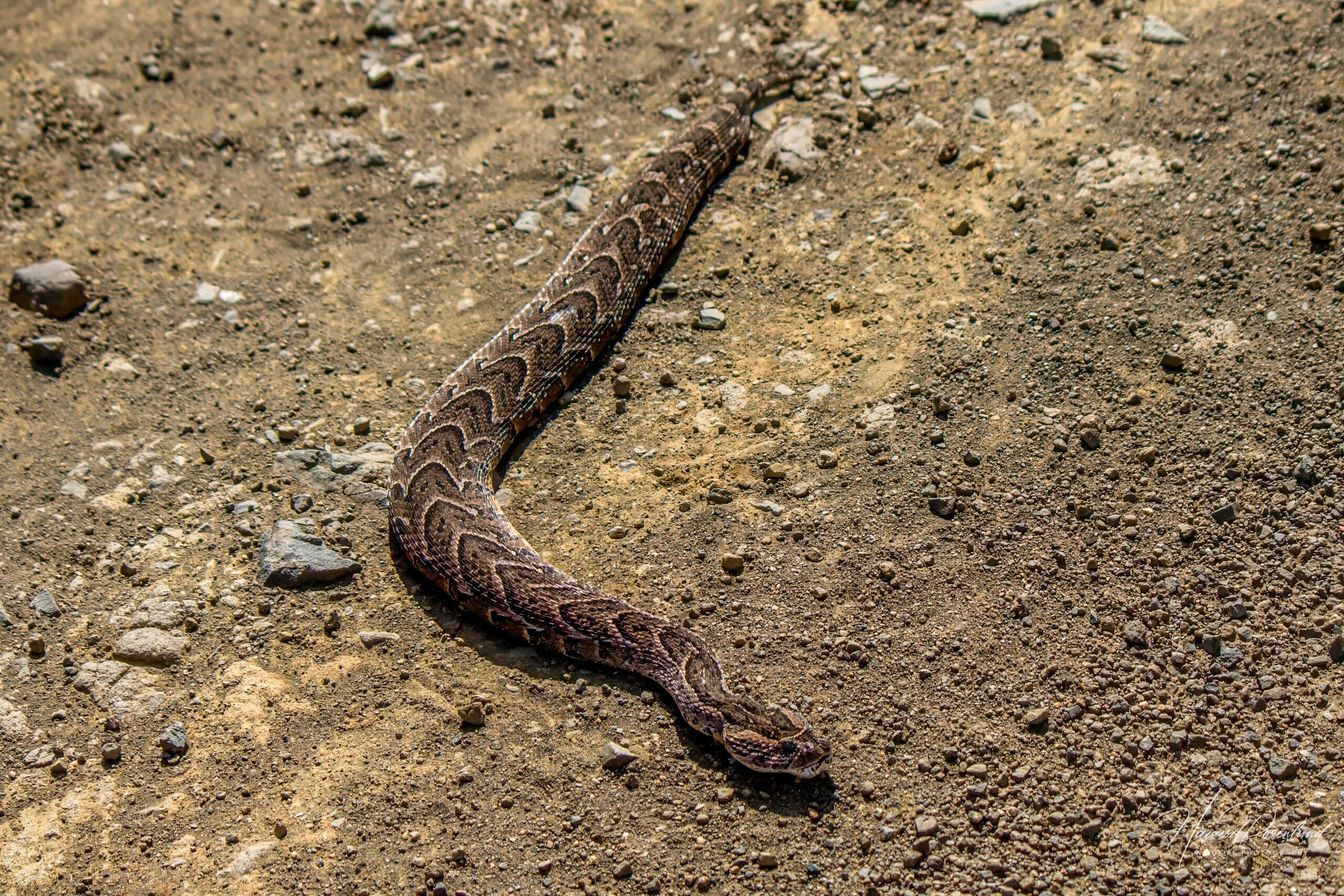
Colour varies from pale yellow and sandy brown to reddish brown, grey or nearly black. A repeating series of dark, pale-edged chevrons or U-shaped bands breaks up the outline of the body. The broad triangular head carries pale lines behind the eyes, and the strongly keeled scales give the snake a rough appearance.
The puff adder is among Africa’s largest vipers, but the Gaboon viper (Bitis gabonica) is generally heavier.
Habitat
Puff adders occupy savanna, grassland, scrub, open woodland, farmland and semi-arid landscapes. They are absent from true desert, high alpine environments and the interior of dense rainforest, but occur from sea level into mountain regions.
Diet
Small mammals form much of the diet, supplemented by ground birds, lizards, amphibians and occasional other snakes.
Hunting
The puff adder is a specialised ambush predator. It can remain coiled beside a game trail or feeding site for days or even weeks, relying on visual camouflage and unusually effective chemical camouflage. A study published in 2015 showed that scent-oriented predators and prey can have difficulty detecting a motionless puff adder.
Despite its heavy build, the strike is extremely rapid. The snake may hold smaller prey, but mammals are often released after the bite and then followed by scent after the venom has taken effect.
Behaviour
Puff adders usually remain motionless when danger approaches because movement, hissing or striking would reveal their position. Once detected or closely threatened, they may inflate the body, form a tight S-shaped striking posture and produce a loud, sustained hiss.
They often move straight ahead using waves of muscular contraction, producing a characteristic caterpillar-like motion. They can also swim and climb onto low vegetation. Although mainly nocturnal, puff adders also bask by day and may then lie in exposed places such as paths.
The combination of camouflage, reluctance to move and a fast defensive strike increases the risk of accidental close encounters. A puff adder should never be approached or handled; where removal is necessary, it should be left to trained local handlers.
Reproduction
Puff adders give birth to live young. During the mating season, males follow the scent trails of females and may engage in prolonged wrestling contests with rivals.
A typical litter contains about 20–40 young, although substantially larger litters occur in large females. An extreme case involved a Kenyan female in captivity at a Czech zoo that gave birth to 156 young in a single litter, reported as the largest litter recorded for any snake. Newborns are usually around 13–20 cm long and are independent from birth.
Venom
The puff adder is highly venomous. Its venom is predominantly cytotoxic and causes severe local tissue injury, with intense pain, rapidly developing swelling, blistering and potentially extensive tissue damage. Serious envenomation can also produce systemic effects, shock and permanent loss of function.
A suspected bite is a medical emergency. Keep the person calm and completely still, remove rings and other tight items before swelling develops, immobilise the affected limb and arrange urgent transport to a medical facility. Do not cut or suck the wound, and do not apply ice or use a tight tourniquet.
WHO recommends pressure-immobilisation bandaging only for bites from predominantly neurotoxic snakes that do not cause significant local swelling. Because puff-adder bites characteristically cause major local tissue injury, pressure-immobilisation bandaging is not recommended as routine first aid for a confirmed bite. Antivenom and other treatment decisions must be made by clinicians after assessing the patient.
Reliable annual figures for puff-adder bites and deaths across Africa are not available, but the species is an important cause of serious snakebite in southern Africa.
Status
The puff adder is classified as least concern on the IUCN Red List, based on the assessment published in 2021. It has an enormous range, remains common in many areas and tolerates some agricultural and settled landscapes.
Road mortality and deliberate killing are important local causes of death, and habitat change may reduce populations in particular areas. No major decline is known for the species as a whole.
Image gallery
Loading map and observations…
Have you seen this species?
Independent species archive
Did you find this species page useful?
Wildlife Vagabond is independently built and maintained. Voluntary support helps cover hosting, maps, data storage and continued improvements to the species archive.
Support Wildlife VagabondSpecies content will remain freely available.
References
Information about the species’ global distribution and status is based primarily on global Red List data. See the references below for details.
- African Snakebite Institute. (n.d.). Puff Adder: identification, camouflage, venom and medical importance. https://www.africansnakebiteinstitute.com/snake/puff-adder/
- Animal Diversity Web. (n.d.). Bitis arietans: morphology, ecology and reproduction. https://animaldiversity.org/accounts/Bitis_arietans/
- Branch. (1978). The venomous snakes of Southern Africa. Part 1. Introduction and Viperidae. https://www.researchgate.net/publication/303802954_The_venomous_snakes_of_Southern_Africa_Part_1_Introduction_and_Viperidae
- International Union for Conservation of Nature. (n.d.). Bitis arietans (Puff Adder), assessment published in 2021. The IUCN Red List of Threatened Species. https://www.iucnredlist.org/species/197461/2485974
- Miller, A. K., Maritz, B., McKay, S., Glaudas, X., & Alexander, G. J. (2015). An ambusher's arsenal: chemical crypsis in the puff adder (Bitis arietans). Proceedings. Biological sciences, 282(1821), 20152182. https://doi.org/10.1098/rspb.2015.2182
- The Reptile Database. (n.d.). Bitis arietans: taxonomy, distribution and reproduction. https://reptile-database.reptarium.cz/Bitis/arietans
- World Health Organization. (n.d.). Guidelines for the prevention and clinical management of snakebite in Africa. https://www.who.int/publications-detail-redirect/9789290231684
- World Health Organization. (n.d.). Snakebite envenoming: treatment and urgent access to medical care. https://www.who.int/teams/control-of-neglected-tropical-diseases/snakebite-envenoming/treatment
- Young, B. A. (2010). How a heavy‐bodied snake strikes quickly: high‐power axial musculature in the puff adder (Bitis arietans). Journal of Experimental Zoology Part A: Ecological Genetics and Physiology, 313A(2), 114-121. https://doi.org/10.1002/jez.579