
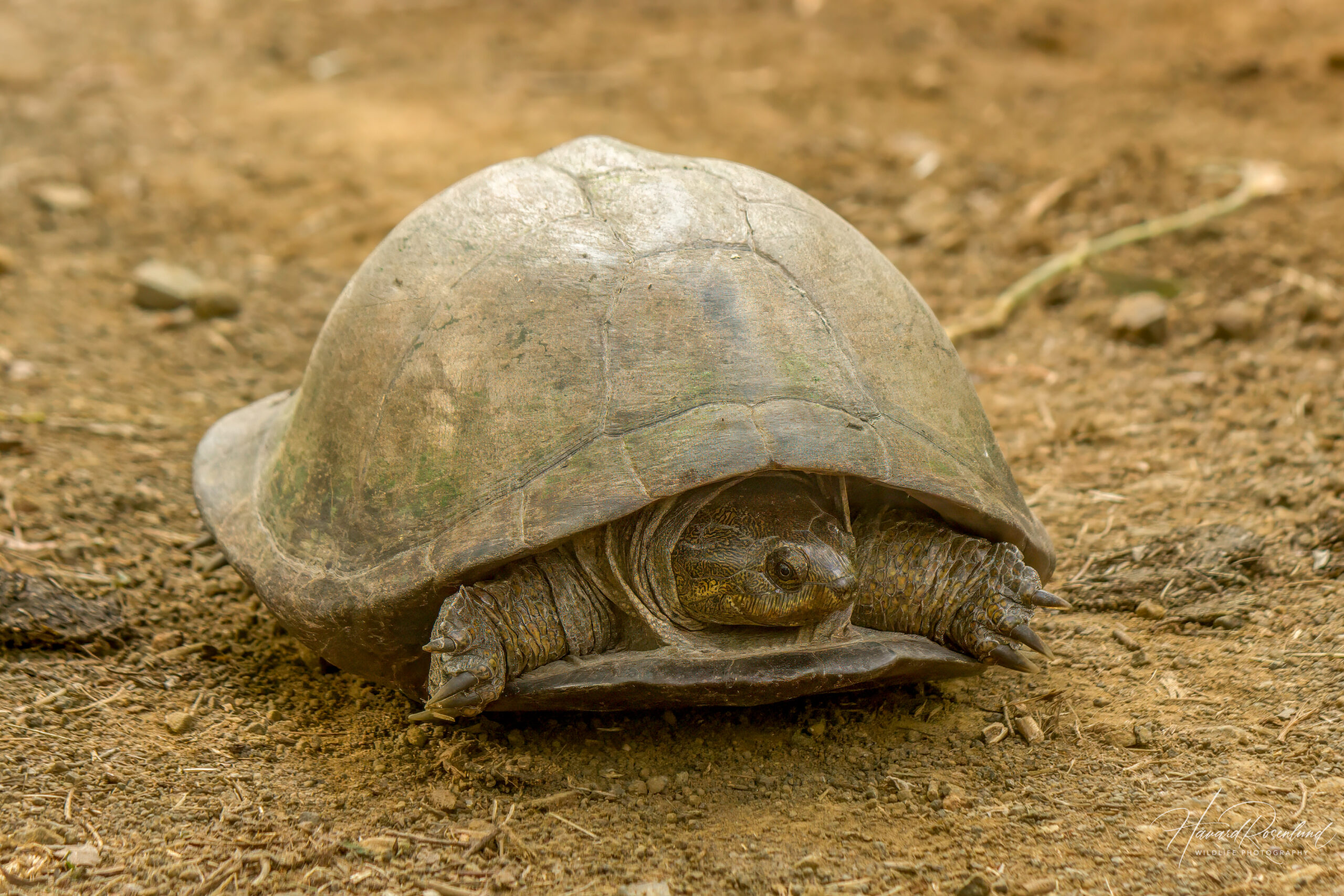
Serrated Hinged Terrapin
Pelusios sinuatus
At a glance
Habitat
- Rivers, lakes, permanent pans and other deeper freshwater habitats
Diet
- Mainly animal prey, including aquatic invertebrates, molluscs, fish and amphibians; also some plant matter
Activity
- Diurnal
Size
- Length: Carapace up to 55 cm Weight: —
Range
- Eastern Africa from southern Ethiopia and Somalia south to northeastern South Africa, extending inland to the upper Zambezi and Lake Tanganyika region
Description
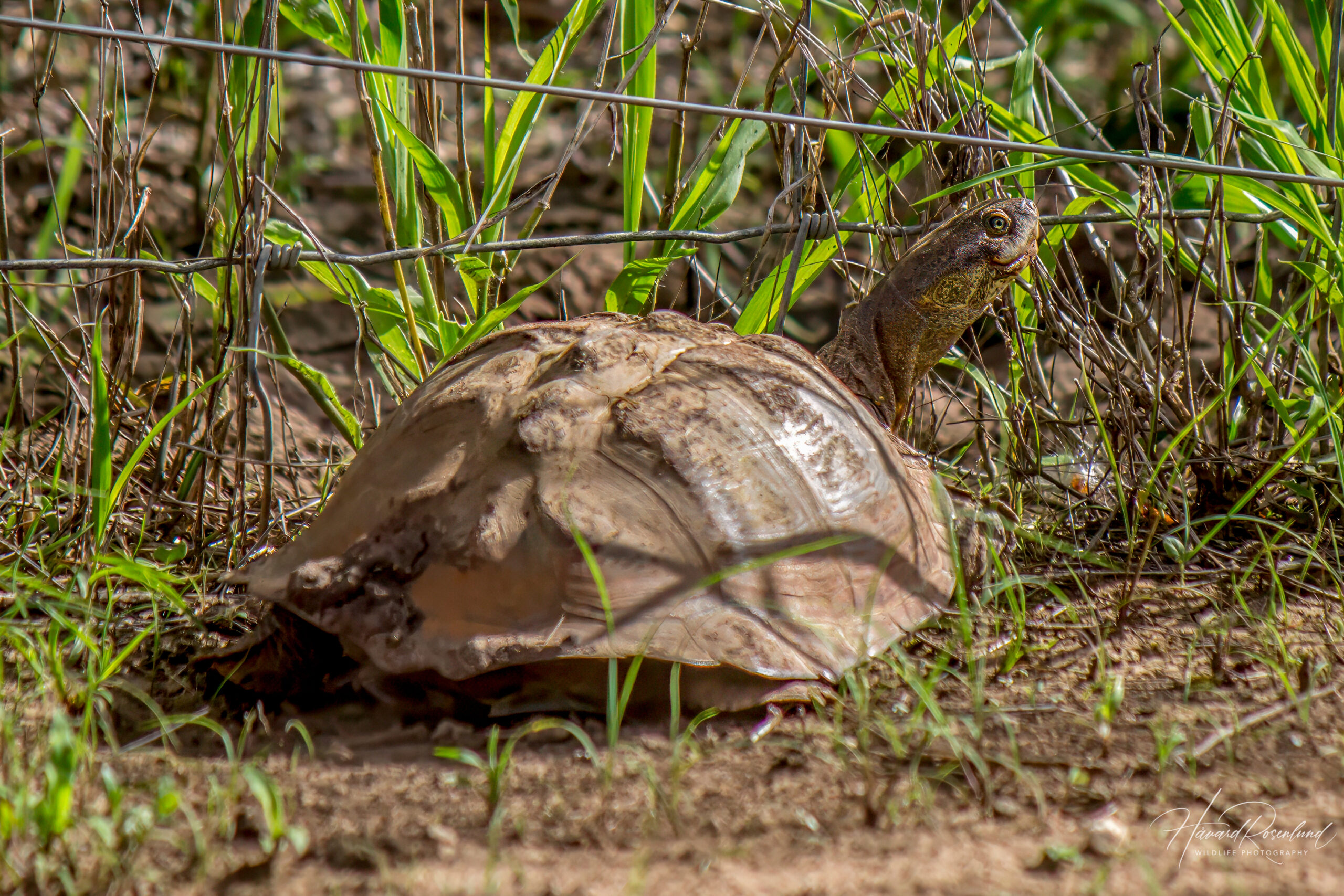
The serrated hinged terrapin (Pelusios sinuatus) is the largest species in the African mud-turtle genus Pelusios. Females grow substantially larger than males and can reach a straight carapace length of about 55 cm. The shell is usually olive-brown to very dark brown, with a distinctly serrated rear margin that is especially noticeable in younger animals. The plastron is yellow with a black border, and the head is broad with a pointed snout.
Males have a longer, thicker tail and a slightly concave plastron. Like other hinged terrapins, the plastron has a movable front lobe that helps close the front of the shell when the head and forelimbs are withdrawn. It is also a side-necked turtle: rather than pulling the neck straight backwards beneath the shell, it bends the neck sideways under the edge of the carapace.
Taxonomy
Genetic research published in 2019 revealed two deeply differentiated geographic lineages and led to recognition of two subspecies. The southern lineage is Pelusios sinuatus sinuatus, while the northern lineage is P. s. bottegi.
South African populations, including the animals represented on this page, belong to P. s. sinuatus. The lineages meet around the Limpopo region, and recent work in southeastern Zimbabwe indicates that P. s. bottegi predominates north of the contact zone. Older names such as P. s. zuluensis and P. s. leptus are no longer recognised as separate subspecies.
Habitat
Serrated hinged terrapins are characteristic of deeper freshwater habitats, especially rivers, lakes and permanent pans. They also use seasonal wetlands when water conditions allow movement between sites.
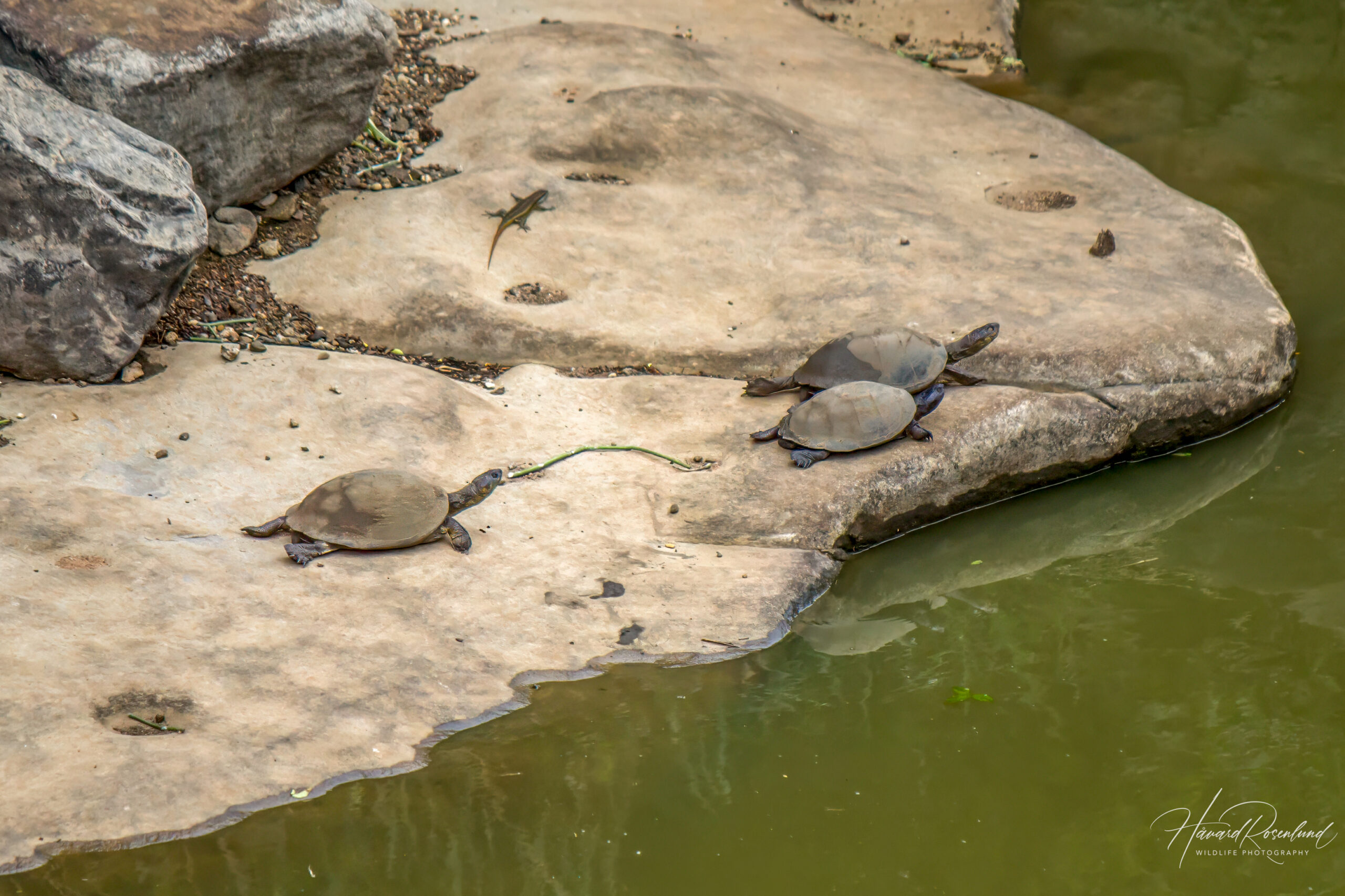
Logs, rocks and mudbanks provide important basking sites. During wet periods individuals can move overland between otherwise separate water bodies, allowing the species to colonise temporary or newly connected wetlands.
Diet
The species is an opportunistic feeder with a strong animal component in the diet. Aquatic insects and other invertebrates, worms, molluscs, fish and amphibians are taken, together with carrion and some plant material.
Much feeding occurs on or near the bottom of freshwater habitats, where serrated hinged terrapins search for live prey and dead organic material. The broad feeding strategy allows them to exploit changing food supplies in permanent and seasonal wetlands.
Behaviour
Serrated hinged terrapins are primarily diurnal and can be conspicuous while basking on logs, rocks and mudbanks. They have even been recorded resting on the backs of sleeping hippopotamuses.
The species is also capable of substantial overland movement. At the start of the rainy season individuals may leave permanent water and colonise isolated pans and waterholes. A study published in 2022 at Nyamithi Pan in Ndumo Game Reserve found that activity changed with air temperature and rainfall, and the tracked animals left the pan after flooding altered the surrounding wetland system.
Reproduction
Egg-laying begins around the onset of the rainy season. In southern Africa this is often in October and November, although nesting has been recorded considerably later.
Females leave the water to excavate nests in soil and can travel surprisingly far before laying; nests have been recorded up to about 500 m from the nearest water body. Clutches contain roughly 7–30 eggs. After covering the nest, the female provides no further parental care and the hatchlings are independent.
Status
The serrated hinged terrapin has not received a modern global assessment on the IUCN Red List and is therefore shown here as not evaluated. The southern subspecies P. s. sinuatus is regionally assessed as least concern in South Africa and Eswatini.
Pollution and wetland degradation can affect local populations, while roads, development and other changes that isolate water bodies can make seasonal movements between wetlands more difficult. The species remains widespread across much of eastern and southeastern Africa.
Image gallery
Loading map and observations…
National Red List status
| Country | Status | Assessment | Source |
|---|---|---|---|
| South Africa | LCLeast Concern | Red List of South African Species 2017 | SANBI – Red List of South African Species |
Have you seen this species?
Independent species archive
Did you find this species page useful?
Wildlife Vagabond is independently built and maintained. Voluntary support helps cover hosting, maps, data storage and continued improvements to the species archive.
Support Wildlife VagabondSpecies content will remain freely available.
References
Information about the species’ global distribution and status is based primarily on global Red List data. See the references below for details.
- IUCN SSC Tortoise and Freshwater Turtle Specialist Group. (n.d.). IUCN/SSC Tortoise and Freshwater Turtle Specialist Group – Pelusios sinuatus. https://iucn-tftsg.org/pelusios-sinuatus-036/
- IUCN SSC Tortoise and Freshwater Turtle Specialist Group. (n.d.). Turtles of the World – Annotated Checklist and Atlas, 10th edition (2025). https://iucn-tftsg.org/wp-content/uploads/crm.10.checklist.atlas_.v10.2025.pdf
- Luiselli, L., Demaya, G. S., Benansio, J. S., Petrozzi, F., Akani, G. C., Eniang, E. A., Ajong, S. N., Di Vittorio, M., Amadi, N., & Dendi, D. (2021). A Comparative Analysis of the Diets of a Genus of Freshwater Turtles across Africa. Diversity, 13(4), 165. https://doi.org/10.3390/d13040165
- Price, C., Burnett, M. J., O’Brien, G., & Downs, C. T. (2022). Presence And Temporal Activities Of Serrated Hinged Terrapin (Pelusios sinuatus) And Marsh Terrapin (Pelomedusa galeata) In KwaZulu-Natal, South Africa, Assessed Using Telemetry. Tropical Conservation Science, 15, 19400829221074241. https://doi.org/10.1177/19400829221074241
- The Reptile Database. (n.d.). Pelusios sinuatus. https://reptile-database.reptarium.cz/Pelusios/sinuatus
- Vamberger, M., Hofmeyr, M. D., Cook, C. A., Netherlands, E. C., & Fritz, U. (2019). Phylogeography of the East African Serrated Hinged Terrapin <i>Pelusios sinuatus</i> (Smith, 1838) and resurrection of <i>Sternothaerus bottegi</i> Boulenger, 1895 as a subspecies of <i>P. sinuatus</i>. Amphibian & Reptile Conservation, 13(2), 42–56. https://www.amphibian-reptile-conservation.org/pdfs/Volume/Vol_13_no_2/ARC_13_2_%5BSpecial_Section%5D_42-56_e184.pdf
- van Wyk, K. M., Maritz, B., & Clegg, B. W. (2025). Distribution and status of reptile species in south-eastern Zimbabwe. African Journal of Herpetology, 74(2), 210-270. https://doi.org/10.1080/21564574.2025.2538151