
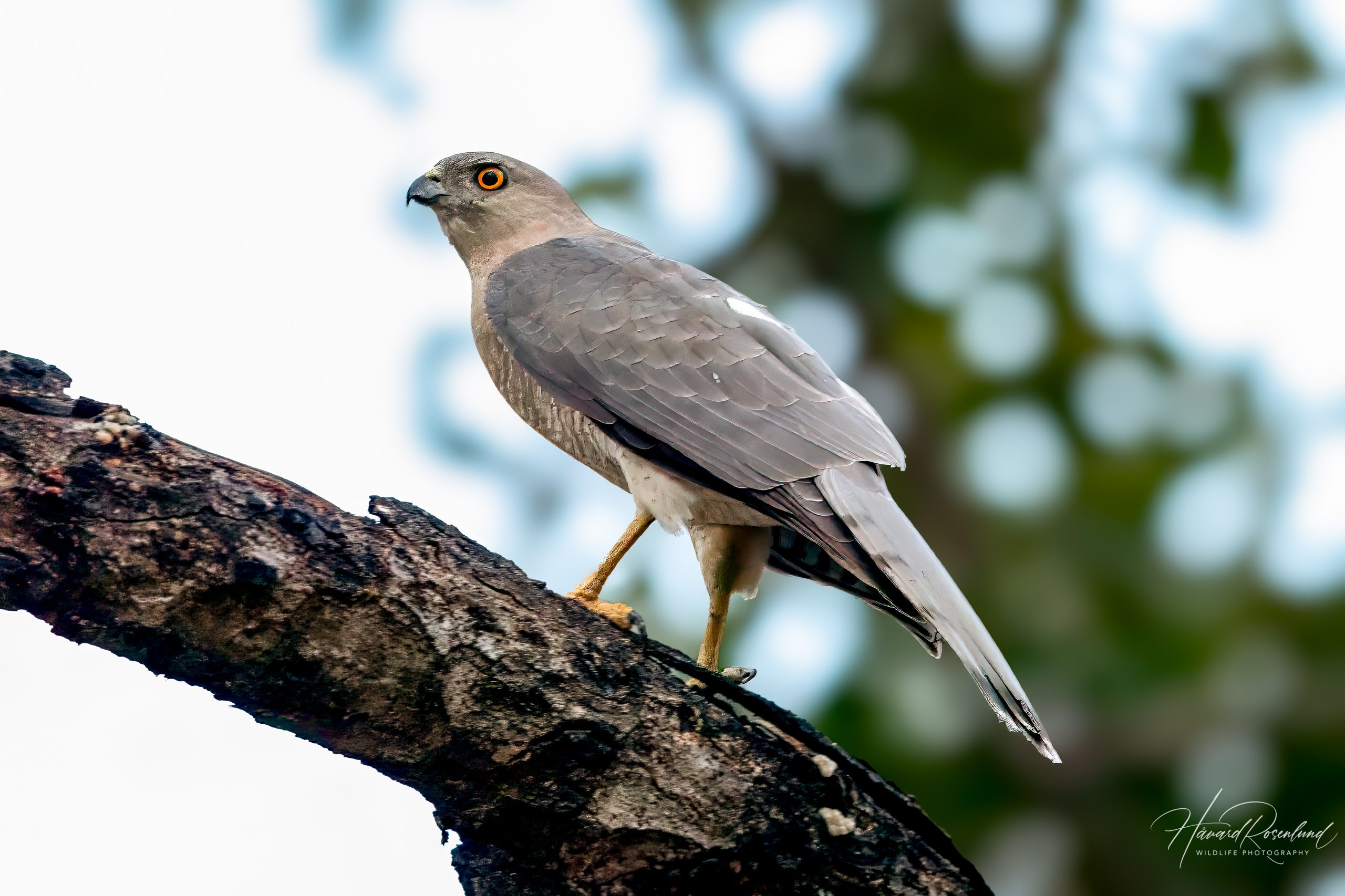
Shikra
Tachyspiza badia
At a glance
Habitat
- Woodland, forest edge, savanna, scrub, farmland, plantations, parks and gardens; highly adaptable in semi-open landscapes
Diet
- Lizards and other small vertebrates, including birds, rodents and frogs, together with large insects
Activity
- Diurnal
Size
- Length: ~26–36 cm Weight: ~100–265 g
Range
- In separate regions of sub-Saharan Africa and from the Middle East and Central Asia through South Asia to Sri Lanka and Southeast Asia
Description
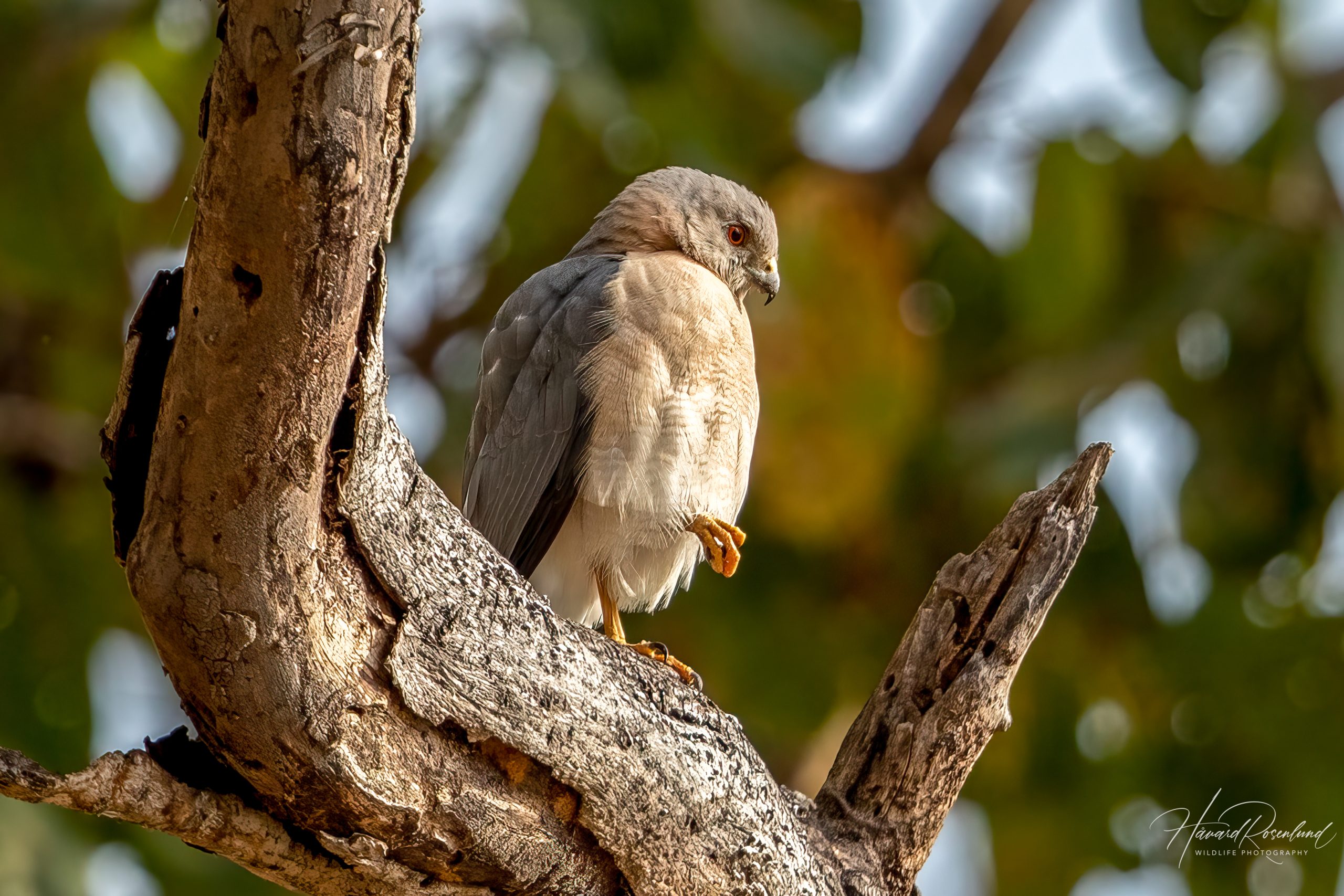
The shikra (Tachyspiza badia) is a small, agile hawk found across large parts of Africa and Asia. Adults are roughly 26–36 cm long, with females noticeably larger and heavier than males. Adult males have blue-grey upperparts, fine rufous barring below and deep red eyes, while females are browner and usually have yellow to orange eyes. Juveniles are brown above with streaked underparts.
The short rounded wings and long tail are typical of hawks adapted to fast manoeuvring between trees and shrubs. Shikras resemble the Eurasian sparrowhawk (Accipiter nisus), but adult shikras are generally paler and show different underpart patterning and eye colour.
Taxonomy
The species was long known as Accipiter badius. Phylogenetic work showed that the traditional genus Accipiter contained several distinct evolutionary lineages, and current classifications place the shikra in the resurrected genus Tachyspiza as T. badia. The change reflects its evolutionary relationships rather than a split or merge of the species itself.
Habitat
Shikras use a broad range of wooded and semi-open habitats, including dry and moist woodland, forest edges, savanna, scrub, farmland, plantations, parks, gardens and leafy residential areas. Mature trees can provide both hunting perches and nesting sites.
Dense forest is not essential. Mosaics of trees and open ground can be especially suitable because they combine cover for ambush with open spaces where prey is easier to detect. This flexibility allows the species to live in very different landscapes, including close to people.
Diet
Shikras are opportunistic predators of small vertebrates and large insects. Lizards are often especially important, alongside small birds, rodents, frogs, bats and large insects.
A detailed nesting study from Ajanta in Maharashtra, published in 2021, found lizards, especially garden lizards, to be the main prey delivered to three chicks. A nest study from Gujarat published in 2025 likewise found reptiles dominating food deliveries, showing how strongly locally abundant lizards can shape the diet during breeding.
Hunting
Shikras often wait quietly on a concealed or partly exposed perch before launching a sudden attack. Their short wings and long tail give excellent control during tight turns, allowing them to pursue birds and lizards through trees and shrubs as well as attack prey on the ground.
Behaviour
Outside the breeding season shikras are usually seen alone and can remain inconspicuous even in quite open, human-dominated landscapes.
Migration
Movement varies across the large and fragmented range. Many populations are largely resident, while some farther north and east make seasonal movements and can shift south in winter. The species should therefore not be treated as uniformly migratory or uniformly sedentary across its entire range.
Breeding
Breeding timing varies across the range and follows local seasonal conditions. Pairs become more vocal and territorial around the nest, giving repeated high-pitched calls and chasing other raptors or potential nest predators. The nest is a platform of twigs built high in a tree, often with fresh green leaves added to the lining. Clutches commonly contain three or four eggs, and incubation lasts about a month.
The parents have different roles. In the Ajanta study from Maharashtra, published in 2021, both adults incubated, but the male contributed less than 10% of the incubation time. He supplied most of the prey, while the female guarded the nest, incubated for most of the day and handled much of the food before feeding the chicks. Both parents remained involved after hatching, but in different ways.
The same study followed three chicks until they left the nest. Two made their first flights 25 days after hatching and the third four days later. The fledglings remained in trees around the nest afterwards, and shortly after fledging two of them were seen feeding together with the female.
Status
The shikra is classified as least concern on the IUCN Red List and remains widespread across Africa and Asia.
Its ability to use farmland, gardens and towns gives the shikra considerable resilience to moderate habitat change. Loss of mature trees, intensive pesticide use and persecution can still reduce local populations, particularly where nesting sites and prey are removed together.
Image gallery
Loading map and observations…
Have you seen this species?
Independent species archive
Did you find this species page useful?
Wildlife Vagabond is independently built and maintained. Voluntary support helps cover hosting, maps, data storage and continued improvements to the species archive.
Support Wildlife VagabondSpecies content will remain freely available.
References
Information about the species’ global distribution and status is based primarily on global Red List data. See the references below for details.
- BirdLife International. (n.d.). Shikra species factsheet. https://datazone.birdlife.org/species/factsheet/shikra-tachyspiza-badia
- Dunning. (2008). CRC Handbook of Avian Body Masses, 2nd edition. https://www.routledge.com/CRC-Handbook-of-Avian-Body-Masses-Second-Edition/Dunning-Jr/p/book/9781420064445
- International Union for Conservation of Nature. (n.d.). Shikra. The IUCN Red List of Threatened Species. https://www.iucnredlist.org/species/22695490/197951702
- IOC World Bird List – Taxonomic updates. (n.d.). Accipiter species transferred to Tachyspiza. https://www.worldbirdnames.org/new/updates/taxonomy/
- Mori & Vyas. (2025). Note on the breeding of Shikra Tachyspiza badia at Polo Forest, Gujarat, India. Flamingo Gujarat, 8(4), 19–23. https://www.researchgate.net/publication/401134482_Note_on_the_breeding_of_Shikra_Tachyspiza_badius_at_Polo_Forest_Gujarat_India
- State of India's Birds. (2025). 2025 – Shikra. https://stateofindiasbirds.in/species/shikra1/
- Suryawanshi. (2021). Nesting behaviour and diet of the Shikra Accipiter badius in Ajanta, Maharashtra. https://www.ncf-india.org/high-altitudes/nesting-behaviour-and-diet-of-the-shikra-accipiter-badius-in-ajanta-maharashtra