
Long-Established Urban Eurasian Coots Returned Faster and Showed Less Neophobia Than Non-urban Birds

A field experiment in Poland found that Eurasian coots (Fulica atra) from a long-established urban population were less shy around people and less neophobic at the nest than birds from non-urban sites. Neophobia is reluctance or fear toward something unfamiliar. The study compared responses to a human intruder and to a novel object during the breeding season.
Researchers compared three populations in 2023 and 2024. The Warsaw urban population had been established by the 1960s or earlier, whereas urban colonisation in Łódź began only in the late 1990s and continued over the following two decades. Non-urban birds bred at fishpond complexes in central Poland with little human disturbance. In one experiment, a researcher approached an active nest and remained within 0.5 m for one minute. In the other, a green cotton strip was placed beside the nest as a novel object.
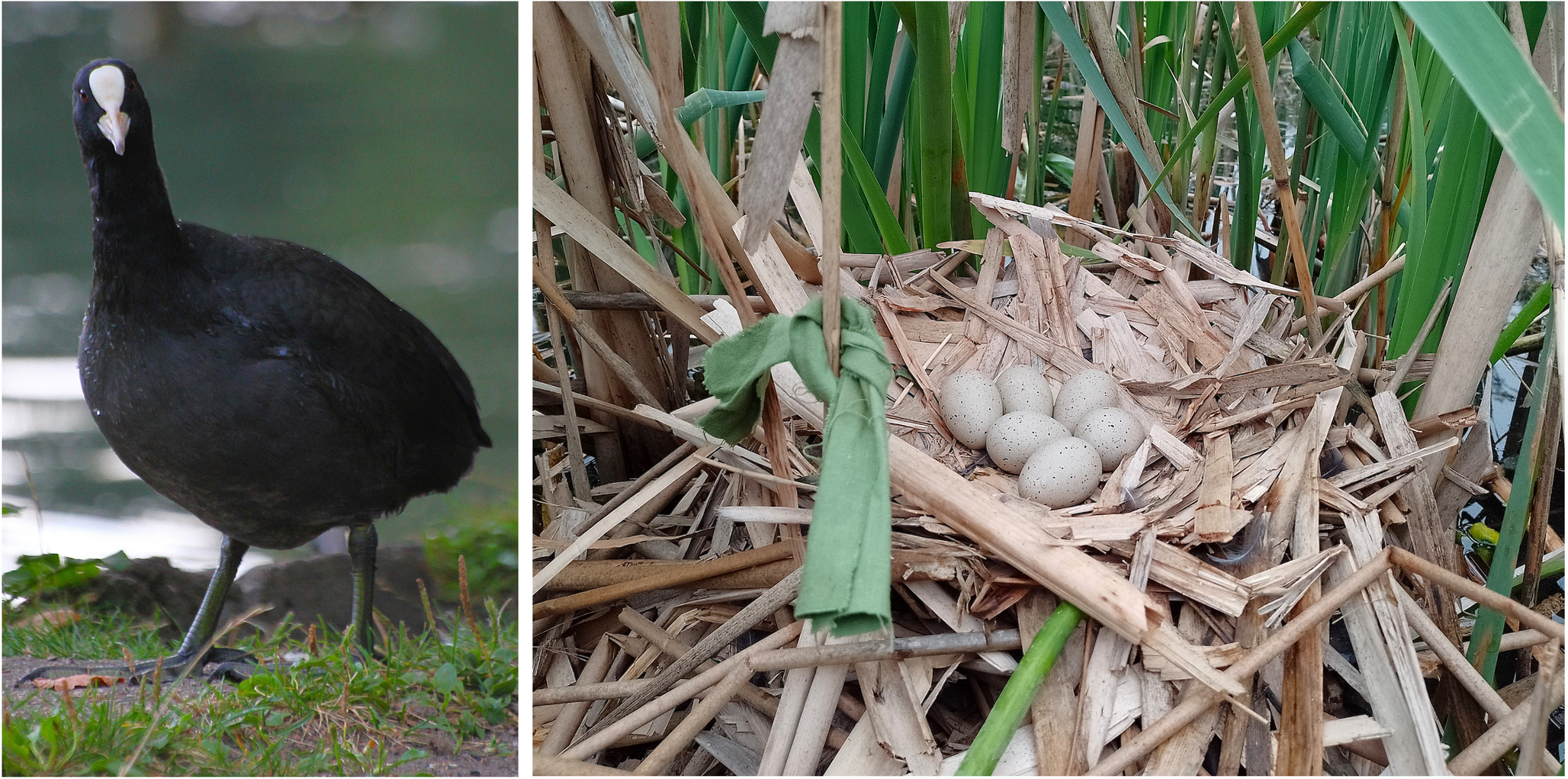
Long-established urban birds returned faster after human approach
The populations did not differ clearly in the probability of returning to the nest or resuming incubation during the human-intruder trial. They did differ in how quickly they did so. Birds from the old urban population returned to the nest after an average of 3.10 minutes and resumed incubation after 3.31 minutes. Non-urban birds took 7.50 minutes to return and 9.30 minutes to resume incubation. Birds from the newer urban population showed intermediate response times of 4.96 and 6.09 minutes.
The long-established urban population showed the weakest neophobia
The novel-object experiment showed a similar gradient. In the old urban population, 56.7% of pairs returned to the nest during the observation period and 53.3% resumed incubation. Among non-urban birds, the corresponding proportions were 20.6% and 8.8%; the newer urban population again showed intermediate responses.
The authors interpret the results as experimental evidence for reduced shyness and neophobia in the long-established urban population. The intermediate responses in Łódź are consistent with behavioural phenotypes developing gradually after urban colonisation, but the authors caution that the study included only one old and one new urban population and that separating behavioural plasticity from microevolutionary change would require further experimental validation.
Behaviour
Related news

Bird Droppings Contained Both Plant Nutrients and Resistance Genes
Droppings from wintering waterbirds at Caohai in China contained phosphorus that can readily become available to algae. Researchers…
Read story →
Boat traffic made wintering coots spend more time swimming in central Belgrade
A 2026 study of Eurasian coots wintering in central Belgrade found that exposure to boat traffic increased the…
Read story →
Longer Shorelines Were Associated With More Chicks in Four Urban Waterbird Species
Across 55 waterbodies in Gdańsk, Poland, longer shorelines were associated with more chicks in mallards, mute swans, Eurasian…
Read story →SPECIES IN THIS STORY
Species in this story

Independent research and conservation news archive
Did you find this information useful?
Wildlife Vagabond is independently built and maintained. Voluntary support helps cover source verification, hosting and continued work on research and conservation news.
Support Wildlife VagabondThe news archive will remain freely available.