
Young Tigress Had Higher Movement-Related Energy Expenditure After Dispersal and Rested About 65% of the Time
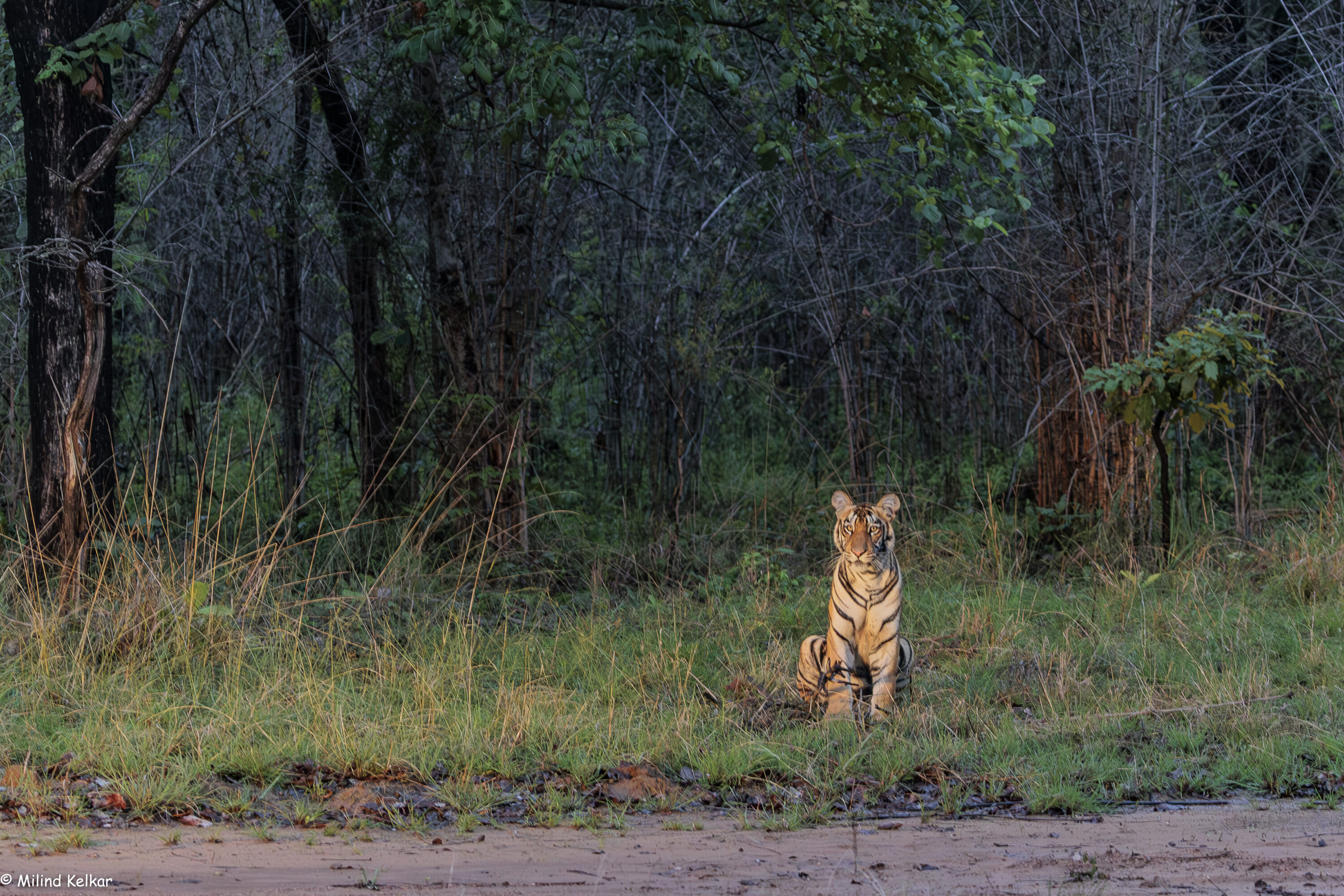
A wild subadult female tiger (Panthera tigris) in Brahmapuri Forest Division, India, eastern Vidarbha, showed higher movement-related energy expenditure after leaving her natal range and establishing a new home range. Researchers fitted her with a GPS collar and tri-axial accelerometer to examine how behaviour, time of day, season and life-history stage shaped her fine-scale patterns in movement-related energy use in a human-dominated landscape.
The accelerometer recorded body movement eight times per second. From these data, the researchers calculated Vectorial Dynamic Body Acceleration, or VeDBA, as a proxy for movement-related energy expenditure. Camera traps, field observations and GPS clusters were used to check the behavioural classifications. Four states could be distinguished reliably: resting, walking, travelling and hunting.
Resting dominated the activity budget
The tigress spent about 65% of the recorded time resting, mainly during the day. Travelling accounted for about 20% and was most frequent in the evening, while walking peaked around dawn and dusk. Hunting produced the strongest bursts of acceleration and the highest VeDBA values of the four behaviours.
The authors interpret the large share of resting as an energy-conservation strategy that may reduce the physiological costs of movement in a fragmented landscape with frequent human presence. They also suggest that the dawn and dusk peaks in walking and travelling may combine favourable prey activity with lower human disturbance, while the reduction in movement around midday may partly reflect the energetic and thermal costs of moving during hotter hours. These are proposed explanations rather than effects directly tested by the study.
Movement-related energy expenditure rose after dispersal
Hourly VeDBA was higher after dispersal than before. The researchers had expected this difference and interpret it as likely reflecting the extra movement involved in establishing a home range, patrolling it and maintaining boundaries against other tigers.
The comparison contrasted the period when the young female remained within her natal range with the later period after she had established a stable home range that no longer overlapped it.
Season Shifted the Daily Pattern of Movement-Related Energy Use
Before dispersal, VeDBA showed two main peaks around dawn and dusk in winter and summer. During the monsoon, the pattern was spread more broadly through the day and peaked in the evening. After dispersal, dawn and dusk peaks returned, although dawn VeDBA was lower in the monsoon than in winter.
The authors suggest that seasonal changes in vegetation, visibility, prey movement and the distribution of local resources may help explain the different monsoon pattern. Despite the shift in timing, the overall level of VeDBA-based movement-related energy expenditure was similar between monsoon and winter. The tigress therefore changed when she was active without a comparably large difference in this movement-related energetic measure between the two seasons.
The study followed only one subadult female for a limited period, so the authors stress that the findings cannot be generalised to male tigers, other females or other landscapes. Its value lies instead in showing how animal-borne accelerometers can connect specific behaviours with fine-scale patterns in movement-related energy use in a free-ranging tiger living in a landscape outside the protected-area network.
Physiology
Related news

Inland Mute Swans Had Higher Winter Body Condition Despite Harsher Winters and Supplemental Feeding
A study of 853 mute swans from four Polish wintering regions found higher body condition inland than on…
Read story →
pH-Adjusted Hill Equation Reliably Estimated Blood Oxygen Saturation From 70–100% in Immobilised White Rhinos
A South African study of 16 immobilised male white rhinos in Kruger National Park found that a pH-adjusted…
Read story →
Juvenile Harris's Hawks Manipulated Pine Cones for About Five Minutes
Two juvenile Harris's hawks in Buenos Aires Province tore pine cones from trees, carried them to new perches…
Read story →SPECIES IN THIS STORY
Species in this story
Independent research and conservation news archive
Did you find this information useful?
Wildlife Vagabond is independently built and maintained. Voluntary support helps cover source verification, hosting and continued work on research and conservation news.
Support Wildlife VagabondThe news archive will remain freely available.