
Most New Golden Jackal Samples Around the Adriatic Matched the Pannonian Genetic Cluster

New genetic sampling around the Adriatic and neighbouring regions assigned most golden jackals (Canis aureus) to the Pannonian genetic cluster, while only two of 27 newly analysed animals showed clear mixed Dalmatian–Pannonian ancestry. The study, published on 11 March 2026, examined how far genetic influence from the distinct Dalmatian population extends beyond its known core area.
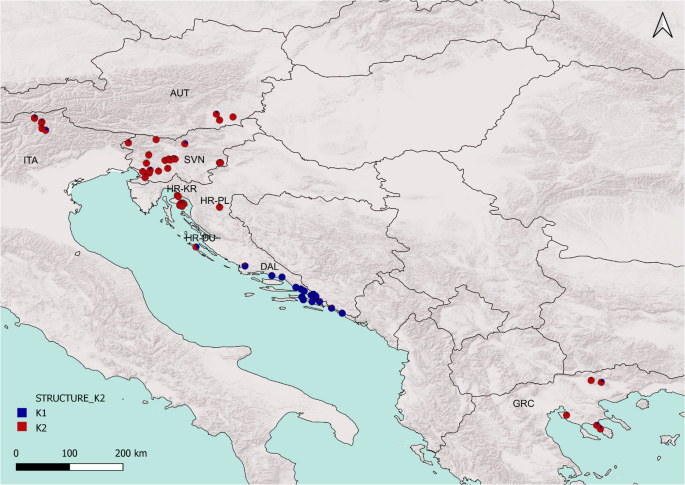
The researchers analysed new samples from western Croatia, north-eastern Italy, south-eastern Austria and northern Greece and compared them with 46 previously analysed reference profiles from the Dalmatian and Pannonian populations. Population assignment was based on 23 microsatellite markers — short repeated DNA regions that are useful for distinguishing genetic structure and gene flow between populations.
Two main genetic clusters were confirmed
Across several analytical methods, the data supported two principal genetic clusters. One corresponded to the Dalmatian population along the Croatian Adriatic coast, while the broader Pannonian cluster included most jackals sampled elsewhere.
Jackals from Austria and Greece, most animals from Croatia’s island of Krk and Plitvice National Park, and most of the Italian samples were assigned to the Pannonian population. None of the 27 new samples was assigned entirely to the Dalmatian cluster.
Only two new animals showed substantial mixed ancestry
One jackal from north-eastern Italy and one from the Croatian island of Dugi Otok showed substantial mixed Dalmatian–Pannonian ancestry. Together with earlier evidence from Slovenia, these individuals indicate that gene flow occurs across the contact zone, but the new data suggest it is limited.
The results extend the documented contact zone from Dalmatia and Dugi Otok toward eastern Italy. At the same time, the strong representation of Pannonian ancestry in the newly sampled areas is consistent with the rapid expansion of this population into northern and western Europe.
The Dalmatian population may have a restricted distribution
The authors conclude that the Dalmatian population may occupy a considerably more restricted area than the widespread and expanding Pannonian population. They also note that the genetic distinctiveness of the Dalmatian group appears to have persisted despite some long-distance dispersal between regions.
However, the researchers explicitly caution that the new sample is small and geographically discontinuous. Important areas of the southern Adriatic and Balkans remain poorly sampled, including Bosnia and Herzegovina, Montenegro and Albania, as well as several Adriatic islands.
Genetics & genomics
Related news

Similar Mammal Diversity, Different Activity Patterns in Grazed and Ungrazed Areas
Camera traps in four northern Israeli reserves found similar numbers of mammal species with and without livestock grazing.…
Read story →
Climate Best Explained Fine-Scale Genetic Connectivity in Expanding Golden Jackals
A Eurasian landscape-genomics study of 363 golden jackals found that geography dominated genetic structure at continental scale, while…
Read story →
Golden Jackals Were Recorded 84% Less Often at Carrion in Grazed Areas of Northern Israel
At three sites in northern Israel, golden jackals were recorded 84% less often at experimental carrion in grazed…
Read story →SPECIES IN THIS STORY
Species in this story

Independent research and conservation news archive
Did you find this information useful?
Wildlife Vagabond is independently built and maintained. Voluntary support helps cover source verification, hosting and continued work on research and conservation news.
Support Wildlife VagabondThe news archive will remain freely available.