
Rare Pioneering Pairs Drove Much of Scottish Osprey Range Recovery
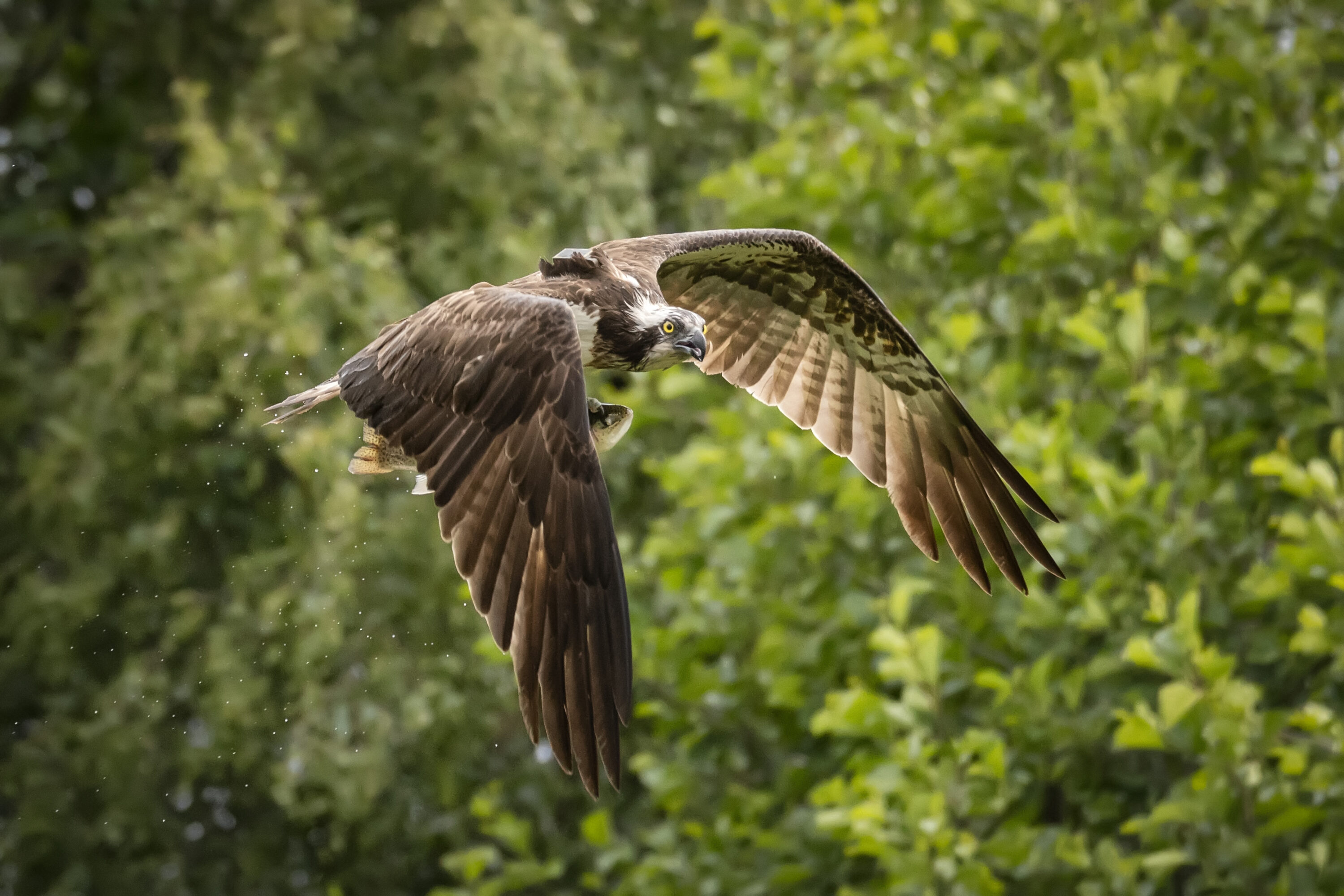
Rare long-distance settlers, rather than a steady outward wave, drove much of the osprey’s (Pandion haliaetus) geographical recovery in northern Scotland. A study published on 12 August 2026 found that new breeding centres were founded by occasional pioneering pairs and then filled in more slowly by later breeders settling nearby.
The researchers analysed annual nest records from Highland and Moray across 54 years, from the first modern breeding return at Loch Garten in 1954 through 2007. The study area covered about 24,000 km² and contained 149 recorded nest sites, 132 of which were occupied by a breeding pair in at least one year. Later years were excluded because the population had become too widespread for new nests and annual occupancy to be recorded with comparable consistency.
Pioneering pairs created distant new breeding centres
The breeding range did not expand smoothly. A conservative measure of occupied area showed no expansion in 20 of the 54 study years, even though the population eventually spread as far as 143 km from Loch Garten. Spatial analysis separated the nests into eight subpopulations. The founding nests of these groups lay an average of 33.8 km from the nearest previously occupied nest, while nests established later within the new clusters averaged only 4.7 km from an earlier nest. Excluding one subpopulation founded by two pairs at once, it took an average of 7.6 years before a second nest was occupied near a founder.
This pattern is known as stratified diffusion: rare long-distance jumps establish new centres, followed by shorter-distance infilling around them. The authors note that it resembles the spread of many biological invasions, even though the Scottish case is the recovery of a native species.
Male dispersal may limit the pace of expansion
The researchers also suggest that males may be an important bottleneck in range expansion. Female ospreys generally disperse farther from their birthplace, whereas males are more strongly natal-philopatric and often select the nest site used to attract a mate. The authors therefore propose that the scarcity of males making rare long-distance pioneering movements may limit how quickly new breeding areas are founded. This is an interpretation of the spatial pattern, not a direct test of individual male movements.
Management could imitate rare pioneering movements
Three of the eight founding pairs used human-established nest sites, and 19% of all occupied nests in the dataset were human-established. The study did not contain enough evidence to show that artificial nests themselves accelerated expansion. The authors nevertheless argue that artificial nest provision and translocations could be used to reproduce the effect of rare pioneering movements, and suggest that encouraging male dispersal may be particularly useful. Their results also show why a simple average expansion rate can be misleading: recovery can pause for years and then advance suddenly when a pioneer establishes a distant new breeding centre.
Ecology
Related news
VKM: Exporting Up to 26 Osprey Young to Ireland Would Not Harm Conservation Status in Norway
VKM concluded that exporting up to 26 wild young ospreys from two Norwegian donor areas to Ireland would…
Read story →
24 Osprey Chicks Fledged From 12 Rutland Nests
Rutland Osprey Project reported 24 chicks fledged from 12 nests in 2026. The season produced 14 chicks assessed…
Read story →
Ospreys Raised Three Chicks in Switzerland’s First Breeding in 112 Years
A male released by the Swiss reintroduction project and an unringed female of unknown origin raised three chicks…
Read story →SPECIES IN THIS STORY
Species in this story
Independent research and conservation news archive
Did you find this information useful?
Wildlife Vagabond is independently built and maintained. Voluntary support helps cover source verification, hosting and continued work on research and conservation news.
Support Wildlife VagabondThe news archive will remain freely available.