
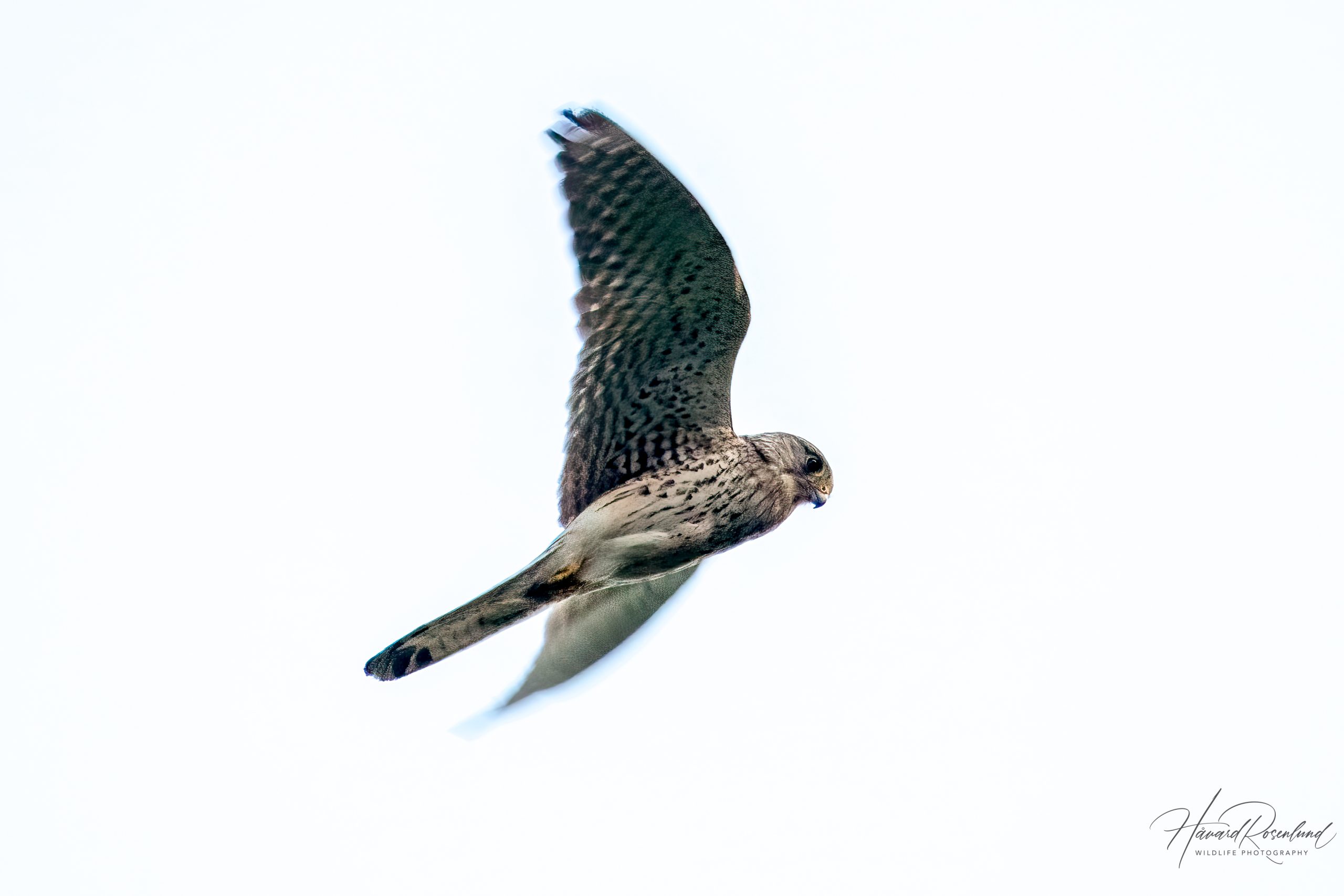
Common Kestrel
Falco tinnunculus
At a glance
Habitat
- Open farmland, grassland, heath, moorland and other open habitats with perches or nesting structures nearby
Diet
- Mainly voles and other small mammals; also birds, reptiles and large insects
Activity
- Diurnal
Size
- Length: 27–35 cm Weight: about 150–220 g
Range
- Europe, Africa and much of Asia; northern populations are more migratory
Description
The common kestrel (Falco tinnunculus) is a small falcon found across Europe, Africa and much of Asia. Adults are about 27–35 cm long, have a wingspan of roughly 57–79 cm and usually weigh around 150–220 g, with females larger than males. Males have a warm reddish-brown back, grey head and grey tail with a broad black tip, while females and juveniles are more uniformly brown and strongly barred.
Both sexes have a dark moustache-like stripe below the eye. The similar lesser kestrel (Falco naumanni) is generally smaller and more lightly marked; adult male lesser kestrels lack the dark spotting across the back that is typical of male common kestrels.
Habitat
Common kestrels are specialists in hunting over open ground rather than in dense forest. Farmland, pasture, grassland, heath, moorland, coastal fields, mountain valleys and road verges can all provide good habitat where low vegetation makes prey visible.
The species also adapts well to human structures. Church towers, farm buildings, cliffs, quarries, bridges and nest boxes can replace natural nesting sites, while surrounding fields or urban grassland provide hunting areas. Suitable landscapes combine open feeding habitat with safe elevated places for resting and nesting.
Diet
Small mammals dominate the diet in many parts of the range, especially voles and mice. Kestrels also take small birds, lizards, frogs and large insects, with the balance changing according to season and local prey abundance.
Hunting
Hovering is the hunting behaviour most strongly associated with the kestrel. The bird faces into the wind and uses rapid wingbeats and constant tail adjustments to keep its head almost fixed over one point on the ground while scanning for movement. When prey is detected, it drops rapidly toward the ground. Field measurements published in 1991 showed that under favourable updrafts kestrels could hold position with very little flapping and use about two-thirds less energy than when continuous powered wingbeats were needed to remain in place, although they then took longer per vole caught. When wind conditions are poorer, birds switch more often to hunting from poles, trees or other raised perches.
Kestrel vision extends into ultraviolet wavelengths. Experiments published in 1995 showed that the birds could detect vole urine and faecal scent marks under UV light, and in the field they hunted more often near artificial trails treated with such marks. A later experiment from 2006 supported the use of UV reflectance from vole scent marks, but a visual-physiology study published in 2013 questioned how reliable this signal is under natural conditions. Measurements of both raptor UV sensitivity and vole-urine reflectance suggested that urine alone is unlikely to provide a strong and stable visual cue. UV traces may therefore contribute to foraging information, but the mechanism is less clear-cut than the earliest experiments suggested.
Migration
Migration varies greatly across the range. Birds in mild western and southern regions can remain near the breeding area throughout the year, while populations farther north and east are increasingly migratory. Young birds also tend to disperse farther than established adults.
European migrants generally move south and west in autumn, with many wintering around the Mediterranean or in Africa. The species therefore ranges from almost completely resident populations to individuals that travel thousands of kilometres between seasons.
Breeding
Kestrels do not build a typical stick nest. They lay eggs on cliff ledges, in cavities, on buildings or in old nests made by crows and other birds, and they readily use nest boxes. A typical clutch contains four to five eggs, although two to seven have been recorded.
The female performs most of the incubation, which usually lasts around 28–29 days, while the male supplies much of the food. After hatching, both adults contribute to feeding the young. The chicks usually fledge after about 32–37 days but remain dependent on their parents for some time afterwards.
Nest boxes can have a large local effect when food is plentiful but natural nest sites are scarce. In Trysil, Norway, 384 pairs bred in 2012 and 355 of them used boxes, showing how strongly a population can respond when nesting sites are the main local limitation.
Status
The common kestrel is classified as least concern on the IUCN Red List. It remains widespread across its large range, but population trends differ substantially between regions.
Changes in agriculture can reduce vole, insect and other prey populations when grassland diversity, field margins and rough vegetation disappear. Pesticides and the loss of nesting sites can add further pressure. Open hunting areas and suitable nesting sites remain key resources.
Image gallery
Loading map and observations…
Have you seen this species?
Independent species archive
Did you find this species page useful?
Wildlife Vagabond is independently built and maintained. Voluntary support helps cover hosting, maps, data storage and continued improvements to the species archive.
Support Wildlife VagabondSpecies content will remain freely available.
References
Information about the species’ global distribution and status is based primarily on global Red List data. See the references below for details.
- Artsdatabanken. (n.d.). Artsdatabanken – Common Kestrel, Norwegian Red List 2021. https://lister.artsdatabanken.no/rodlisteforarter/2021/28583
- BirdLife International. (n.d.). Common Kestrel species factsheet. https://datazone.birdlife.org/species/factsheet/common-kestrel-falco-tinnunculus
- BirdLife Norway. (2014). Kestrel nest-box project in Trysil, Report 1-2014. https://www.birdlife.no/prosjekter/rapporter/2014_01_NOF.pdf
- British Trust for Ornithology. (n.d.). Kestrel BirdFacts. https://www.bto.org/learn/about-birds/birdfacts/kestrel
- International Union for Conservation of Nature. (n.d.). Common Kestrel. The IUCN Red List of Threatened Species. https://www.iucnredlist.org/species/22696362/206316110
- Lind, O., Mitkus, M., Olsson, P., & Kelber, A. (2013). Ultraviolet sensitivity and colour vision in raptor foraging. Journal of Experimental Biology, 216(10), 1819-1826. https://doi.org/10.1242/jeb.082834
- Videler & Groenewold. (1991). Field measurements of hanging flight aerodynamics in the Kestrel. https://research.rug.nl/en/publications/field-measurements-of-hanging-flight-aerodynamics-in-the-kestrel-/
- Viitala, J., Korplmäki, E., Palokangas, P., & Koivula, M. (1995). Attraction of kestrels to vole scent marks visible in ultraviolet light. Nature, 373(6513), 425-427. https://doi.org/10.1038/373425a0
- Zampiga, E., Gaibani, G., Csermely, D., Frey, H., & Hoi, H. (2006). Innate and learned aspects of vole urine UV‐reflectance use in the hunting behaviour of the common kestrel Falco tinnunculus. Journal of Avian Biology, 37(4), 318-322. https://doi.org/10.1111/j.2006.0908-8857.03825.x