
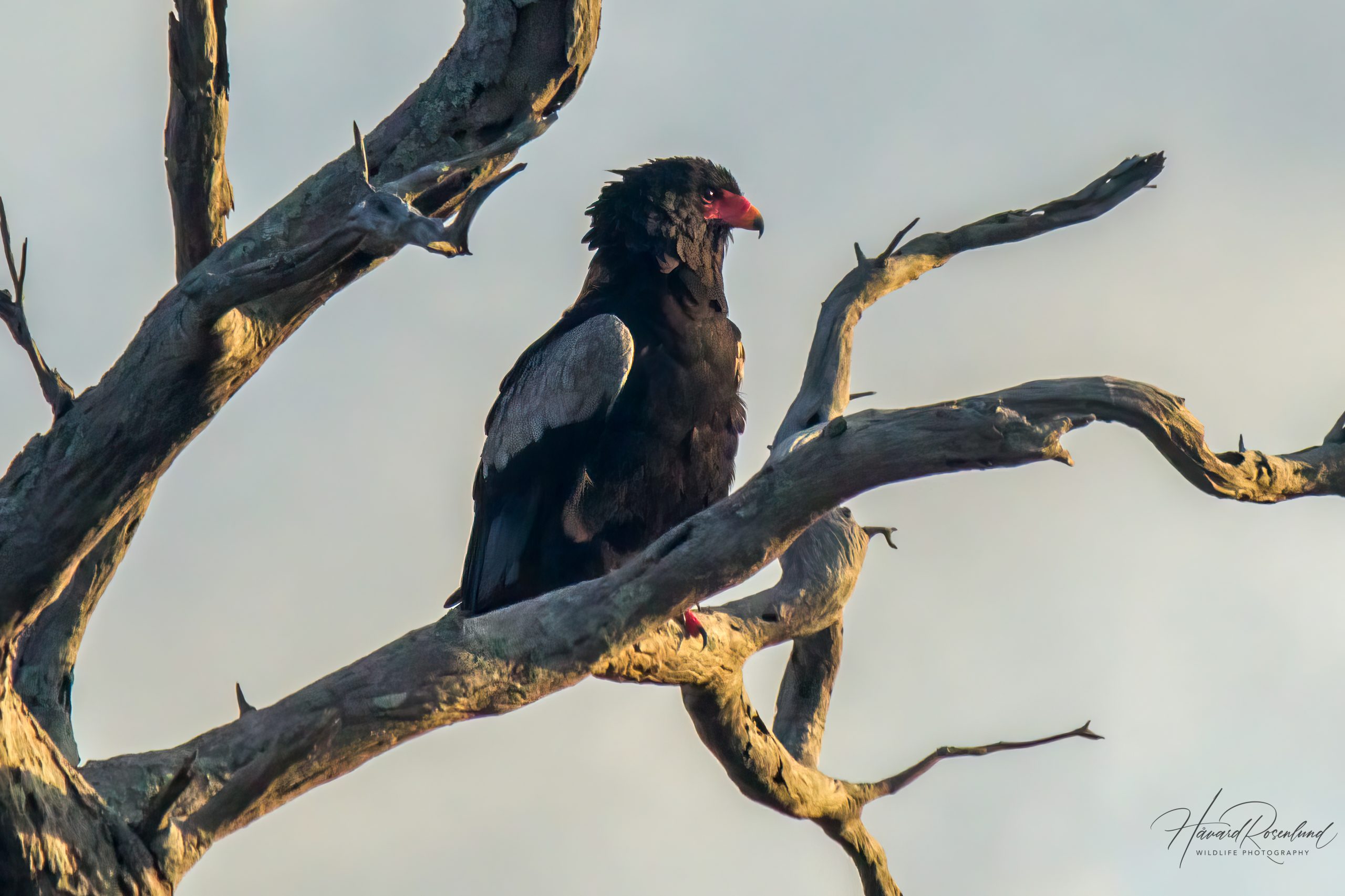
Bateleur
Terathopius ecaudatus
At a glance
Habitat
- Savanna, open woodland and semi-arid bushveld; avoids dense forest
Diet
- Carrion plus small and medium vertebrates, reptiles, birds and large insects
Activity
- Diurnal; spends much of the day flying low over large areas in search of food
Size
- Length: 55–70 cm Weight: 1.8–2.95 kg
Range
- Widespread but strongly declining across sub-Saharan Africa
Description
The bateleur (Terathopius ecaudatus) is one of Africa's most distinctive raptors. Adults are about 55–70 cm long, weigh roughly 1.8–2.95 kg and have a wingspan of around 168–190 cm. The body is predominantly black with chestnut on the back, grey shoulders, a very short tail and bright red facial skin, legs and feet.
Males and females differ most clearly in the underwing pattern, with females showing broader pale areas in the flight feathers. Juveniles are brown with duller greenish facial skin and longer wings and tails than adults. Several successive plumages are passed through before the full adult appearance is reached at about seven to eight years of age.
Habitat
Bateleurs are characteristic of savanna, open woodland and semi-arid bushveld and are much less associated with dense forest. They need large, open landscapes where aerial searching is effective, together with mature trees for nesting and roosting.
The species now occurs disproportionately in protected areas and other landscapes with low human pressure. This reflects not a narrow habitat requirement, but the heavy mortality and disturbance it experiences in many intensively used landscapes outside reserves.
Diet
The bateleur has a broad carnivorous diet. It eats carrion but also takes live prey including snakes and other reptiles, birds, small and medium-sized mammals, large insects and occasional fish.
The balance between hunting and scavenging varies with age and opportunity. Carrion can be especially valuable to young birds that have not yet developed the hunting efficiency of experienced adults.
Hunting & scavenging
Bateleurs spend much of the day on the wing, often using low, efficient gliding flight to search over enormous areas. Adults can cover up to about 480 km in a single day. When live prey is detected they can descend rapidly to the ground and take a wide range of vertebrates, with snakes particularly important in many areas. The legs and feet have thick, coarse skin that may reduce the risk of injury from snakes.
The same low-ranging aerial searches make bateleurs exceptionally good at discovering fresh carcasses, and they are often among the first raptors to arrive. Their descent can in turn alert vultures and other scavengers to food that might otherwise take longer to locate.
Bateleurs feed quickly when they arrive early at a carcass but become less dominant as larger scavengers accumulate. They may also obtain food through kleptoparasitism, meaning they harass another bird until it drops its prey, although bateleurs themselves can lose food to larger eagles. Hunting and scavenging therefore form a flexible continuum rather than two sharply separated feeding strategies.
This close association with carcasses is one reason poisoned bait is so dangerous to the species.
Behaviour
The extremely short tail and long wings give the bateleur its characteristic rocking glide, with frequent side-to-side adjustments while soaring. This aerial performance inspired the name bateleur, a French word associated with an acrobat or tightrope performer.
The bare skin of the face, legs and feet can change from paler red-orange when the bird is relaxed to much brighter red during excitement or agitation. Adults are usually encountered alone or as established pairs, while juveniles and other non-breeders can range much more widely before settling. Groups of more than 20 birds may occasionally gather at rich feeding or resting sites.
Home ranges
Established bateleur pairs defend their territories throughout the year, including after breeding failure and in years when they do not nest. In southern Africa, breeding home ranges have been estimated at roughly 21–40 km², although the exact area depends on prey availability and habitat.
Non-breeding and immature birds are much less spatially restricted and can roam far beyond the compact areas used by established pairs. This contrast helps explain why even populations centred on large reserves remain exposed to poisoning and other threats in the surrounding landscape.
Breeding
Bateleurs form long-term monogamous pairs and defend large territories. Breeding timing varies geographically: the main season is roughly December–August in southern Africa, September–May in West Africa and can extend through the year in East Africa. A relatively small stick nest is usually built in the fork of a tall tree, often below the main canopy and frequently near a watercourse. Only one egg is normally laid.
Incubation lasts about 55 days. The female performs much of the incubation, although the male may take over for shorter periods. A breeding study in Kruger National Park recorded nestling periods from about 100 days to more than 190 days, an exceptionally long and variable period for a raptor. After the first flight, the young bird continues to depend on its parents for several months.
The same work documented two nests where an extra non-breeding bird briefly helped with incubation or chick care. These birds may have been offspring from previous years, but only a few cases are known, so it is unclear how typical this behaviour is. With a single-egg clutch and prolonged parental care, the species has a low reproductive rate.
Status
The bateleur is globally classified as Endangered on the IUCN Red List. In South Africa, Lesotho and Eswatini it is also classified as Endangered, with an estimated regional population of about 900 mature individuals that is still declining.
The decline extends far beyond southern Africa. Long-term road surveys from several parts of Africa indicate a median decline of about 87% over three generations across the areas studied. The enormous range therefore conceals a species that has disappeared or become much scarcer in many human-dominated landscapes.
Threats
Poisoning is one of the most serious threats. Bateleurs readily investigate carcasses and can be killed by poisoned bait intended for predators, by carcasses contaminated during wildlife crime and by other toxic substances. At least 30 bateleurs were recorded killed in poisoning events across Africa from 2015 to 2024.
Habitat loss, bush encroachment, persecution, illegal possession and trade, nest disturbance and other forms of human-caused mortality add to the pressure. Birds can also drown in steep-sided artificial reservoirs. Because the species matures slowly and produces only one young at a time, additional adult mortality has effects that can persist for many years.
Conservation
Conservation priorities include preventing wildlife poisoning, rapid response to poisoning incidents, reducing persecution and securing large landscapes with safe nesting trees and adequate food. Protected areas remain disproportionately important, but bateleurs routinely cross reserve boundaries and therefore require safer surrounding landscapes as well.
The Endangered Wildlife Trust tracks bateleurs across southern Africa and follows regional population trends. The movements of tagged birds help identify where they leave protected areas and encounter threats such as poisoning. The organisation also works on poisoning response and outreach with landowners and livestock farmers, while The Peregrine Fund monitors African raptors and works to reduce poisoning in parts of the bateleur's range.
Conservation organizations


Image gallery
Loading map and observations…
National Red List status
| Country | Status | Assessment | Source |
|---|---|---|---|
| South Africa | ENEndangered | Regional Red Data Book of Birds of South Africa, Lesotho and Eswatini 2025 | BirdLife South Africa – Regional Red Data Book 2025 |
Have you seen this species?
Independent species archive
Did you find this species page useful?
Wildlife Vagabond is independently built and maintained. Voluntary support helps cover hosting, maps, data storage and continued improvements to the species archive.
Support Wildlife VagabondSpecies content will remain freely available.
References
Information about the species’ global distribution and status is based primarily on global Red List data. See the references below for details.
- BirdLife International. (n.d.). Bateleur species factsheet. https://datazone.birdlife.org/species/factsheet/bateleur-terathopius-ecaudatus
- BirdLife South Africa. (2025). Bateleur, Red Data Book of Birds of South Africa, Lesotho and Eswatini. https://www.birdlife.org.za/red-list/bateleur/
- BirdLife South Africa. (n.d.). Bateleur, Bird of the Year 2024. https://www.birdlife.org.za/bird-of-the-year-2024/
- International Union for Conservation of Nature. (n.d.). Bateleur. The IUCN Red List of Threatened Species. https://www.iucnredlist.org/species/22695289/174413323
- Shaw, P., Ogada, D., Dunn, L., Buij, R., Amar, A., Garbett, R., Herremans, M., Virani, M. Z., Kendall, C. J., Croes, B. M., Odino, M., Kapila, S., Wairasho, P., Rutz, C., Botha, A., Gallo-Orsi, U., Murn, C., Maude, G., & Thomsett, S. (2024). African savanna raptors show evidence of widespread population collapse and a growing dependence on protected areas. Nature Ecology & Evolution, 8(1), 45-56. https://doi.org/10.1038/s41559-023-02236-0
- The Peregrine Fund. (n.d.). Bateleur species profile. https://peregrinefund.org/explore-raptors-species/eagles/bateleur-eagle
- Watson, R. T. (1990). Breeding biology of the bateleur. Ostrich, 61(1-2), 13-23. https://doi.org/10.1080/00306525.1990.9633933
- Watson, R. T. (1990). Population dynamics of the bateleur in the Kruger National Park. Ostrich, 61(1-2), 5-12. https://doi.org/10.1080/00306525.1990.9633931
- Watson, R. (1989). Aggressive display and territoriality of the bateleurTerathopius ecaudatus. South African Journal of Zoology, 24(2), 146-150. https://doi.org/10.1080/02541858.1989.11448146