
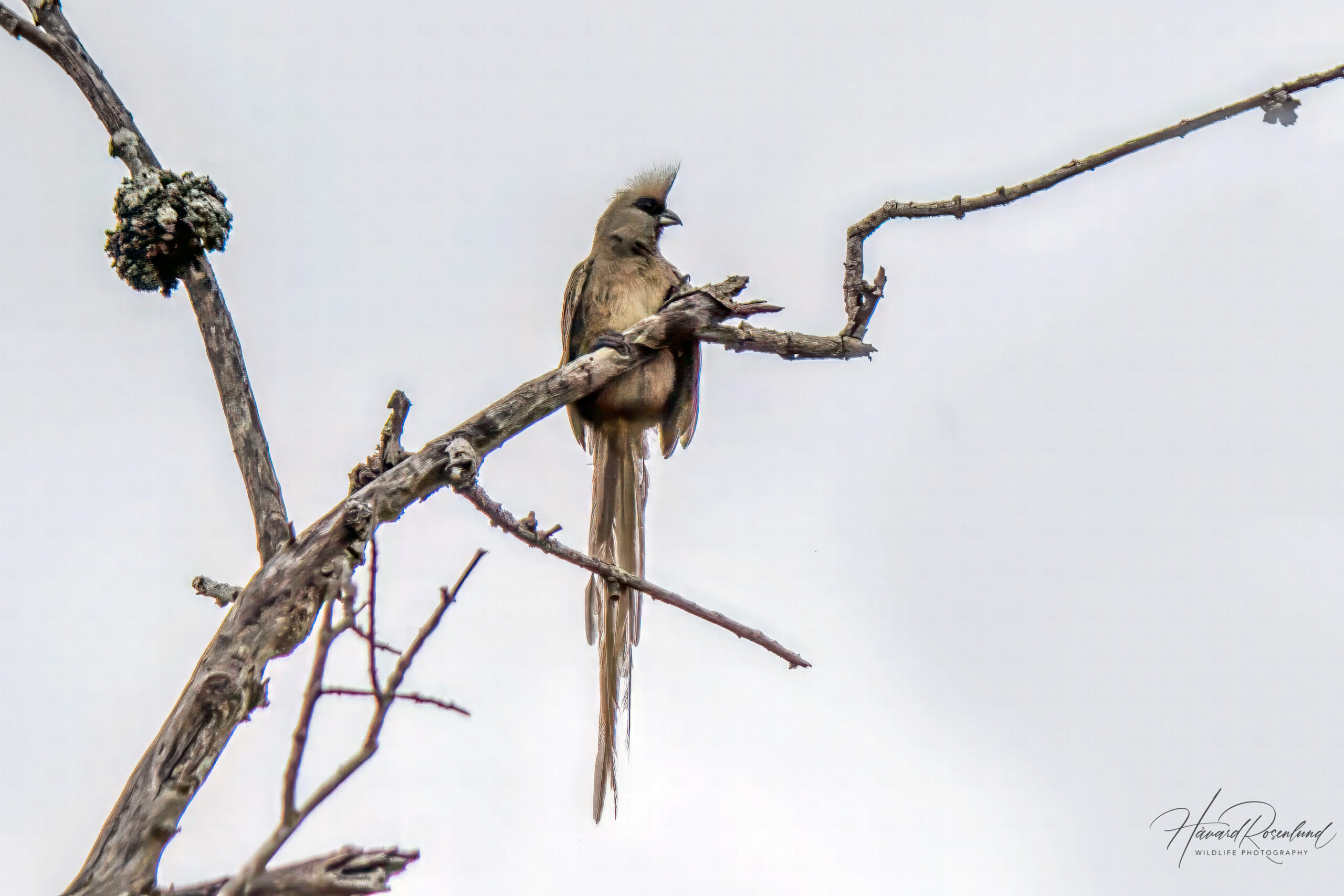
Speckled Mousebird
Colius striatus
At a glance
Habitat
- Woodland edges, thickets, savanna, riverine vegetation, plantations, orchards, parks and well-vegetated gardens
Diet
- Mainly fruit and leaves; also buds, flowers, nectar, seeds and occasional small invertebrates
Activity
- Diurnal; active in social groups and often rests or sunbathes between feeding bouts
Size
- Length: Up to about 35 cm including the long tail Weight: About 50–55 g
Range
- Widespread through much of central, eastern and southern sub-Saharan Africa
Description
The speckled mousebird (Colius striatus) is the largest living mousebird, reaching about 35 cm including a tail that makes up more than half the total length. Adults weigh only around 50–55 g. The plumage is soft grey-brown to brown with fine barring on the neck and underparts, a prominent crest, a dark bare patch around the eye and a black upper mandible contrasting with the pale lower mandible.
Mousebirds have unusually mobile toes that give the feet a highly flexible grip. They climb through branches, hang at odd angles and scramble through vegetation in the manner that inspired their English name. Fossils show that the lineage was once much more diverse and widespread, with Paleogene records from both Europe and North America; all six living mousebird species are now confined to sub-Saharan Africa.
Habitat
Speckled mousebirds are highly adaptable and occur in woodland edges, thickets, savanna, riverine vegetation, plantations, orchards, parks and suburban gardens. Dense foliage for feeding, shelter and nesting is more important than undisturbed wilderness, allowing the species to thrive in many human-modified landscapes.
Diet
The diet is unusually plant-rich for such a small bird. Fruit is important, but leaves can also form a substantial part of the diet, together with buds, flowers, nectar and seeds. Small invertebrates are taken occasionally. The ability to use relatively low-energy foliage provides a dependable food source when richer foods are scarce.
Speckled mousebirds process fruit rapidly rather than retaining it in a large fermentation system. A feeding study published in 2000 found that food passage on a fruit diet averaged just 54 minutes. The birds compensated for relatively low digestive efficiency by eating large quantities, an unusual strategy for a small bird that regularly consumes both fruit and leaves.
Social behaviour
Speckled mousebirds are strongly social throughout the year. Flocks of about 5–20 birds are typical in southern Africa, and the birds feed, rest and move together. At night they press tightly against one another at communal roosts. Groups may remain socially integrated during breeding, with non-breeding birds sometimes helping a pair raise young. They are also vocal, with a warbling tsu-tsu call in flight and a distinctive tisk-tisk alarm call.
Their climbing ability also shapes everyday group behaviour: birds often move together through dense vegetation rather than making long flights, clambering among branches and hanging in unusual positions while feeding and resting.
Thermoregulation
Communal roosting plays an important role in temperature regulation. An experiment published in 2006 in Pietermaritzburg, South Africa, found that birds clustered together maintained more stable night-time body temperatures than birds forced to roost alone.
When food is restricted, speckled mousebirds can lower body temperature and metabolic rate substantially, reducing energy expenditure. Huddling moderates these temperature drops and helps synchronise body temperature within the group. Their social behaviour and physiology therefore work together to reduce the energetic cost of cold nights and limited food.
Breeding
Breeding can occur throughout the year when conditions are suitable; in southern Africa, activity peaks markedly from September to January. The species is usually monogamous, but polygyny also occurs, so a male may occasionally breed with more than one female. Both sexes build a shallow cup nest from grasses, stems and other plant material, often lined with softer material and hidden in dense vegetation. A clutch commonly contains three or four eggs, and incubation lasts about two weeks. The chicks normally leave the nest at around 17–18 days of age.
Speckled mousebirds can breed cooperatively. A pair may receive help from juvenile or adult group members, and southern African accounts describe groups with several helpers, some of which may not be closely related to the breeding pair. Helpers assist with feeding young and nest defence, allowing the wider social group to remain involved throughout the breeding cycle.
Status
The speckled mousebird is globally classified as Least Concern on the IUCN Red List. It is widespread through much of central, eastern and southern Africa and remains common in many suitable habitats.
The species adapts readily to orchards, gardens and other well-vegetated human landscapes, and no major range-wide threat is currently known. It can be regarded as a nuisance where flocks feed on cultivated fruit, but this local conflict does not presently translate into a global conservation concern.
Image gallery
Loading map and observations…
Have you seen this species?
Independent species archive
Did you find this species page useful?
Wildlife Vagabond is independently built and maintained. Voluntary support helps cover hosting, maps, data storage and continued improvements to the species archive.
Support Wildlife VagabondSpecies content will remain freely available.
References
Information about the species’ global distribution and status is based primarily on global Red List data. See the references below for details.
- Berman & Raikow. (1982). Hindlimb musculature of the mousebirds (Coliiformes). https://academic.oup.com/auk/article-abstract/99/1/41/5187853
- Biodiversity and Development Institute. (2022). Speckled Mousebird. https://thebdi.org/2022/08/12/speckled-mousebird-colius-striatus/
- Biodiversity Explorer. (n.d.). Speckled Mousebird. Iziko Museums of South Africa. https://www.biodiversityexplorer.info/birds/coliidae/colius_striatus.htm
- BirdLife International. (n.d.). Speckled Mousebird species factsheet. https://datazone.birdlife.org/species/factsheet/speckled-mousebird-colius-striatus
- Downs, C. T., Wirminghaus, J. O., & Lawes, M. J. (2000). Anatomical and Nutritional Adaptations of the Speckled Mousebird (Colius striatus). The Auk, 117(3), 791-794. https://doi.org/10.1093/auk/117.3.791
- International Union for Conservation of Nature. (n.d.). Speckled Mousebird. The IUCN Red List of Threatened Species. https://www.iucnredlist.org/species/22683776/93000568
- McKechnie, A. E., & Lovegrove, B. G. (2001). Heterothermic responses in the speckled mousebird (Colius striatus). Journal of Comparative Physiology B: Biochemical, Systemic, and Environmental Physiology, 171(6), 507-518. https://doi.org/10.1007/s003600100201
- McKechnie, A. E., Körtner, G., & Lovegrove, B. G. (2006). Thermoregulation under semi-natural conditions in speckled mousebirds: the role of communal roosting. African Zoology, 41(2), 155-163. https://doi.org/10.1080/15627020.2006.11407350
- Zelenkov, N. V., & Dyke, G. J. (2008). The fossil record and evolution of mousebirds (Aves: Coliiformes). Palaeontology, 51(6), 1403-1418. https://doi.org/10.1111/j.1475-4983.2008.00814.x