
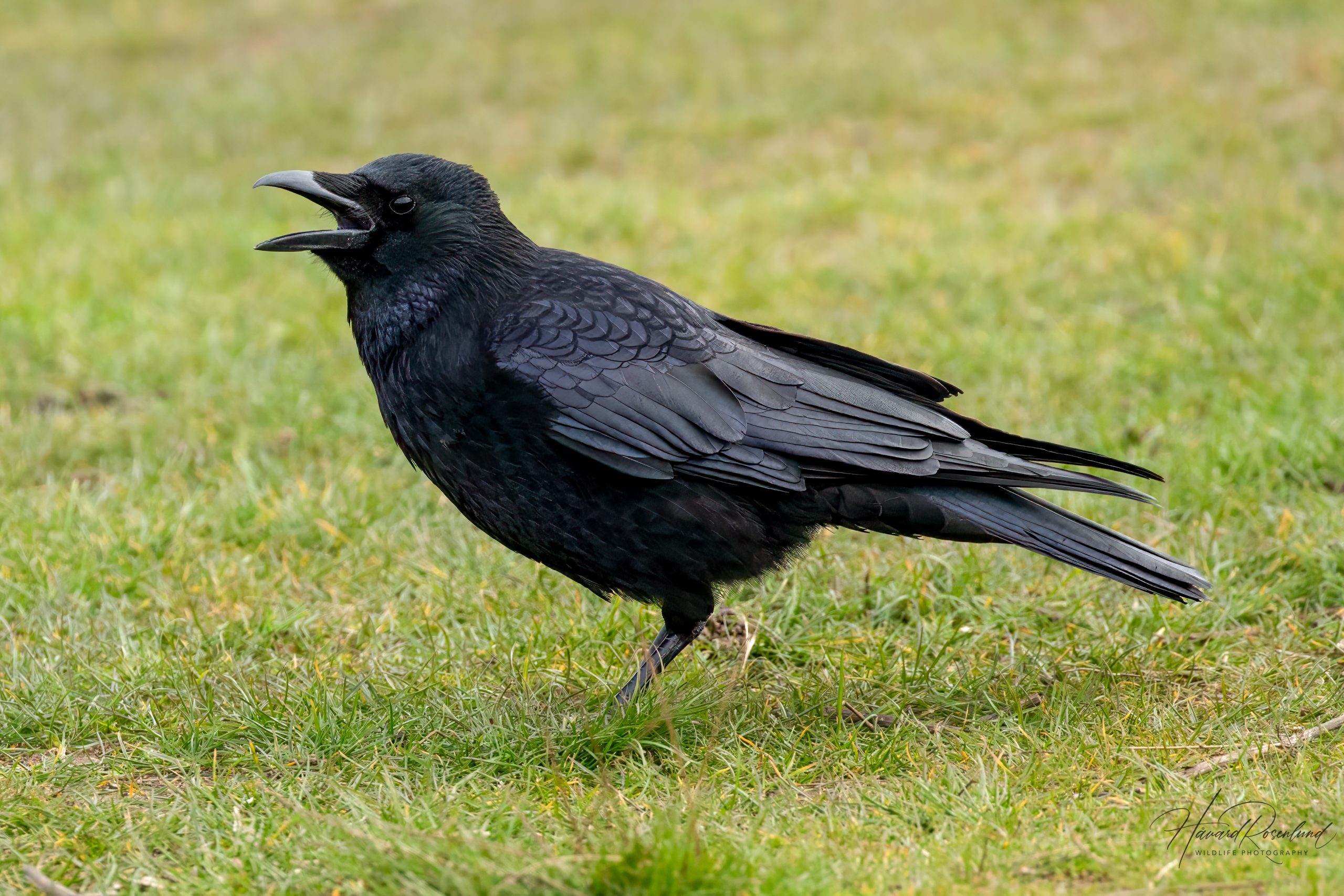
Western Carrion Crow
Corvus corone corone
At a glance
Habitat
- Farmland, woodland edges, coasts, uplands, parks, villages and cities
Diet
- Omnivorous: invertebrates, small vertebrates, eggs, carrion, grain, fruit and human food
Activity
- Diurnal
Size
- Length: 44–51 cm Weight: about 509 g on average
Range
- Western Europe; the nominate all-black form meets hooded forms along a narrow contact zone farther east and north
Description
The western carrion crow (Corvus corone corone) is the all-black nominate subspecies of the carrion crow (Corvus corone) in western Europe. Adults are roughly 44–51 cm long, have a wingspan of about 84–100 cm and average around 509 g. The plumage, bill and legs are entirely black, with a purple, blue or green sheen visible in good light. The bill is stout but less massive and arched than that of a raven, and the tail is comparatively square-ended.
The similar rook (Corvus frugilegus) has a more peaked crown and, in adults, a conspicuous patch of bare pale skin around the base of the bill. Western carrion crows also tend to be encountered as territorial pairs rather than in the dense feeding colonies typical of rooks.
Taxonomy
Carrion and hooded crows have repeatedly moved between species and subspecies status. AviList v2025b treats them as one polytypic species, Corvus corone. Under this treatment the western all-black form on this page is C. c. corone, while the familiar grey-and-black form is Hooded Crow (C. c. cornix). Other all-black and hooded subspecies occur farther east across Eurasia.
The European forms meet along a long, narrow hybrid zone and interbreed. Genomic studies show extensive gene flow across most of the genome despite their striking difference in colour. A study published in 2019 found that interaction between the gene NDP and a region on chromosome 18 explained more than 68% of the plumage variation across the hybrid zone. Both regions are under strong divergent selection.
Habitat
Western carrion crows occupy an exceptionally broad range of open and semi-open habitats, including farmland, pasture, woodland edges, moorland, coasts, parks, villages and cities. Their success depends less on one habitat type than on access to open feeding ground, suitable nesting sites and resources that change through the year.
Diet
The diet is exceptionally broad. Western carrion crows take insects and other invertebrates, earthworms, eggs and young birds, small vertebrates, carrion, grain, seeds, fruit and discarded human food. They forage on the ground, probe soil and vegetation, search shorelines and roadsides, and scavenge carcasses. Ploughed fields, grazed pasture and other temporary concentrations of food can be exploited quickly.
Behaviour
Western carrion crows are behaviourally flexible and learn quickly how predictable changes in their surroundings affect access to food and safe space. Individuals adjust where and when they forage as local conditions change and may move repeatedly between different feeding areas within the same day.
Social behaviour
Most breeding western carrion crows live as long-term territorial pairs, but the social system is flexible. Non-breeding birds form loose groups. A study published in 2002 from northern Spain found 73.3% of the surveyed territories occupied by cooperative groups, with up to nine birds in a group. These groups contained a breeding pair and additional birds that could help with territory defence or chick rearing. Cooperative breeding is therefore much more common in some populations than in others.
Intelligence
The species is an important model in animal-cognition research. In a 2024 experiment, three trained carrion crows learned to produce an instructed number of vocalisations from one to four after seeing or hearing arbitrary numerical cues. Features of the very first call predicted how many calls would follow, indicating that the birds planned the vocal sequence before beginning it. This was a controlled laboratory task rather than evidence that wild crows routinely use numerical calls in the same way.
Breeding
Western carrion crows build a large stick nest, usually high in a tree but sometimes on cliffs, pylons or buildings. The nest cup is lined with softer materials such as grass, wool or hair and moss. One brood is normal each year. A typical clutch contains 3–4 eggs. The female incubates for about 18–20 days, while the male supplies much of her food, and both parents feed the young after hatching. The chicks normally remain in the nest for about 29 days. After fledging they remain dependent on the adults for roughly four to five weeks.
Where cooperative groups occur, helpers may also contribute to nest defence and chick feeding. The amount of assistance varies among individuals and territories, so cooperative rearing is a regional social strategy rather than the normal breeding system throughout the subspecies' range.
Relationship with humans
Western carrion crows adapt readily to human-modified landscapes. Towns and cities can provide lawns, playing fields, road verges, parks and refuse as feeding opportunities, while buildings and other structures can supplement trees as nesting sites. Birds living around people can become much more tolerant of close human activity than their rural counterparts.
They also learn to exploit recurring human activities that temporarily expose food, including mowing, cultivation and traffic-related opportunities. The same individuals may move repeatedly between built-up areas and surrounding farmland rather than functioning as strictly urban birds, making the relationship with people a good example of the species' broader behavioural flexibility.
Status
The western carrion crow is not assessed separately by the IUCN; its status follows the parent species Corvus corone, which is classified as least concern. The nominate form remains common across much of western Europe.
Britain holds a particularly large population of this form. BTO estimated about 1.1 million breeding territories in 2016 and records a 15% increase in the breeding population between 1995 and 2024, although growth has slowed compared with earlier decades.
Image gallery
Loading map and observations…
Have you seen this species?
Independent species archive
Did you find this species page useful?
Wildlife Vagabond is independently built and maintained. Voluntary support helps cover hosting, maps, data storage and continued improvements to the species archive.
Support Wildlife VagabondSpecies content will remain freely available.
References
Information about the species’ global distribution and status is based primarily on global Red List data. See the references below for details.
- Baglione, V., Canestrari, D., Marcos, J. M., Griesser, M., & Ekman, J. (2002). History, environment and social behaviour: experimentally induced cooperative breeding in the carrion crow. Proceedings of the Royal Society B: Biological Sciences, 269(1497), 1247–1251. https://doi.org/10.1098/rspb.2002.2016
- BirdLife International. (n.d.). Carrion Crow species factsheet. https://datazone.birdlife.org/species/factsheet/carrion-crow-corvus-corone
- British Trust for Ornithology. (n.d.). Carrion Crow BirdFacts. https://www.bto.org/learn/about-birds/birdfacts/carrion-crow
- Christidis, L., Rheindt, F. E., Iliff, M. J., Lepage, D., Rasmussen, P. C., Donald, P., Alström, P., Areta, J. I., Brammer, F., Chesser, T., Donsker, D., Dowsett, B., Gerbracht, J., Kirsch, M., Kuziemko, M., Lagerqvist, M., Littauer, R., Longmore, W., Norman, J., … Stervander, M. (2026). AviList v2025b. AviList. https://doi.org/10.2173/avilist.v2025b
- International Union for Conservation of Nature. (n.d.). Corvus corone corone. The IUCN Red List of Threatened Species. https://www.iucnredlist.org/species/22706016/131944737
- Knief, U., Bossu, C. M., Saino, N., Hansson, B., Poelstra, J., Vijay, N., Weissensteiner, M., & Wolf, J. B. W. (2019). Epistatic mutations under divergent selection govern phenotypic variation in the crow hybrid zone. Nature Ecology & Evolution, 3(4), 570-576. https://doi.org/10.1038/s41559-019-0847-9
- Liao, D. A., Brecht, K. F., Veit, L., & Nieder, A. (2024). Crows “count” the number of self-generated vocalizations. Science, 384(6698), 874-877. https://doi.org/10.1126/science.adl0984
- Tobias, J. A., Sheard, C., Pigot, A. L., Devenish, A. J. M., Yang, J., Sayol, F., Neate‐Clegg, M. H. C., Alioravainen, N., Weeks, T. L., Barber, R. A., Walkden, P. A., MacGregor, H. E. A., Jones, S. E. I., Vincent, C., Phillips, A. G., Marples, N. M., Montaño‐Centellas, F. A., Leandro‐Silva, V., Claramunt, S., … Schleuning, M. (2022). AVONET: morphological, ecological and geographical data for all birds. Ecology Letters, 25(3), 581-597. https://doi.org/10.1111/ele.13898