
Most Tracked Common Terns From One German Baltic Colony Used the Western Route; 18% Used the Eastern Route

Common terns (Sterna hirundo) from a breeding colony on Germany’s Baltic coast followed two distinct routes to African wintering areas. Of 71 birds tracked with light-level geolocators, 58 used a western route and 13 — 18.3% — used an eastern route. These small loggers estimate broad position from the timing of dawn and dusk, giving less spatial precision than GPS but allowing migration to be reconstructed across the annual cycle.
The western-route birds travelled through the Wadden Sea and along the coasts of France, Portugal and Spain before following western Africa south. Senegal and Mauritania were important autumn stopover areas, while many birds continued to winter along the coasts of Namibia and South Africa. Birds on the eastern route crossed or skirted the eastern Mediterranean and followed the Red Sea and eastern African coast toward the Mozambique Channel. Across all tracked birds, 11 wintered off Mozambique and two off Madagascar; one eastern-route bird instead continued around the Cape to Cape Town, while one western-route bird reached the Mozambique Channel.
The eastern route required much more time
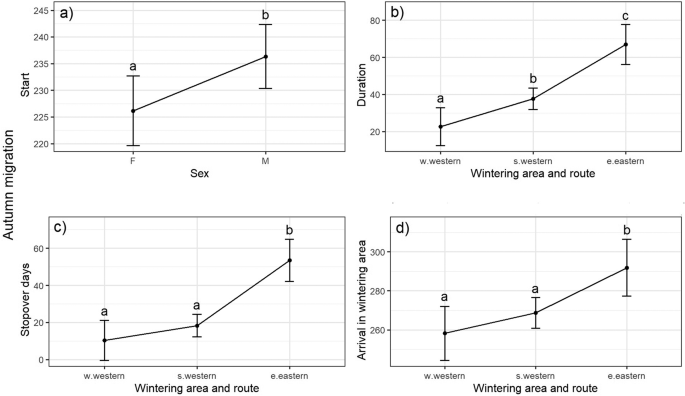
Migration route and wintering area were the strongest factors associated with migration duration and time spent at stopovers. In models based on complete tracks from birds of known sex, individuals using the eastern route and wintering in eastern Africa migrated about 29 to 44 days longer than the two western-route groups. They also spent about 35 to 43 more days at stopover sites.
Sex mainly affected when migration began. Females started autumn migration an average of 10.2 days earlier than males and spring migration 4.6 days earlier. Arrival back in the breeding area was associated with year rather than sex or route in the study’s models, although the authors caution that some years had very small samples.
The eastern route was more common than ringing records suggested
Ringing data had long indicated that Common Terns from western and central Europe mainly used the East Atlantic flyway. Tracking studies have more recently revealed an eastern African route, and the new sample shows that it was used by a substantial minority of birds from Riether Werder rather than by only isolated individuals.
The authors identify route and wintering area as major sources of variation in migration duration and stopover time, with sex adding further variation in departure timing. They also note that Riether Werder remains the only known Common Tern colony where birds using both migration routes and three distinct wintering regions have been documented breeding in the same colony and pairing with one another. Almost all individuals were tracked for only one year; just two had two complete annual tracks, and both retained the western route and southern-African wintering area. The study therefore describes the colony’s mix of migration strategies more securely than individual year-to-year route fidelity.
Ecology
Related news
Common Tern Eggs Had More PCBs, HCB and Mercury Than Oystercatcher Eggs in 40-Year Wadden Sea Study
Monitoring from 1981–2023 found higher PCB, HCB and mercury levels in common tern eggs than in Eurasian oystercatcher…
Read story →
DNA in Common Tern Chick Droppings Closely Matched the Fish Adults Delivered
Across three breeding seasons, the proportion of dietary DNA reads assigned to each prey type closely matched the…
Read story →
Common Terns Extended Foraging Trips by Up to 87% in Poor Prey and Productivity Years
Four Gulf of Maine breeding seasons showed that common terns increased foraging-trip duration by 23–87% and expanded foraging…
Read story →SPECIES IN THIS STORY
Species in this story

Independent research and conservation news archive
Did you find this information useful?
Wildlife Vagabond is independently built and maintained. Voluntary support helps cover source verification, hosting and continued work on research and conservation news.
Support Wildlife VagabondThe news archive will remain freely available.