
Male Emerald-spotted Wood-Doves approached lower-frequency rivals less often

A field experiment in Uganda shows that song frequency influences how male emerald-spotted wood-doves (Turtur chalcospilos) respond to territorial rivals.
Researchers worked in Lake Mburo National Park during the breeding seasons of 2023 and 2025. They tested 103 territorial males using playback experiments in which each bird heard the song of an unfamiliar male. The recordings were altered so that the simulated intruder sang either at a relatively low or a relatively high frequency, while playback volume was standardised to match the natural song level of the species.
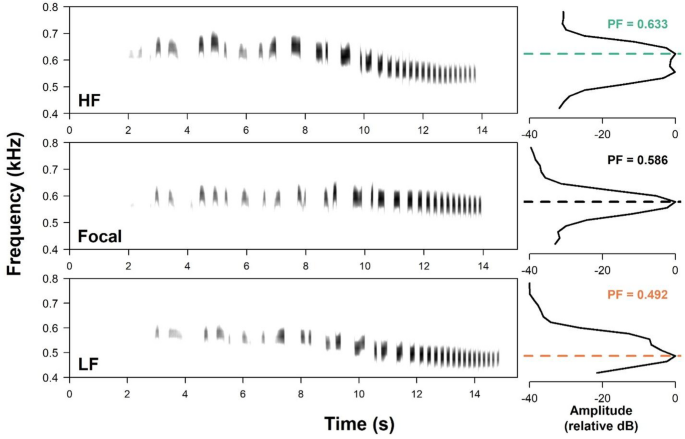
Lower-frequency rivals triggered less physical approach
The difference in approach behaviour was pronounced. Of the males exposed to lower-frequency playback, 59.3% approached the loudspeaker, compared with 93.9% of males hearing the higher-frequency treatment. The researchers also combined several movement measures, including flights, closest approach and time spent near the speaker. These physical responses became weaker as the simulated intruder’s song frequency became lower relative to the focal male’s own song.
The birds did not show the same pattern in their vocal response. The analysis did not support a clear difference in song output during or after playback between the low- and high-frequency treatments. The clearest effect of frequency was therefore on physical engagement with the simulated rival rather than on how much the males sang back.
The experiment did not reveal what low frequency signals
This is notable because song frequency in emerald-spotted wood-doves is only weakly related to body size estimated from structural measurements. Low-frequency calls are often proposed to signal a larger or more competitive rival, but the authors stress that their experiment does not identify what information the frequency difference actually encodes in this species.
They suggest that the response could involve other properties of the vocal system, physical limits on how the sounds are produced, or how receivers perceive frequency. What the experiment demonstrates directly is that territorial males use frequency when assessing an unfamiliar rival: lower-frequency simulated intruders elicited less physical approach and escalation.
The study was published in Behavioral Ecology and Sociobiology on 29 July 2026.
Behaviour
Related news

Three Ways of Analysing Elephant Calls Gave Different Results
Recordings from a semi-free herd in South Africa show how the method used to classify call timing can…
Read story →
Female Rhesus Macaques That Watched Unfamiliar Female Faces Longer Were More Likely to Have Offspring the Following Year
At a semi-free-ranging population in Puerto Rico, females that spent longer looking at an unfamiliar female’s neutral face…
Read story →
City and Forest Great Tits Respond Differently to Artificial Light at Night
In a common-garden experiment, artificial light initially advanced daily activity onset in great tits from both city and…
Read story →SPECIES IN THIS STORY
Species in this story

Independent research and conservation news archive
Did you find this information useful?
Wildlife Vagabond is independently built and maintained. Voluntary support helps cover source verification, hosting and continued work on research and conservation news.
Support Wildlife VagabondThe news archive will remain freely available.