
Model Points to Feces and Alternative Hosts in Muskox Bacterial Disease
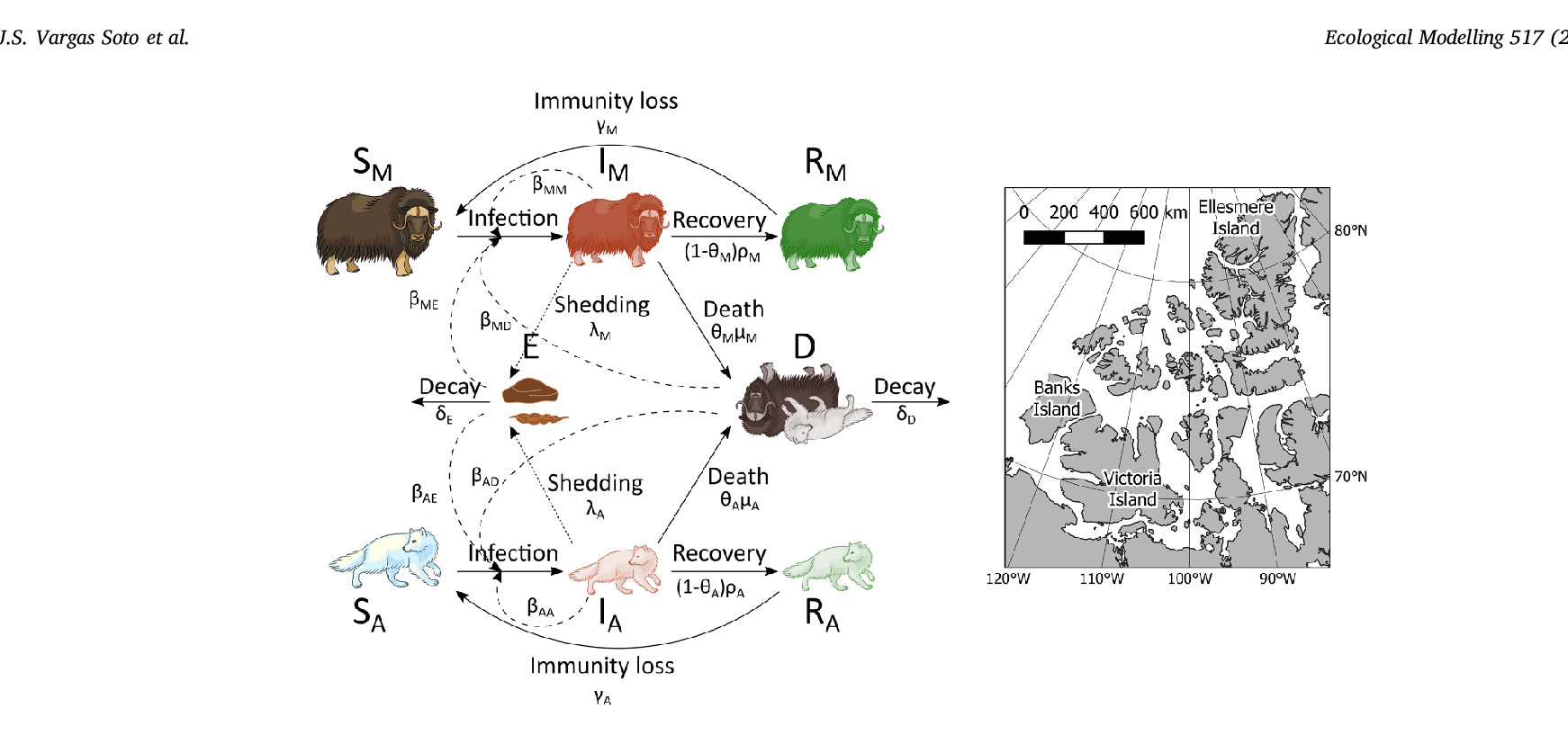
A study published in Ecological Modelling on 17 April 2026 used a multi-host epidemiological model to examine how the bacterium Erysipelothrix rhusiopathiae may persist and spread in Arctic muskox (Ovibos moschatus) populations. The bacterium has been associated with acute deaths and mass mortalities of muskoxen in the Canadian Arctic, including outbreaks first documented on Banks and Victoria islands in 2012 and later on Ellesmere Island. The model addresses how the bacterium may persist and spread through the host community and environment; it does not model the clinical course of disease within an individual muskox.
The model represented muskoxen and an alternative host, parameterized using Arctic foxes, together with direct transmission and two environmental sources: feces and infected carcasses. The Arctic fox therefore served as the model’s data-based alternative-host example, not as proof that foxes drive the observed muskox outbreaks. With all modelled transmission routes included, the estimated basic reproduction number, R0, was 15.1. R0 describes how many new infections one infection is expected to generate in a susceptible system; values above 1 allow transmission to sustain itself in the model. Direct transmission alone gave an R0 of 10.0 and fecal transmission alone 5.7, while carcass-only transmission produced an R0 of 0.045 under the study’s parameter estimates.
Environmental persistence strongly shaped modelled transmission
Processes that controlled environmental transmission, particularly bacterial shedding and persistence outside the host, had the strongest influence on R0 in the fecal-transmission scenarios. When both hosts were included, R0 was especially sensitive to the alternative host’s density, transmission coefficients and shedding rate. The numerical model also showed that disease-induced mortality could drive strong muskox population declines, and that an alternative host could accelerate those declines by allowing transmission pressure to remain high even as muskox density fell.
The authors identified environmental reservoirs—places such as contaminated soil and ponds where bacteria may persist outside an animal—together with overlap among potential host species as important priorities for empirical work. They noted that the wider Arctic host system may include foxes, wolves, polar bears, caribou, hares, lemmings and ravens.
Disease, parasites & microbiology
Related news
Synthetic Images Helped Train Muskox Detectors When Real Aerial Photos Were Scarce
A 2026 study found that object-detection models trained only on synthetic muskox images could detect more than 80%…
Read story →
Dovrefjell Winter Count Found 220 Muskoxen, Above the 200-animal Management Target
Norway's 2026 winter count recorded 220 muskoxen on Dovrefjell, including 32 calves. The population has ranged from 200…
Read story →
91% of Wild Muskoxen Examined Had Enamel Cracks in the Canadian Arctic
Researchers examining 243 lower jaws from wild muskoxen in the Canadian Arctic found enamel cracks in 91.4% of…
Read story →SPECIES IN THIS STORY
Species in this story
Independent research and conservation news archive
Did you find this information useful?
Wildlife Vagabond is independently built and maintained. Voluntary support helps cover source verification, hosting and continued work on research and conservation news.
Support Wildlife VagabondThe news archive will remain freely available.