
Researchers set out five priorities for China’s recovering Amur tiger population

A conservation perspective published on 8 May 2026 sets out five priorities for the next phase of Amur tiger (Panthera tigris altaica) recovery in China. It is not a new population survey. Instead, the authors review current challenges and propose how conservation should change as tiger numbers recover.
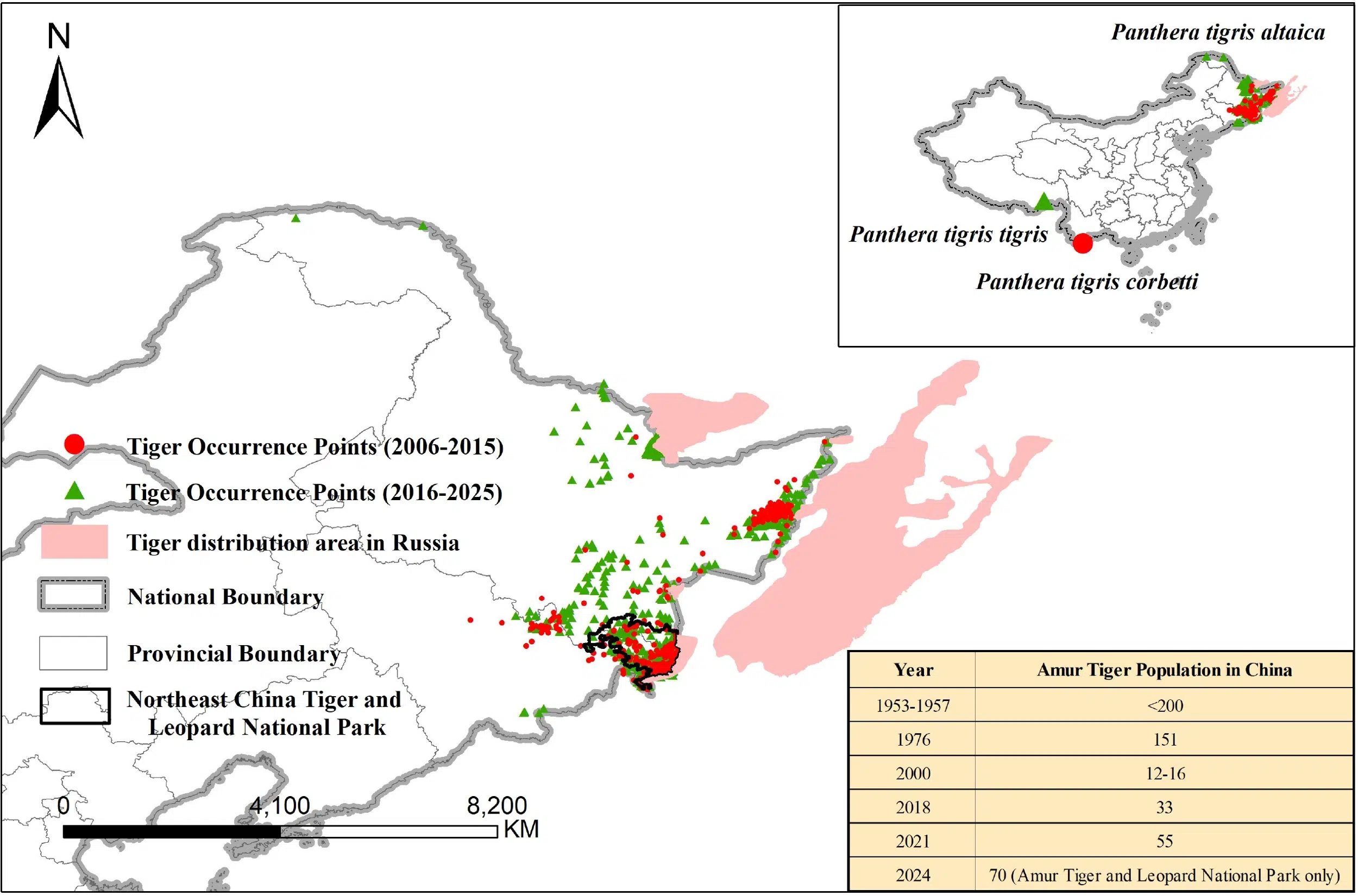
The article cites an official 2024 figure of at least 70 Amur tigers in China and earlier modelling suggesting that suitable habitat in the country could support about 310 individuals. The authors argue that further numerical recovery will therefore need to be accompanied by greater population resilience, because isolation, inbreeding, disease and human–tiger conflict can become increasingly important as populations expand or remain concentrated in limited areas.
Better forest habitat and more prey
The first priority is to improve habitat quality and prey resources. The authors argue that forest cover alone is not enough if plantations or simplified forests provide little food or structural diversity for the ungulates on which tigers depend. They propose pilot work on “tiger-friendly” forest transformation, including changes that increase vegetation diversity, biomass and habitat heterogeneity, together with measures to rebuild prey populations where necessary.
Genetics, disease and pollution as interacting risks
The second priority is to treat inbreeding, infectious disease and environmental pollution as risks that can interact. Small or isolated populations can lose genetic diversity, while disease and pollutants can reduce individual health and resilience. The authors call for more integrated expertise and monitoring across genetics, pathogens and contaminants. Where isolation becomes severe, they suggest that cross-patch or cross-border translocation — and, in some situations, carefully planned rewilding and reintroduction — could be considered.
Coexistence needs both technology and local support
The third area is human–tiger conflict and community development. The authors emphasise monitoring and early warning, effective deterrence, rescue capacity and protection of local livelihoods. They also discuss AI-based monitoring, improved communication networks, drones and other technologies as tools that could make responses faster and more precise.
Technology is only one part of their proposal. Compensation schemes, livestock management, incentive programmes and conservation-compatible sources of local income are presented as central to long-term coexistence. The paper also explores more experimental ideas for linking wildlife management with local economic benefits; these are proposals for future management, not outcomes demonstrated by the article.
Cross-border conservation for a cross-border population
The fourth priority is stronger cooperation between China and Russia and across scientific disciplines. Amur tigers move between the two countries, so the authors argue that habitat connectivity, monitoring, disease surveillance, rescue work and population management cannot be handled entirely within national boundaries. They specifically call for stronger long-term cooperation and discuss transboundary protected areas as one possible tool.
Could tiger conservation also attract carbon finance?
The fifth proposal links tiger conservation with carbon-neutrality and carbon-market programmes. The argument is indirect: large carnivores can influence prey communities and vegetation through food-web effects, and changes in forest structure can in turn affect carbon cycling and storage. The authors therefore call for research to quantify whether tiger recovery and tiger-oriented forest management produce measurable carbon benefits.
If such benefits could be demonstrated and valued, they suggest that carbon markets might become an additional source of conservation finance. The article does not show that this funding mechanism already works for Amur tigers; it presents the idea as a research and policy direction.
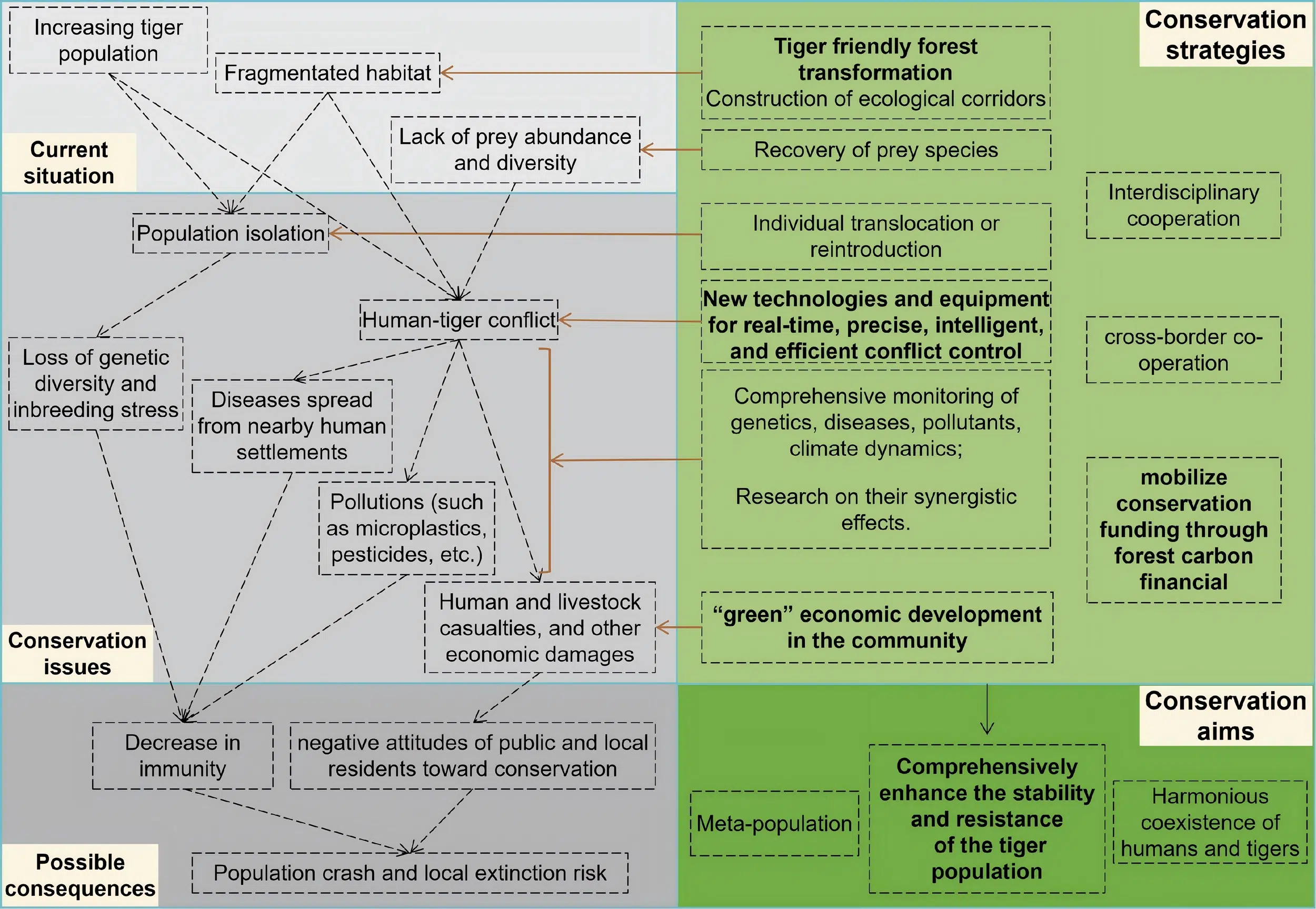
Taken together, the five priorities shift the emphasis from simply increasing tiger numbers to building a population that is genetically, ecologically and socially more resilient. They are the authors’ proposed agenda for the next phase of recovery, not a set of interventions already shown to succeed.
Management
Related news

Human Activity and Large Wildlife Overlapped Most in Chitwan’s Buffer Zone
Camera traps across Chitwan National Park and surrounding forests showed the greatest overlap of human activity with large…
Read story →
India launches a new evaluation cycle for its 58 tiger reserves
India’s sixth management effectiveness evaluation is planned to cover all 58 tiger reserves. The new cycle adds solid…
Read story →
One Male Tiger Confirmed in Bhutan’s Biological Corridor 7
A 5,144-trap-night survey photographed one adult male tiger at two stations in Bhutan’s Biological Corridor 7, confirming use…
Read story →SPECIES IN THIS STORY
Species in this story

Independent research and conservation news archive
Did you find this information useful?
Wildlife Vagabond is independently built and maintained. Voluntary support helps cover source verification, hosting and continued work on research and conservation news.
Support Wildlife VagabondThe news archive will remain freely available.