
Almost All Adult Common Tern Call Types Had Distinct Measurable Acoustic Profiles
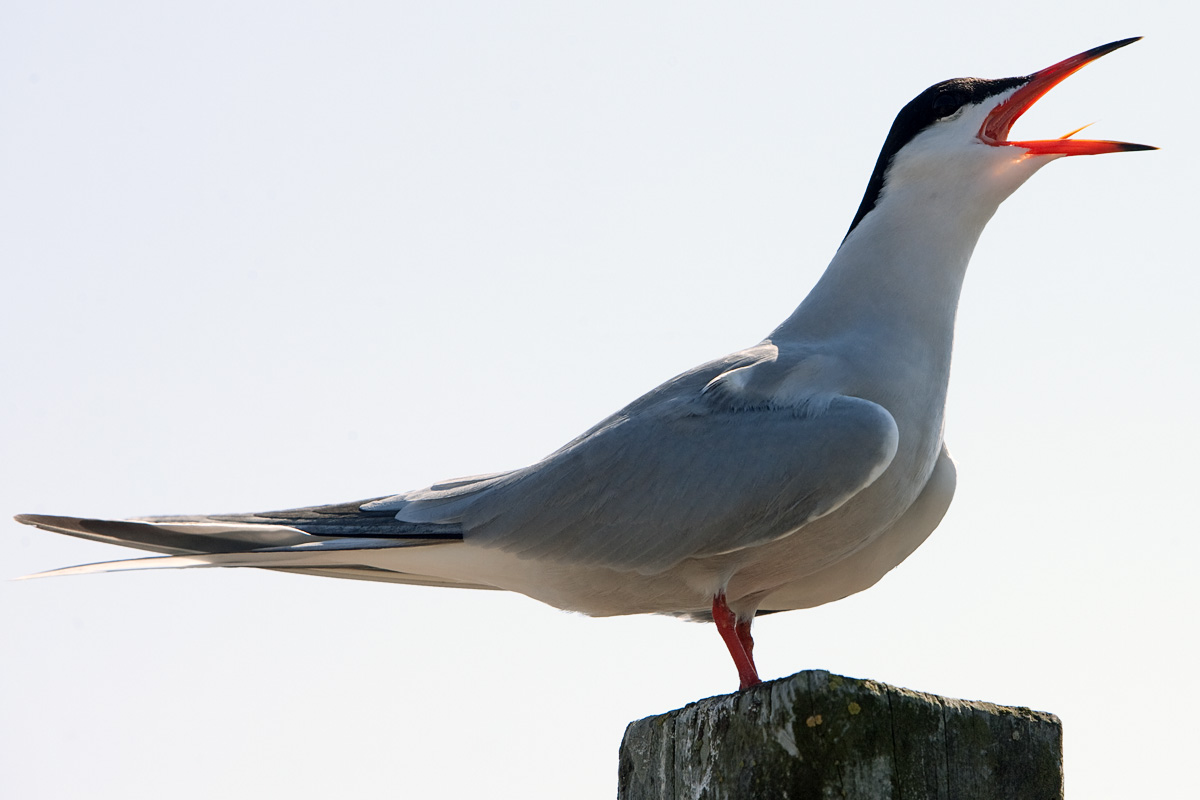
A bioRxiv preprint posted on 22 May 2026 found measurable acoustic differences among almost all adult common tern (Sterna hirundo) call types identified in recordings from a breeding colony on Seavey Island, New Hampshire. The study is a preprint and had not yet undergone peer review.
Researchers deployed autonomous AudioMoth recorders across the breeding season. They inspected the recordings both by ear and as spectrograms — visual maps showing how sound energy is distributed across frequency and time — and assigned recurring sounds to different call types.
Four measurements described each call
For every call, the team measured peak frequency, the frequency at which the call carried its strongest energy; 90% bandwidth, the frequency range containing most of the call’s energy; 90% syllable duration, the time containing most of the energy within an individual syllable; and total bout duration, the length of the complete call sequence.
Biologically, these measurements describe whether a call is higher or lower pitched, spectrally narrow or broad, brief or prolonged, and whether it is produced as a short syllable or a longer sequence. They therefore turn descriptive call names into measurable acoustic profiles.
Almost every call type had a distinct measured profile
Each identified call type differed from the others in at least one of the four acoustic measurements, with one exception: the kek and kip/tjuk calls could not be separated by any of these four variables.
This does not establish that kek and kip/tjuk are the same biological signal. They could still differ in acoustic features that were not measured, in behavioural context or in how birds respond to them. The result is narrower: the four quantitative measurements used here did not distinguish the two call types.
The discussion also highlights a possible behavioural link: the kee-ar and kek calls are both associated with escape and alarm behaviour, and the authors suggest they may be part of a graded alarm system. This study quantified call structure rather than experimentally testing the function of those calls.
The authors describe the work as the first quantitative analysis of common tern vocalisations in North America. Quantitative profiles can make it easier to connect crowded colony soundscapes with behaviour instead of relying only on human labels for calls.
A foundation for passive acoustic monitoring
Common tern colonies are difficult acoustic environments because many birds call simultaneously and sounds overlap. Once call types have measurable spectral and temporal characteristics, automated classifiers can potentially search large recordings for particular vocalisations and follow how colony sound changes through the breeding season.
Passive acoustic monitoring could therefore complement direct observation while reducing disturbance at breeding colonies. The present preprint establishes candidate acoustic parameters for that work; further validation is still needed before automated classification can be assumed to identify every call reliably in dense colony recordings.
Behaviour
Related news
Common Tern Eggs Had More PCBs, HCB and Mercury Than Oystercatcher Eggs in 40-Year Wadden Sea Study
Monitoring from 1981–2023 found higher PCB, HCB and mercury levels in common tern eggs than in Eurasian oystercatcher…
Read story →
DNA in Common Tern Chick Droppings Closely Matched the Fish Adults Delivered
Across three breeding seasons, the proportion of dietary DNA reads assigned to each prey type closely matched the…
Read story →
Common Terns Extended Foraging Trips by Up to 87% in Poor Prey and Productivity Years
Four Gulf of Maine breeding seasons showed that common terns increased foraging-trip duration by 23–87% and expanded foraging…
Read story →SPECIES IN THIS STORY
Species in this story

Independent research and conservation news archive
Did you find this information useful?
Wildlife Vagabond is independently built and maintained. Voluntary support helps cover source verification, hosting and continued work on research and conservation news.
Support Wildlife VagabondThe news archive will remain freely available.