Coyotes Had a Narrower Resource Niche After 1950, Contrary to Expectations After Wolf Loss
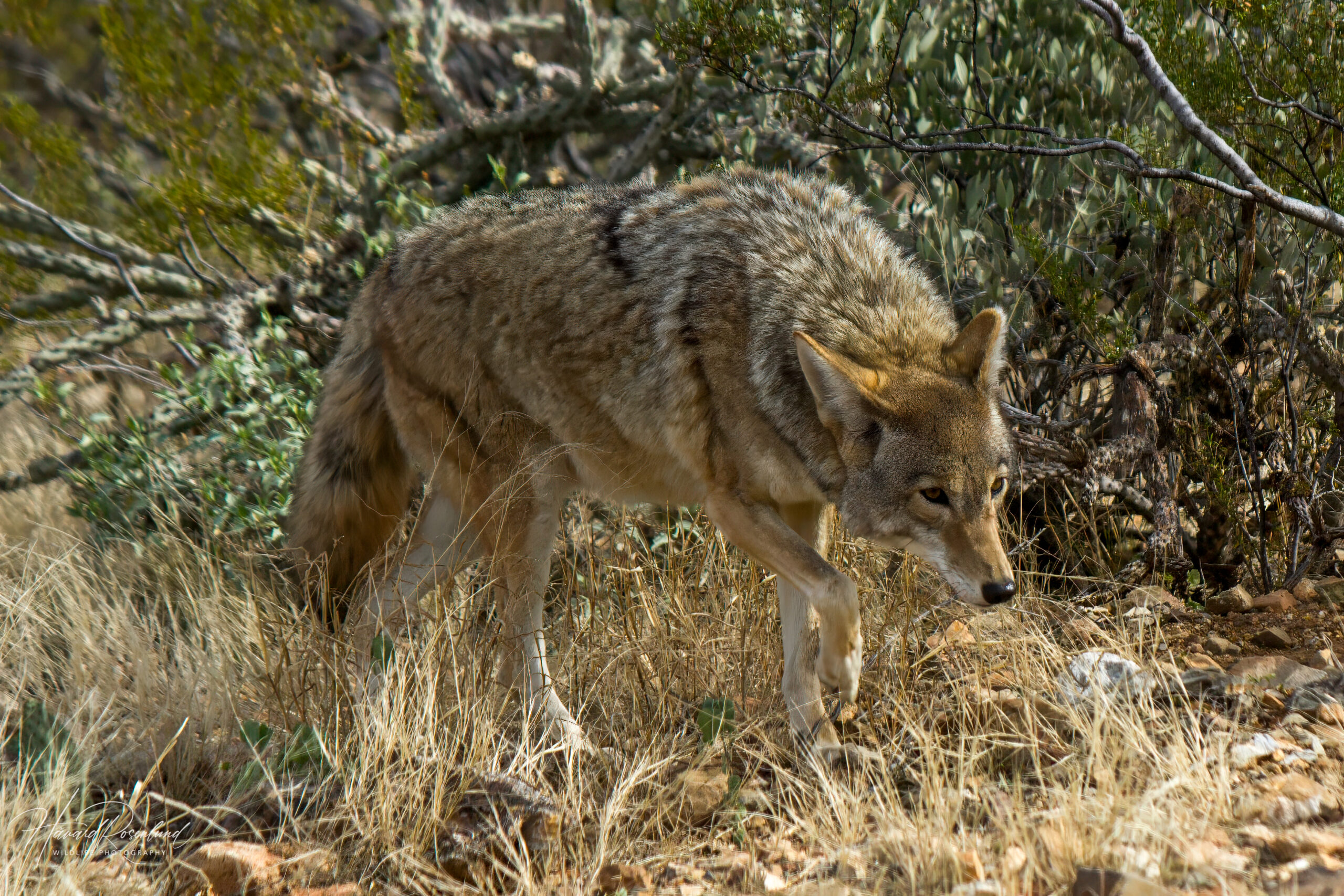
Coyotes (Canis latrans) from the Southern Great Plains showed a narrower long-term resource niche in specimens collected after 1950 than in older museum material. That was the opposite of the study’s expectation that coyotes would broaden their resource use after large wolf competitors had largely disappeared from the region.
The researchers analysed carbon-13 and nitrogen-15 in bone collagen from coyotes and several wolf taxa from Texas, USA, Oklahoma and New Mexico. These stable isotopes provide a long-term signature of the resource pathways represented in an animal’s diet: carbon can distinguish broad food or habitat pathways, while nitrogen often reflects trophic position.
The post-1950 coyote niche was narrower, not broader
The estimated isotopic niche of pre-1950 coyotes was roughly twice as broad as that of the post-1950 sample, and the later niche sat within the earlier isotope space. Average isotope values did not shift strongly; the main change was that the range of long-term resource signatures became narrower.
An isotopic niche is not a home range and does not identify every prey species eaten. It describes how widely the analysed animals spread across isotope space, which can reflect the breadth of resources used over the period recorded in their tissues.
Wolf loss did not produce the expected niche release
The study tested the idea that removing larger competitors could free coyotes to use a wider set of resources. Instead, the later sample showed the opposite pattern. The author discusses possible explanations, including changes in coyote social organisation and the loss of carrion from wolf kills, but the isotope data cannot establish which mechanism caused the narrowing.
The comparison is also historical rather than experimental. “Before” and “after 1950” samples came from different times and places within the region, so the study shows a temporal difference in isotopic niche breadth but cannot prove that wolf extirpation caused it.
Coyotes and red wolves once overlapped strongly in resource use
Pre-1950 coyotes also showed extensive isotopic overlap with red wolves (Canis rufus). The author interprets this as evidence that the two canids may historically have relied on many of the same resource pathways and therefore had strong potential for ecological competition.
Mexican wolves (Canis lupus baileyi) showed a more constrained and distinct isotopic niche, while the Great Plains wolf (Canis lupus nubilus) differed in breadth and overlap from the other groups. These comparisons reinforce that wolf-like canids did not all use the Southern Great Plains in the same way.
Museum specimens reveal change but limit precision
The historical material makes comparisons possible after red wolves and Great Plains wolves disappeared from the region, but sample sizes were modest and specimens covered broad dates and locations. The study therefore reconstructs patterns in long-term resource signatures rather than complete past diets.
Its clearest result is nevertheless striking: coyotes occupied a narrower isotopic resource niche after 1950, despite the regional loss of large wolf competitors that had been expected to release them into a broader one.
Ecology
Related news
Coyotes Increased Across Illinois Over Four Decades, but County Trends Varied
Four long-running Illinois surveys together showed a statewide coyote increase from 1980–2023, while county-level populations followed more variable…
Read story →
Mange in Coyotes Varied With Urban Density and Habitat Connectivity Across North American Cities
Camera-trap data linked visible mange in coyotes to urban intensity and habitat connectivity at two spatial scales, while…
Read story →
Coyotes Chose Steep Slopes and Stable Soils for Dens in Elk Island National Park
A study of 42 coyote dens in Elk Island National Park found that steep slopes, stable soils and…
Read story →SPECIES IN THIS STORY