
Female caribou in Denali prioritised safety early, then forage
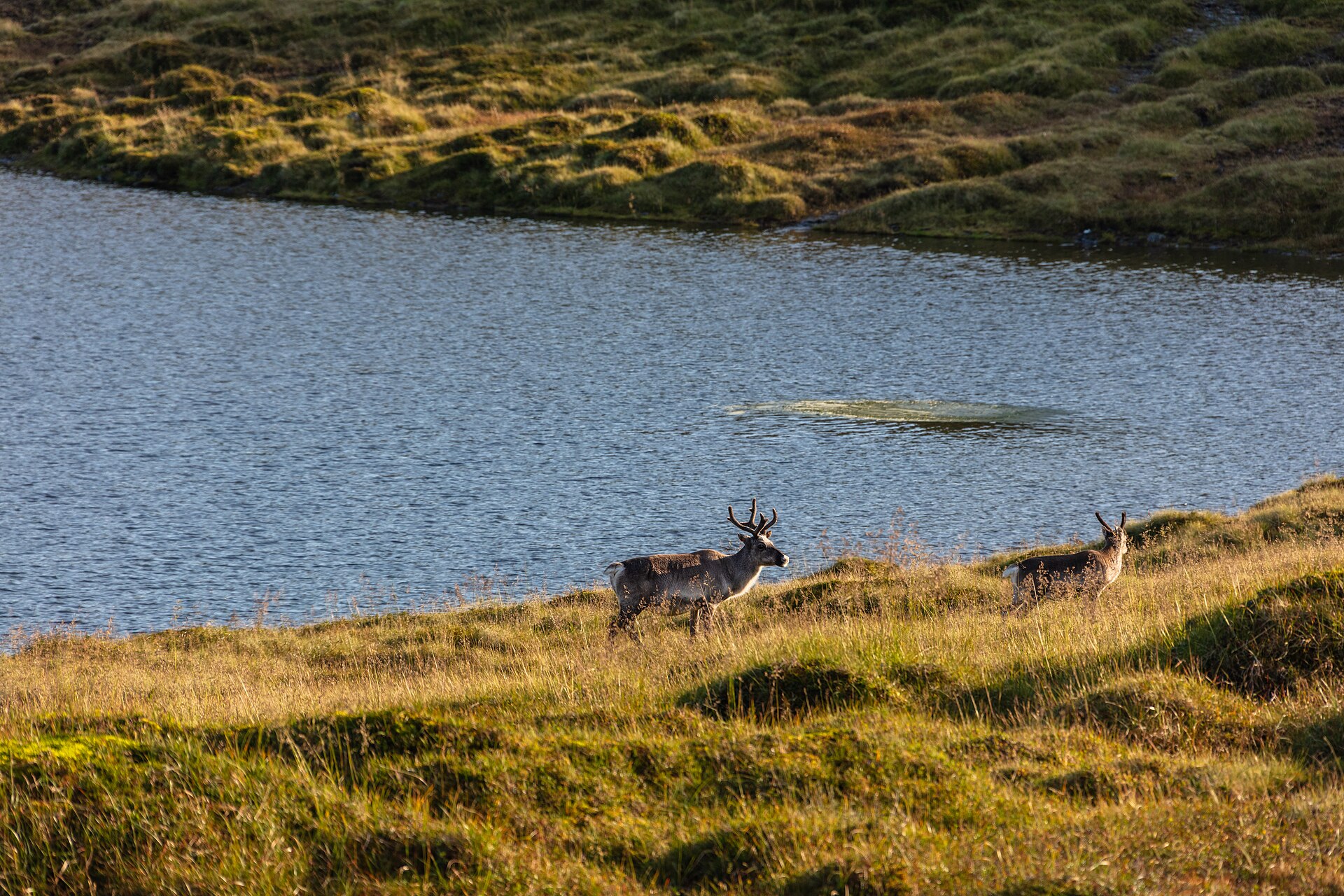
Female caribou in Denali National Park, Alaska, changed how they balanced forage and safety as summer progressed. When calves were young, females used high-quality forage less in areas with greater wolf use. They also used areas with lower predicted mosquito activity than males. By late summer, the forage–risk trade-off had weakened: females used areas with more wolf activity, and their use of preferred forage varied less with wolf use. Males showed a different pattern, selecting areas with more wolf use during early summer rather than avoiding them.
The study followed wild caribou (Rangifer tarandus) in the Denali herd using GPS data from 22 adult females tracked in 2010–2013 and 40 adult males tracked in 2014–2018. Collars recorded locations every two hours. Researchers compared those locations with vegetation greenness measured by satellite, a map-based estimate of wolf space use, and a weather-based estimate of mosquito activity. Greenness was an indirect measure of forage conditions: intermediate values were treated as likely to represent younger, higher-quality vegetation. Wolf use around dens and rendezvous sites provided an indirect measure of predation risk, not a record of encounters. The mosquito estimate was based on temperature and wind, not direct counts of mosquitoes or bites.
Females traded forage for safety while calves were young
The researchers distinguished the habitats animals selected from the areas they actually used, taking account of how habitats were distributed across the landscape. That distinction revealed a seasonal pattern that selection alone would have missed. Both sexes selected intermediate greenness values across summer, but how much they used such forage areas depended on wolf use.
During early summer, females used areas with intermediate greenness most where estimated wolf use was low; their use of those forage areas fell sharply where wolf use was greater. The pattern is consistent with females giving safety more weight while calves were vulnerable. Males showed no comparable avoidance: during this period they selected areas with more wolf use, while their use of preferred forage tended to be greatest where wolf use was low or moderate.
The calving period showed a different pattern. Both sexes weakly selected areas with higher wolf use. Although both selected intermediate greenness overall, females during calving used both low- and high-greenness habitats, whereas males mainly used intermediate greenness. The authors suggest that snow may limit access to safer, higher ground early in calving: females often have to cross valleys with greater wolf risk to reach calving and post-calving areas. Once calves were older, the early-summer forage–risk trade-off weakened. By late summer, females used areas with more wolf use, and their use of preferred forage was less tied to wolf activity.
Females also used higher elevations than males after calving. In early summer, their median elevation was 1,244 metres, compared with 1,050 metres for males; in late summer, the medians were 1,038 and 974 metres. During early summer, females also used areas with lower predicted mosquito activity than males. The authors interpret the shift to higher elevations as reducing females’ exposure to both wolves and mosquitoes while calves were vulnerable. Because males and females used different areas during this period, their contrasting responses to predation risk also contributed to early-summer sexual segregation.
Female daily movement increased from a median of 8.7 kilometres during calving to 12.6 in early summer and 14.7 in late summer. Male movement remained relatively steady at 8.0, 7.1 and 7.7 kilometres across the three periods. The authors suggest that males’ lower movement rates may help conserve energy. Female movement was highest in late summer, when females also moved to lower-elevation habitat; the early-summer period of mosquito harassment was another context for their increased movement.
Summer survival was higher among females
Summer survival estimates, based on monitoring 69 adult females and 52 adult males, were 95.6% and 90.0%, respectively; the difference was statistically supported. Seven female and 12 male deaths were recorded, all suspected to have been caused by predation. Male mortality was more than twice female mortality. The authors interpret females’ early-summer avoidance of areas with greater wolf use, alongside their higher movement rates, as behaviors associated with their higher summer survival.
The study cannot establish that behaviour caused the survival difference, but the contrasting seasonal patterns show how female and male caribou balance food, predators and insect harassment differently while calves grow – and use different parts of the landscape as a result.
Ecology
Related news

Cattle-virus tests failed to detect a pestivirus isolated from reindeer
Researchers isolated Reindeer-508 from one of 645 tissue samples collected from semi-domesticated reindeer in Norway. It was most…
Read story →
Late-winter recreation overlaps key habitat for caribou and wolverines
Across western Canada, all three study species showed spatial overlap with high-intensity recreation. In late winter, the busiest…
Read story →
Wild reindeer supplied food and materials in medieval Yamal
More than 16,000 animal remains from the Bukhta Nakhodka settlement offer a glimpse of medieval subsistence and trade…
Read story →SPECIES IN THIS STORY
Species in this story
Independent research and conservation news archive
Did you find this information useful?
Wildlife Vagabond is independently built and maintained. Voluntary support helps cover source verification, hosting and continued work on research and conservation news.
Support Wildlife VagabondThe news archive will remain freely available.