
Great Egret Was Photographed Catching and Eating a Bananaquit in the Dominican Republic
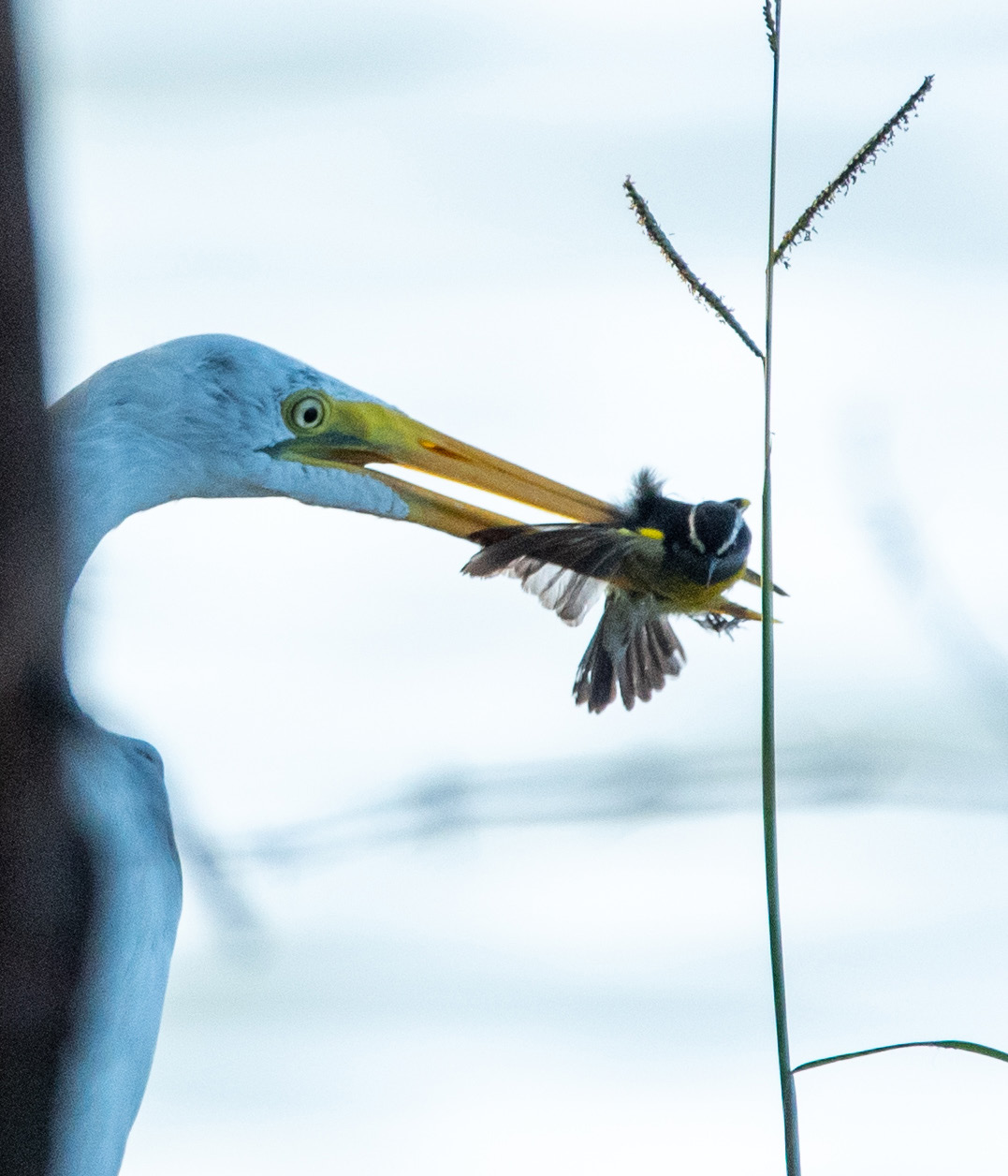
A great egret (Ardea alba) was photographically documented catching and eating a bananaquit (Coereba flaveola) at Hatillo Reservoir in the Dominican Republic. The research note, published on 18 June 2026 in the Journal of Caribbean Ornithology, describes the first documented successful predation of a bananaquit by a great egret.
The event itself took place at 08:30 on 12 November 2022 at the southern edge of Hatillo Reservoir in Sánchez Ramírez Province. A fully feathered bananaquit was foraging on a wire fence and fallen logs near the reservoir when an adult great egret approached it using the slow, stealthy stalking behaviour typical of the species.
The egret then launched a precise attack and caught the small passerine in its bill. The bananaquit struggled for several minutes before being swallowed completely. It had been part of a pair, and the second bird flew away when the attack occurred. The observers could not determine whether the captured individual was an adult or a juvenile.
Great egrets are primarily associated with aquatic prey such as fish, amphibians and invertebrates, but previous records show that their diet can also include birds and other terrestrial prey. The authors reviewed earlier reports of avian predation by great egrets, including rails, shorebirds, grebes, meadowlarks, sparrows and swallows.
The Hatillo Reservoir observation is the first documented case of a great egret successfully taking a bananaquit and the first photographic evidence of great egret predation on a passerine reported from the Dominican Republic, Hispaniola and the wider Caribbean region. The authors interpret the record as further evidence of the species’ trophic plasticity and its ability to actively hunt small passerines in terrestrial habitat. Because this is a single documented event, it does not show how frequently great egrets use passerines as prey; the authors suggest future dietary studies to assess how common this behaviour is.
Behaviour
Related news
Six of Seven GPS-Tracked Great Egrets Returned to the Same Wintering Grounds
Six of seven great egrets tracked across at least two complete winters returned to the same wintering grounds;…
Read story →
Poland’s Breeding Great Egret Population Reached 1,150–1,250 Pairs
Poland’s breeding great egret population increased by 84% from 2013 to 2025. Breeding was documented at 31 sites,…
Read story →
Bile-Duct Trematodes Found in the Lungs and Body Cavity of a Great Egret
A case report from South Korea found the bile-duct trematode Pegosomum bubulcum on the liver surface, in the…
Read story →SPECIES IN THIS STORY
Species in this story
Independent research and conservation news archive
Did you find this information useful?
Wildlife Vagabond is independently built and maintained. Voluntary support helps cover source verification, hosting and continued work on research and conservation news.
Support Wildlife VagabondThe news archive will remain freely available.