
How far young blue tits move from home may be partly inherited—but nest boxes complicate the picture
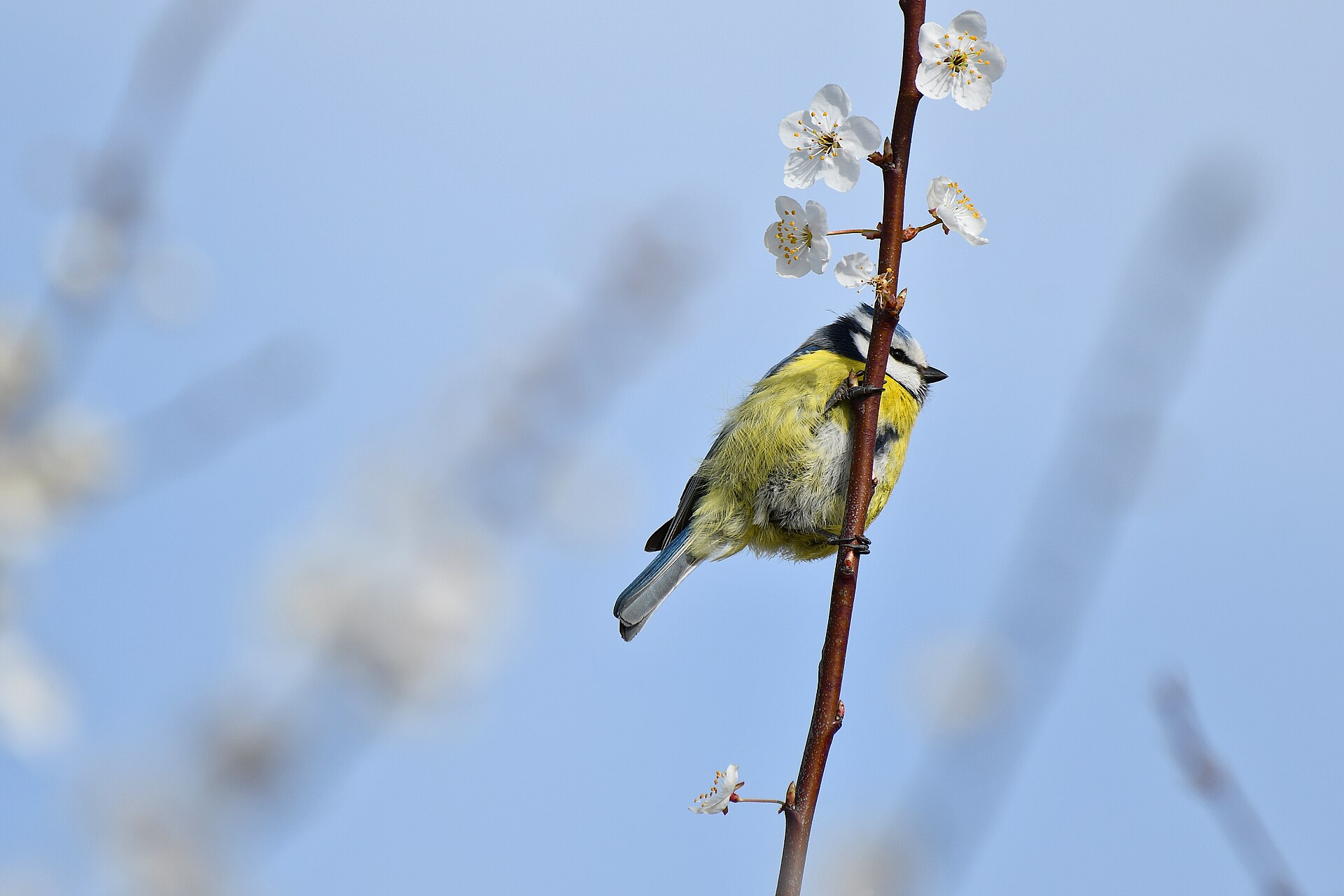
When a bird breeds somewhere other than where it was born, the distance between its birthplace and its first breeding site is called natal dispersal distance. Dispersal can carry genetic variants between populations and affect competition for nesting sites. Across four populations of Eurasian blue tits (Cyanistes caeruleus), researchers investigated whether inherited differences help explain how far young birds move.
The populations had been monitored for 26–48 years. Researchers used family records spanning generations for 2,718 birds to estimate heritability, and DNA data from 139 birds to look for genetic variants associated with dispersal distance.
A modest, uncertain genetic signal
Estimated heritability ranged from 3% to 13% across the four populations. Heritability describes how much of the variation between individuals in a population is associated with additive genetic differences—the combined effects of inherited genetic variants. It does not mean that this percentage of an individual bird’s dispersal distance is genetically determined. The estimates were imprecise, with uncertainty intervals extending close to zero.
The DNA analysis identified four variants associated with dispersal distance. The preprint links them to processes involving the central nervous system, metabolism and hormones—all relevant to movement and behaviour. These associations do not establish that the variants cause birds to disperse a particular distance.
When nest-box layout can resemble heredity
Related birds may nest close to one another, while the available nest boxes constrain which birthplace-to-breeding-site distances researchers can measure. Nearby relatives may therefore show similar measured dispersal distances partly because of the spatial arrangement of nest boxes, rather than because their inherited traits determine the distances. The researchers found that nest-box layout could distort estimates of additive genetic variation in three of the four populations.
The results suggest that natal dispersal distance may have some evolutionary potential in these blue tit populations, but that the genetic signal is difficult to separate from spatial patterns. This matters when interpreting how populations might respond to habitat loss and fragmentation. The study is a preprint and has not been peer reviewed.
Evolution & taxonomy
Related news
Urban Bird Diversity Was More Strongly Linked to Forest Structure Than the Surrounding City
Across 12 urban forests in three Italian cities, researchers recorded 2,035 birds from 52 species. Local forest structure…
Read story →
Record May Heatwave Reduced Breeding Success and Nestling Mass in Great Tits and Eurasian Blue Tits
Compared with equivalent parts of the breeding season in 1978–2025, fledgling number declined by 4.5 nestlings in 2026…
Read story →
Autumn Movement Timing Stayed Stable as Wings Became Rounder in Great and Eurasian Blue Tits
Hungarian ringing data from 2004–2024 found stable autumn movement timing in great and Eurasian blue tits, while body…
Read story →SPECIES IN THIS STORY
Species in this story

Independent research and conservation news archive
Did you find this information useful?
Wildlife Vagabond is independently built and maintained. Voluntary support helps cover source verification, hosting and continued work on research and conservation news.
Support Wildlife VagabondThe news archive will remain freely available.